Psychiatry EHR: The Complete Guide to Choosing Software for Psychiatric Practices in 2026
Mental health requirements are increasing, but psychiatrists are not getting enough hours in the day. In fact, physicians spend nearly 20 hours or more a week on paperwork and administrative tasks.
For psychiatric practices, where every patient encounter needs detailed notes, medication management, and strict compliance, these administrative loads can add up fast. The core problem is not just the paperwork; it’s using systems that were never specifically built for behavioral health.
And, when it comes to psychiatric documentation, DSM-5 diagnoses, psychotherapy workflows, and EPCS psychiatry e-prescribing, general EHRs often fall short. As a result, providers spend more time clicking through screens instead of focusing on patient care.
Because of this, investing in the right psychiatry EHR software becomes a practice decision and not just a technology upgrade. With a specialty-built solution, practices can bring documentation, scheduling, billing, compliance, and patient management, all in one streamlined workflow.
This means less time spent navigating administrative tasks and more time focused on what actually matters the most while delivering quality patient care.
In this guide, we'll walk you through everything you need to know about choosing the best psychiatry EHR software in 2026, including the features to prioritize, common pitfalls to avoid, and what to look for if you're planning to upgrade your Psychiatry EHR.
What Is Psychiatry EHR Software and Why Do Psychiatrists Need It?
Psychiatry EHR software is an electronic health record system, specifically designed for mental health practices. As compared to general EHRs, it supports psychiatric documentation, medication management, behavioral health workflows, and practice operations within a single platform.
This further allows psychiatrists to spend less time navigating administrative tasks and more time providing quality patient care.
Let’s have a quick look at Psychiatric EHR vs. General EHR:
| Feature | General EHR | Psychiatry EHR Software |
|---|---|---|
| Documentation | Standard clinical templates | Psychiatry-specific templates for evaluations, psychotherapy notes, and treatment plans |
| Diagnoses | ICD-based documentation | DSM-5-supported documentation and behavioral health workflows |
| Medication Management | Basic e-prescribing | EPCS psychiatry e-prescribing, refill management, and medication monitoring |
| Practice Workflow | Designed for multiple specialties | Built specifically for psychiatric and behavioral health practices |
| Compliance | General HIPAA compliance | Supports behavioral health requirements, including 42 CFR Part 2 |
Platforms like eCareHealth are specifically built to support these specialty-specific workflows by helping psychiatric practices streamline documentation, prescribing, scheduling, billing, and compliance from one integrated system.
As practices continue to grow and patient expectations continue to evolve, selecting software that is specifically designed for psychiatry can make everyday operations significantly more efficient.
Which Psychiatry-Specific Features Should Every Psychiatry EHR Include?
The right psychiatry EHR software should not only store patient records, but also support the complete psychiatric care journey, from the initial evaluation to ongoing treatment, medication management, and follow-up care.
Let’s see some of the features every psychiatric practice should look for:
| Feature | Why It Matters |
|---|---|
| Mental Status Exam (MSE) templates | Standardizes psychiatric evaluations and improves documentation consistency. |
| DSM-5 documentation | Simplifies diagnosis selection and supports accurate clinical records. |
| Suicide & violence risk assessments | Helps identify high-risk patients and supports timely intervention. |
| PHQ-9, GAD-7 & AIMS assessments | Enables standardized screening, progress tracking, and outcome measurement. |
| Medication management & polypharmacy monitoring | Supports safer prescribing with interaction checks and medication history. |
| EPCS psychiatry e-prescribing | Securely prescribes controlled substances while meeting regulatory requirements. |
| Telepsychiatry | Delivers virtual care through secure video consultations. |
| AI-assisted documentation | Reduces manual charting and speeds up clinical note creation. |
| Patient engagement tools | Simplifies appointment reminders, secure messaging, and patient communication. |
With all these capabilities in one platform, eCareHealth helps psychiatrists streamline documentation, manage medications safely, deliver virtual care, and enhance patient engagement, while supporting efficient day-to-day practice operations.
For a closer look at the capabilities needed to support complex psychiatric workflows, explore our guide to EHR for Psychiatrists: Essential Features for Managing Complex Psychiatric Care.
How Does Psychiatry Billing Software Improve Practice Efficiency?
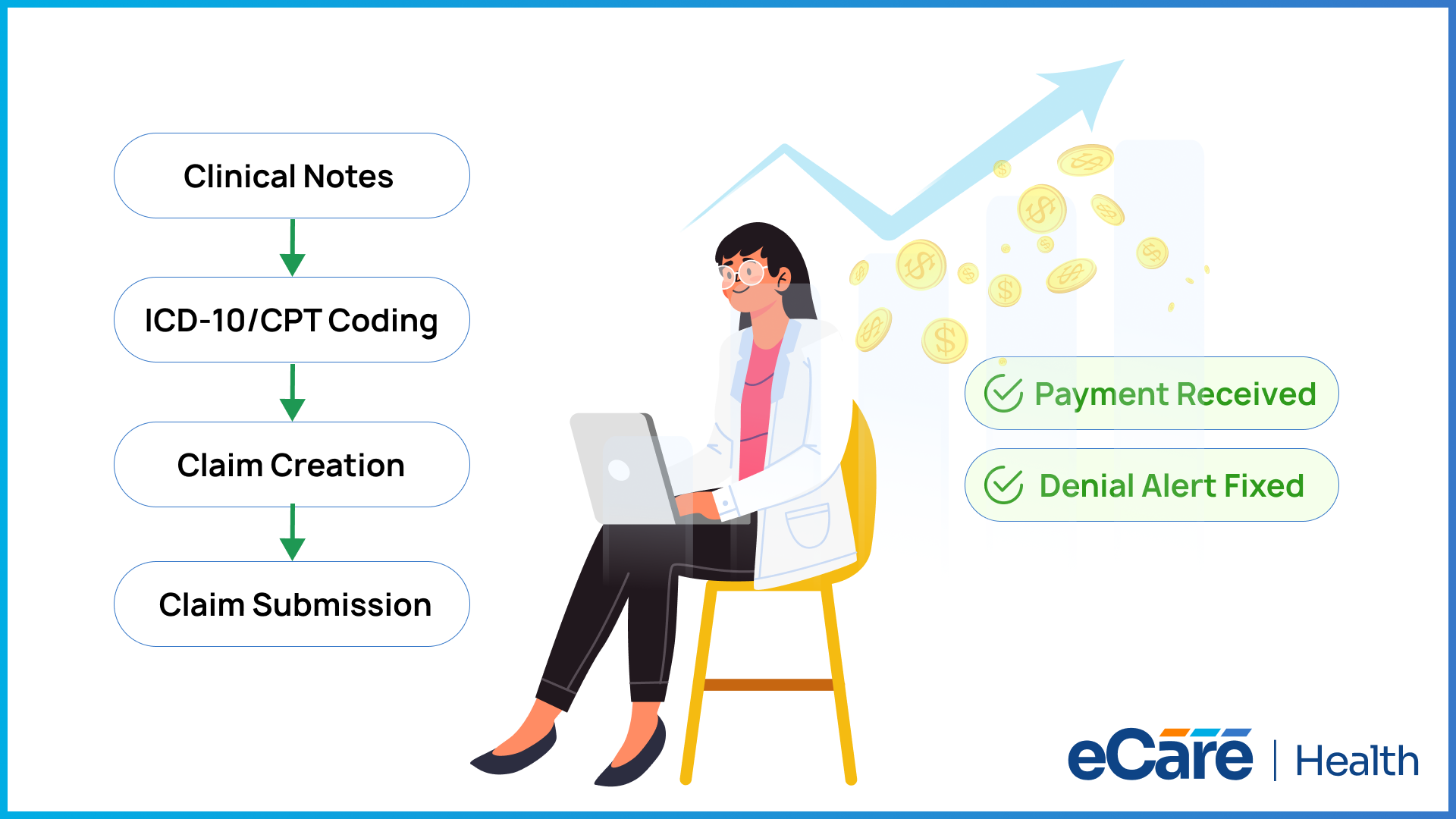
Even the best clinical care can be held back because of inefficient billing. When documentation, coding, and claims are managed across multiple systems, practices are more likely to face delayed reimbursements, denied claims, and unnecessary administrative work.
However, integrated psychiatry billing software can eliminate all these gaps by connecting clinical as well as financial workflows within a single platform. With documentation, coding, and billing working together, it becomes easy for providers to capture charges more accurately, submit cleaner claims, track payments in real time, and resolve denials faster.
To understand which capabilities to look for when evaluating these solutions, explore our guide to Psychiatry Billing Software: Key Features and How to Choose the Right Solution for Your Practice.
This further enhances the revenue cycle and gives your staff more time to focus on patient care, rather than paperwork. After all, a seamless billing process is the backbone of a financially healthy practice.
eCareHealth platform is built specifically with specialty-specific workflows in mind, which can further simplify psychiatric billing by integrating documentation, claims management, payment tracking, and revenue cycle processes into one platform. The result is a more efficient practice with fewer billing errors, faster reimbursements, and a stronger financial foundation.
Why Is EPCS Essential for Modern Psychiatry Practices?
As psychiatric practices depend heavily on digital workflows, secure electronic prescribing has become a necessity instead of an option. EPCS psychiatry e-prescribing helps providers prescribe controlled substances safely, meet regulatory requirements, and enhance medication management without disrupting clinical workflows.
Secure & Compliant Prescribing
While meeting DEA requirements, EPCS allows psychiatrists to electronically prescribe Schedule II-V controlled substances. It also replaces paper prescriptions with a secure and authenticated process that can minimize fraud and support regulatory compliance.
For a deeper look at how EPCS works and what psychiatric providers should know before adopting it, explore our guide to E-Prescribing for Psychiatry (EPCS): What Every Psychiatric Provider Needs to Know.
Safer Medication Management
With integrated PDMP access, you get visibility into a patient’s controlled substance history, drug interaction and allergy checks, which can further help to reduce prescribing risks. All these tools together can enhance medication safety and support better clinical decision-making.
Built for Modern Psychiatric Care
As EPCS adoption continues to grow, practices need smart solutions for ensuring secure prescribing. By integrating EPCS directly into psychiatric workflows, eCareHealth helps providers to prescribe confidently and stay compliant, while delivering more efficient patient care.
How Should You Choose the Best Psychiatry EHR Software?
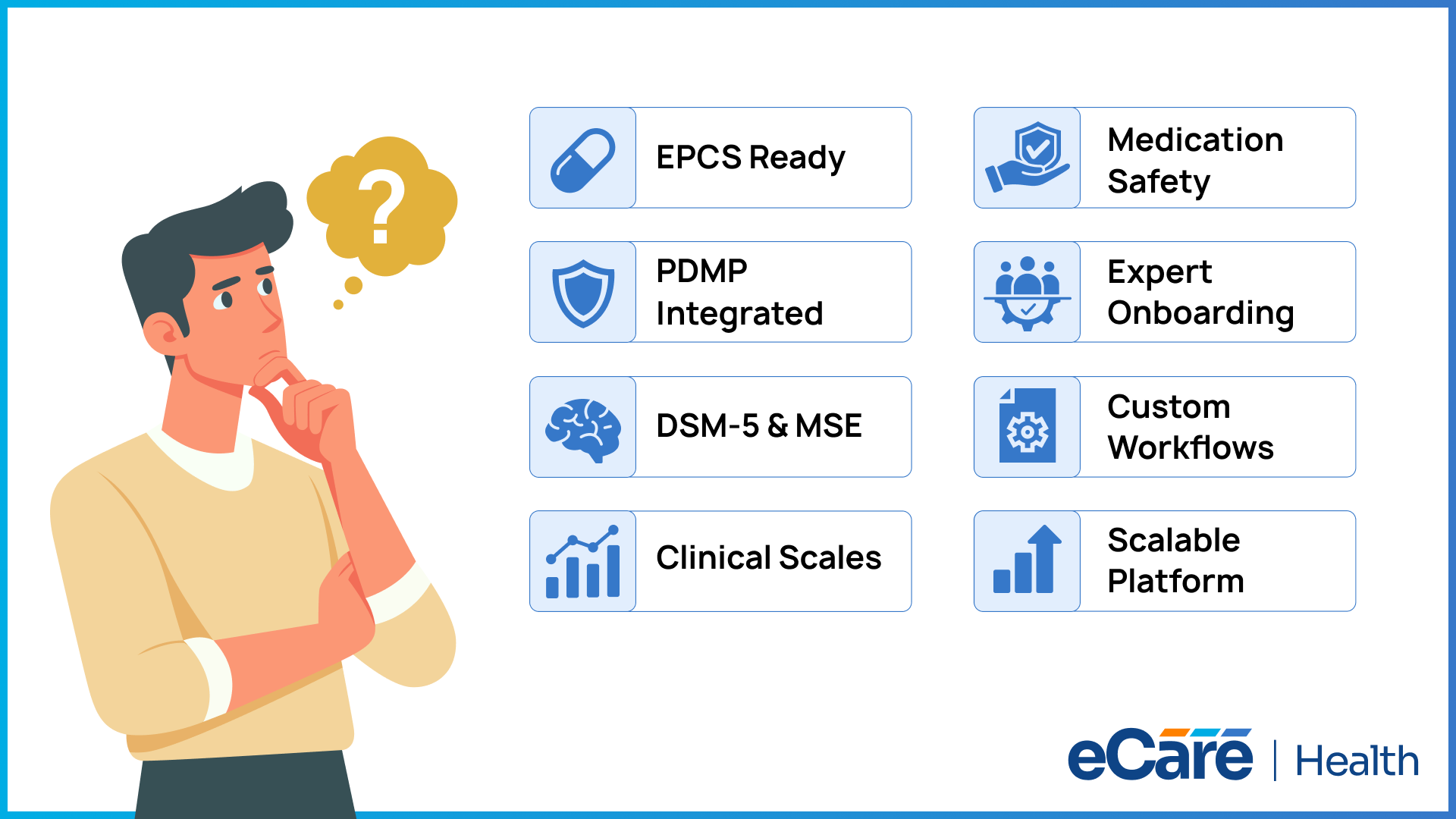
Selecting the right psychiatry EHR software is not about finding the platform with the longest feature list. It’s actually about choosing a solution that can fit perfectly with your clinical workflows today while supporting your practice as it grows.
Let’s have a look at the psychiatry EHR evaluation checklist:
- Supports EPCS psychiatry e-prescribing and meets DEA requirements.
- Integrates with PDMP for safer controlled substance prescribing.
- Includes DSM-5 documentation and customizable Mental Status Exam (MSE) templates.
- Supports clinical rating scales such as PHQ-9, GAD-7, and AIMS.
- Provides medication interaction and allergy checking.
- Offers built-in telepsychiatry for virtual patient visits.
- Allows workflow customization to match your practice's needs.
- Scales easily as your patient volume, providers, and locations grow.
When you consider implementation as important as software selection, having the right technology partner makes all the difference. With eCareHealth, psychiatric practices can successfully implement psychiatry EHR software with specialty-specific workflows, guided onboarding, and ongoing support. This makes the transition more seamless from day one.
Is Psychiatry EHR Software Right for New and Growing Practices?
No matter if you are starting a psychiatry private practice or expanding an existing one, selecting the right technology early can lead to administrative burden reduction, while supporting long-term growth. With a scalable EHR, practices can stay organized today and also prepare for tomorrow’s demands.
For New Practices
For new psychiatric practices, software is required to simplify everyday operations without adding complexity. Cloud-based psychiatric practice management software solutions offer secure access from anywhere, while reducing IT maintenance and supporting telepsychiatry. Furthermore, it also makes it easier to manage appointments, documentation, billing, and patient communication from one platform.
If you're setting up a new psychiatric practice, our guide on Starting a Psychiatric Private Practice: EHR and Technology Setup Guide for 2026 can help you understand the essential technology and EHR considerations before getting started.
For Growing Practices
Workflows become even more demanding as patient volumes and provider teams increase. A scalable EHR supports practice growth with customizable workflows, stronger patient engagement, seamless collaboration, and tools that keep operations running efficiently without sacrificing quality of care.
With eCareHeath, you can grow your practice by supporting psychiatric providers at every stage from solo practitioners to multi-provider organizations, by combining clinical, operational, and patient engagement tools in one integrated platform.
What Future Trends Are Shaping Psychiatry EHR Software?
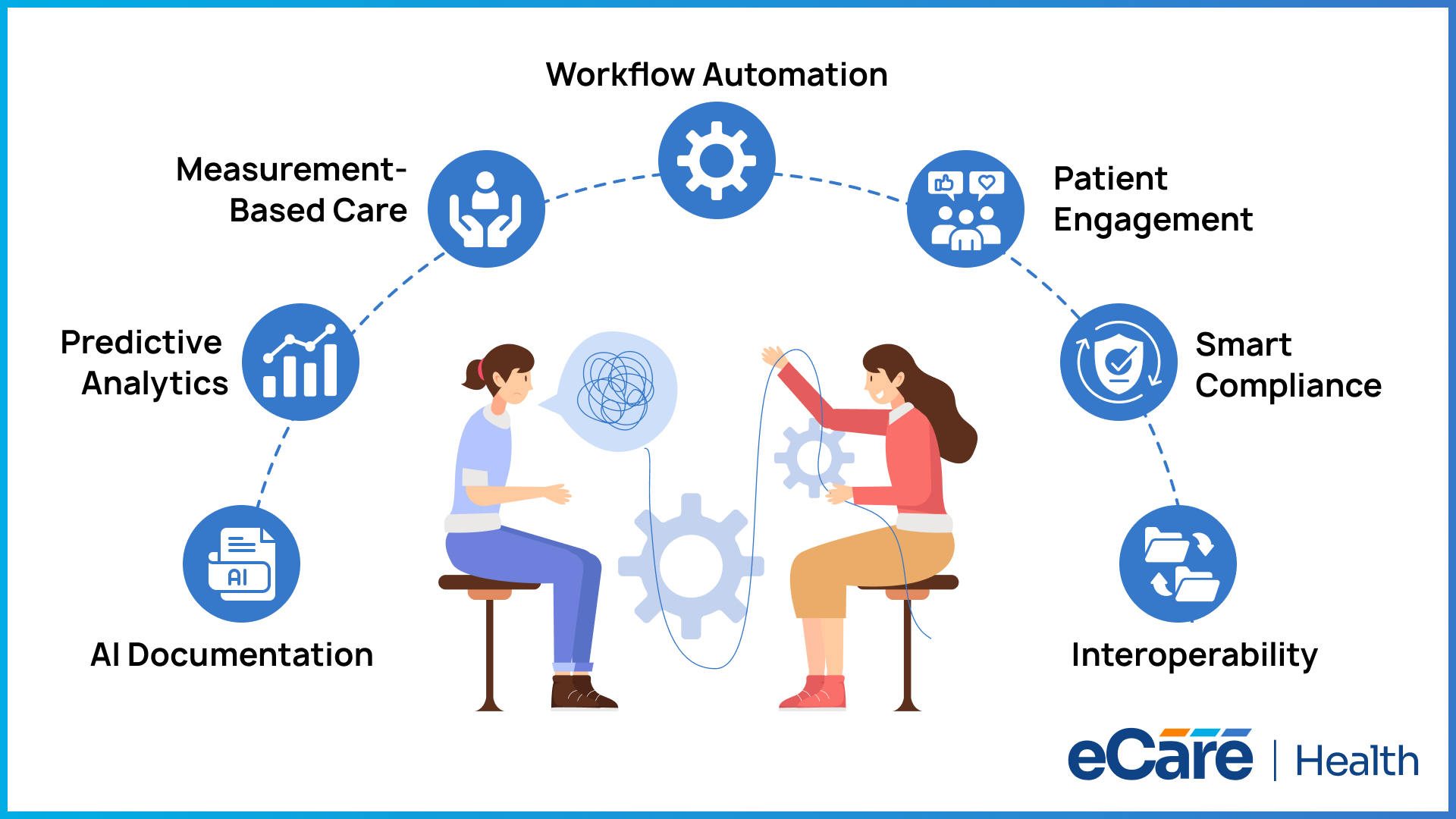
The future of psychiatry EHR software goes far beyond digital recordkeeping. Factors like AI-assisted documentation, predictive analytics, measurement-based care, workflow automation, improved interoperability, and stronger patient engagement transform how psychiatric practices deliver and manage care. These innovations further help to minimize administrative work and enable more informed clinical decisions.
As technology continues to evolve, modern psychiatry EHR platforms will play an even greater role in improving both patient outcomes and practice efficiency. eCareHealth continues to innovate with specialty-focused solutions that help psychiatric practices stay ahead of changing clinical needs, regulatory requirements, and the future of behavioral healthcare.
Conclusion
Choosing the right psychiatry EHR software is more than a technology decision—it's an investment in the future of your practice. A specialty-specific solution supports every aspect of psychiatric care, from documentation and EPCS psychiatry e-prescribing to billing, compliance, and long-term practice growth, helping providers deliver better care with greater efficiency.
If you're looking for an EHR for Psychiatrists that simplifies daily workflows without compromising quality, eCareHealth offers an integrated platform built specifically for behavioral health practices.
With specialty-focused tools that streamline clinical, administrative, and financial processes, it empowers psychiatric providers to focus less on paperwork and more on delivering exceptional patient care.
Frequently Asked Questions
1. What is psychiatry EHR software?
Psychiatry EHR software is a specialized electronic health record system designed for mental health practices. It supports psychiatric documentation, medication management, scheduling, billing, telepsychiatry, and compliance, helping providers streamline workflows and deliver high-quality patient care.
2. How does psychiatry EHR software support medication management and controlled-substance prescribing?
It helps psychiatrists manage prescriptions through features like EPCS, medication history, refill management, allergy alerts, and drug interaction checks. Many platforms also integrate with Prescription Drug Monitoring Programs (PDMPs) to support safer prescribing decisions.
3. What psychiatry-specific features should an EHR include?
A psychiatry EHR should include DSM-5 documentation, Mental Status Exam (MSE) templates, psychotherapy notes, clinical rating scales, medication management, EPCS, telepsychiatry, integrated billing, and customizable workflows designed for behavioral health practices.
4. Does psychiatry EHR software support DSM-5 documentation and Mental Status Exams (MSE)?
Yes. Most specialty-specific psychiatry EHRs provide built-in DSM-5 documentation tools and customizable MSE templates, making it easier to document diagnoses, assessments, and treatment plans accurately and consistently.
5. What is EPCS psychiatry e-prescribing, and why is it important?
EPCS (Electronic Prescribing of Controlled Substances) allows psychiatrists to securely prescribe Schedule II–V controlled medications electronically while meeting DEA requirements. It improves prescribing efficiency, enhances medication safety, and helps reduce prescription fraud.
6. Does psychiatry EHR software support medication interaction checks and polypharmacy management?
Yes. Many psychiatry EHR systems include drug interaction, allergy, and duplicate therapy checks. They also help providers monitor patients taking multiple medications, reducing the risk of adverse drug events.
7. What psychiatry-specific capabilities should I evaluate before selecting an EHR?
Look for features such as EPCS, PDMP integration, DSM-5 documentation, MSE templates, clinical rating scales, medication management, telepsychiatry, workflow customization, integrated billing, and scalability to support future practice growth.
8. How does psychiatry EHR software help meet DEA and HIPAA compliance requirements?
Psychiatry EHR software supports compliance by offering secure access controls, audit trails, encrypted data storage, HIPAA-compliant communication, and EPCS functionality that aligns with DEA requirements for controlled-substance prescribing.
9. What should a new psychiatric practice look for in an EHR?
New practices should choose an EHR that is easy to implement, cloud-based, scalable, and includes integrated documentation, scheduling, billing, telepsychiatry, patient engagement, and compliance tools to support long-term growth.
10. Can psychiatry EHR software support telepsychiatry and measurement-based care?
Yes. Many modern psychiatry EHR platforms include secure telepsychiatry capabilities along with standardized assessment tools like PHQ-9 and GAD-7, enabling providers to monitor patient progress and support measurement-based care.
11. How does psychiatry EHR software improve patient care and practice efficiency?
By bringing documentation, prescribing, billing, scheduling, and patient communication into one platform, psychiatry EHR software reduces administrative work, improves workflow efficiency, and allows providers to spend more time with patients.
12. Is psychiatry EHR software suitable for solo and multi-provider psychiatric practices?
Yes. Most modern psychiatry EHR solutions are scalable and can support solo practitioners, group practices, and multi-location organizations with customizable workflows and centralized practice management.
13. Can psychiatry EHR software support both in-person and telepsychiatry workflows?
Yes. Modern psychiatry EHR software is designed to manage both in-person and virtual care. Providers can schedule appointments, document visits, prescribe medications, and communicate with patients through a single integrated platform, ensuring a consistent care experience regardless of how services are delivered.