




Revenue Cycle Management Software

From Clean Claims to Faster Payment, Everything in One Place

Prevent avoidable claim errors before submission with connected eligibility, coding, claim scrubbing, denial management, and billing workflows all in one platform.

Start Your 2 Weeks Free Trial. Unlock All Features. No Credit Card Required.
HIPAA Compliant
SOC 2 Type II
ISO 27001
G2: 4.5 out of 5 stars Capterra: 4.5 out of 5 stars
Revenue Leakage

Why Revenue Leaks After the Visit Ends

When eligibility, coding, claims, denials, and patient balances live in different places, money slows at every handoff, and no one owns the gap between them.

01
Denials

Denials That Trace Back Weeks

A claim comes back rejected for something that should have been known at check-in. By the time it surfaces, the encounter is a month old, and the rework costs more staff time than the claim returns.
Recoverable revenue written off because the appeal window closed.
02
Eligibility

Coverage Checked Too Late

Eligibility verified while the patient is standing at the desk leaves no time to fix a coverage problem, so the visit happens anyway, and the claim fails later.
Balances that become a patient conversation instead of a payer payment.
03
Coding

Claims Rebuilt by Hand

Billing re-enters what the front desk and the clinical note already captured. Every re-keyed field creates another chance for the claim to be wrong.
Rework on claims that should have gone out clean.
04
A/R days

No Line of Sight From Claim to Cash

Once a claim leaves, most practices cannot see where it is without logging into a payer portal. Work that should be prioritized by value ends up prioritized by whoever shouts.
Cash sitting in A/R weeks longer than it needs to.
The Solution

A Smarter Revenue Cycle From Eligibility to Payment

With eCareHealth revenue cycle management software, each step closes before the next begins, instead of handing a problem downstream where it costs more to fix.

eCareHealth RCM

Catch it before submission

Eligibility is verified at booking and again before the visit, and every claim is scrubbed against payer-specific rules before it is filed.

Build the claim from the note

Charges drop from the signed encounter with coding suggested from the documentation, so nothing is rebuilt from an export.

Work what is recoverable

Denials arrive as a worklist ranked by value and appeal deadline, with the reason code translated and the documentation already attached.

RCM Workflow

One Revenue Cycle Management Platform From Visit to Payment

Connect eligibility, charge capture, coding, scrubbing, submission, remittance, denials, and patient collections in one place, so your billing team works the exceptions instead of rebuilding the routine.

01

Eligibility

Benefits verified at booking and again before the visit.

02

Coding

Suggested from the documentation, checked for compliance.

03

Claim

Built from the signed encounter, not rebuilt from an export.

04

Scrubbing

Payer-specific rules run before anything is filed.

05

Submission

Filed electronically and tracked to acknowledgement.

06

Payment

ERAs post to the original claim lines, variances flagged.

07

Denial

Worklist with reasons, documents and appeal deadlines.

Key RCM Capabilities

Revenue Cycle Management Features That Help You Submit Cleaner Claims

From eligibility verification and accurate coding to claim scrubbing, denial management, payment posting, and A/R analytics, these eCareHealth RCM features connect every step of the revenue cycle in one platform.

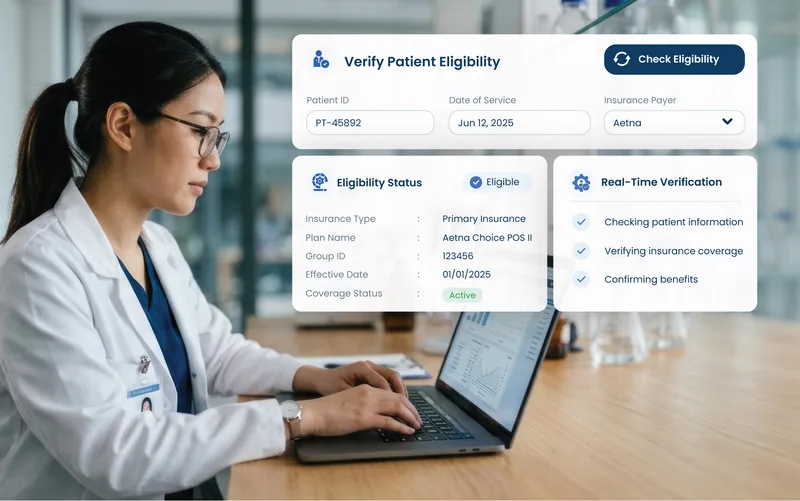
eCareHealth real-time eligibility: a patient eligibility check returning active Aetna coverage alongside a live verification of insurance and benefits
Real-Time Eligibility

Verify Coverage Before Claims Go Out

Verify insurance coverage and benefits before the visit to catch eligibility issues early, reduce avoidable denials, and prevent unexpected patient bills.

  • Real-time insurance eligibility checks
  • Automated benefits verification
  • Patient insurance validation
  • Coverage status visibility
  • Eligibility issue alerts
  • Reduced eligibility-related denials
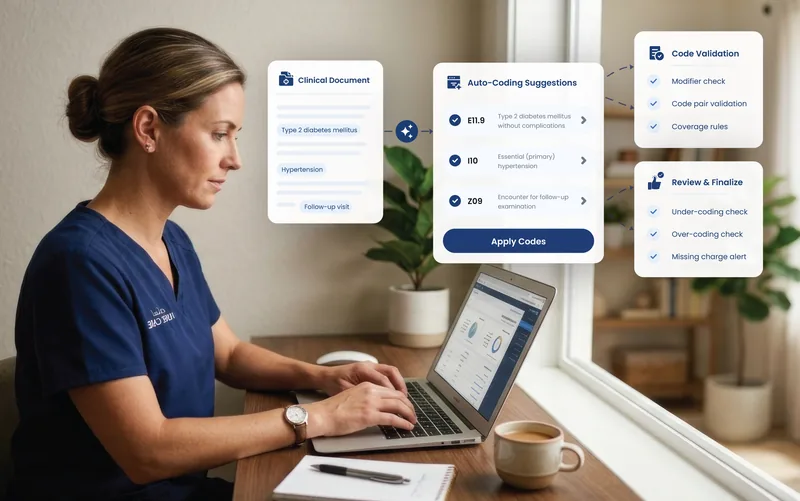
eCareHealth auto-coding: ICD-10 codes suggested from a clinical document beside modifier and code-pair validation and under- and over-coding review
Auto-Coding

Turn Documentation Into Accurate Codes

Use automated coding support to translate clinical documentation into appropriate ICD-10 and CPT codes while helping your billing team catch coding gaps before submission.

  • ICD-10 and CPT codes suggested from the documentation
  • Modifier and code-pair validation
  • Under-coding and over-coding flags
  • Diagnosis support checked against the level billed
  • Fee schedule and payer rule checks
  • Missing-charge and unbilled-visit review
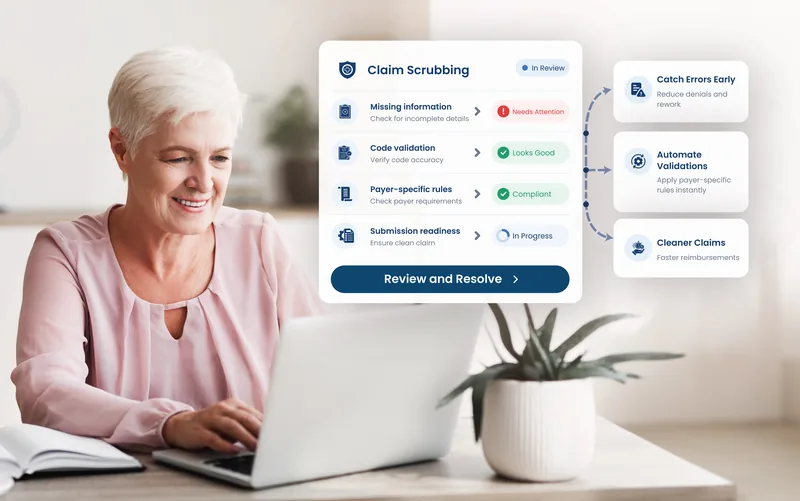
eCareHealth claim scrubbing: a pre-submission checklist flagging missing information, code validation and payer-specific rules before the claim is filed
Claim Scrubbing

Catch Claim Errors Before Submission

Validate claims before they reach the payer to identify missing, incorrect, or inconsistent information that can cause rejections, denials, and payment delays.

  • Automated claim validation
  • Pre-submission error detection
  • Payer-specific claim checks
  • Missing information alerts
  • First-pass claim optimization
  • Reduced avoidable rejections
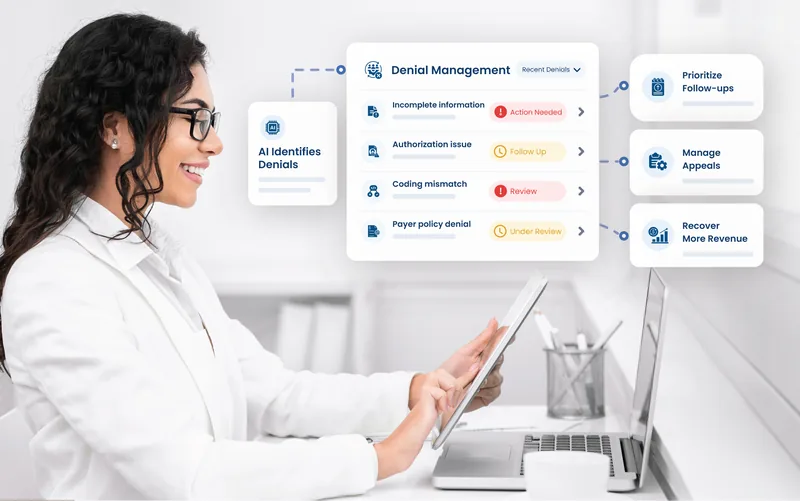
eCareHealth denial management: denials listed by reason with follow-up priority, appeal handling and revenue recovery actions
Automated Denial Management

Turn Denials Into Recoverable Revenue

Give billing teams the tools to identify denial reasons, prioritize follow-up, and manage rebills and appeals without losing track of outstanding claims.

  • Automated denial identification
  • Denial reason tracking
  • Payer-specific workflows
  • Rebilling and resubmission
  • Appeal management
  • Denial trend analysis
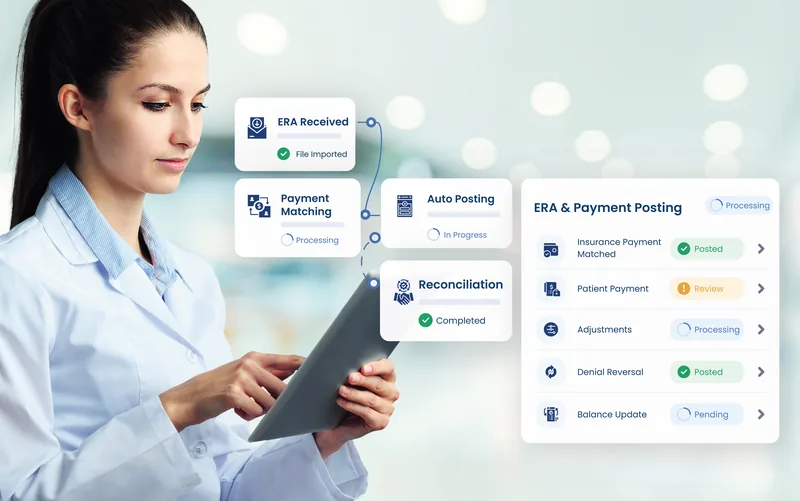
eCareHealth ERA and payment posting: an imported remittance auto-posting insurance and patient payments, adjustments and reconciliation
ERA & Payment Posting

Post Payments With Less Manual Work

Automate electronic remittance processing and payment posting to reduce data entry, reconcile payments efficiently, and keep financial records up to date.

  • Automated ERA processing
  • Electronic payment posting
  • Insurance payment reconciliation
  • Patient payment tracking
  • Adjustment management
  • Automated posting workflows
eCareHealth A/R analytics: an accounts receivable overview with days in A/R, net rate and collections beside payer performance and denial trend charts
A/R Analytics & Dashboards

See Where Your Revenue Is Stuck

Get a clear view of accounts receivable, payer performance, denial trends, and collections so your team can identify bottlenecks and act before revenue slips through the cracks.

  • Real-time A/R dashboards
  • Per-provider A/R aging
  • Per-payer performance tracking
  • Days in A/R monitoring
  • Denial trend reporting
  • Net collection rate visibility

See Where Your Revenue Is Leaking in a 30-Minute Review

Start Your 2-Week Free Trial. No Credit Card Required.
Specialty-Specific EHR

Billing Software Tuned to Your Specialty Billing Rules

Payer rules, modifiers, unit limits and documentation requirements change with the specialty. eCareHealth configures to yours rather than making you work around a default.

Primary Care

Family & Internal Medicine

Templates, dashboards and preventive-care tracking built for family medicine, internal medicine and general practice clinics.

Configured for Primary CareClinical templates, order sets, documentation fields, assessment templates and forms
Where a generic EHR gets in the way
  • Referrals and care coordination run on calls, faxes and manual follow-up
  • Chronic conditions are hard to track across a year of visits
  • Intake forms are repetitive and never flow into the chart
  • Annuals and follow-ups need too much typing for what they contain
How eCareHealth handles it
  • Referral management with electronic sharing, tracking and care-team messaging
  • Smart problem list and chronic-care dashboards for ongoing monitoring
  • Digital intake that auto-fills history, allergies and medications
  • Quick templates for annual exams, sick visits and chronic follow-ups
Automation & Intelligence

Less Manual Work, Fewer Places to Lose a Claim

Each item below replaces a manual check that a person is doing today, usually under time pressure.

01

Claim scrubbing

Every claim is checked against payer-specific rules before submission: required fields, code pairings, modifier logic, diagnosis support, and fee-schedule alignment.

02

Automated eligibility

Benefits are verified at booking and re-verified before the visit, in batch across tomorrow’s schedule, without anyone opening a payer portal.

03

Claim tracking

Status is followed from submission to acknowledgment to adjudication, so a claim that silently stalls is visible rather than assumed to be in progress.

04

Alerts

Timely-filing deadlines, appeal windows, unbilled visits, and stalled claims raise an alert while there is still time to act on them.

05

Automated posting

ERAs post against the original claim lines, with underpayments and contractual variances flagged instead of quietly absorbed.

06

Workflow automation

Denials, rejections, and aged balances route into ranked worklists by value and deadline, so the highest-value work is at the top of the queue.

Trusted by Healthcare Practices

How Practices Cleaned Up Their Billing with eCareHealth

From small clinics to growing healthcare practices, discover how teams simplified operations and delivered better patient experiences.

Family Medicine · Independent Clinic

We used to find out a claim was wrong three weeks after we sent it. Now the scrubber catches it the same day, our biller fixes it in the queue, and the money arrives on the first pass instead of the third.

Dr. David Cattran, Family Medicine Practitioner
Dr. David Cattran
Family Medicine Practitioner
Clean claim rate up from 89% to 97%Days in A/R down from 44 to 28Rejections down by a third

Fewer claims coming back at all

The Challenge
  • Claims coded from a superbill after the visit
  • Errors found by the payer, not before filing
  • Rework absorbing most of one biller’s week
The Result
  • Charges dropping from the signed note
  • Payer-specific scrubbing before submission
  • Corrections made in the queue the same day
97%
Clean Claim Rate
28
Days in A/R
−⅓
Rejections

Primary Care · Private Practice

The denials were always there. What changed is that they arrive ranked by value with the appeal deadline attached, so the biggest ones get worked first.

Portrait of Daniel Larratt, primary care physician, in a white coat with a stethoscope
Daniel Larratt
PCP
$78k recovered over twelve monthsAppeal deadlines missed: zeroDenial follow-up time cut by half

Denials worked in value order, not arrival order

The Challenge
  • Denials worked chronologically while large claims aged
  • Reason codes needing a manual lookup each time
  • Appeal windows closing unnoticed
The Result
  • Worklist ranked by value and deadline
  • Reason codes translated into next actions
  • Documentation attached to the appeal automatically
$78k
Recovered Over Twelve Months
0
Appeal Deadlines Missed
½
Denial Follow-Up Time
Multi-Specialty Clinic · Operations

Legacy A/R kept being worked while new claims went out of the new system from day one, so we never had a week where nothing was being collected.

Dr. Louis Yenson, Clinic Operations Manager
Dr. Louis Yenson
Clinic Operations Manager
Zero weeks without collections during migrationPayer enrollment completed in four weeks100% of outstanding A/R migrated

A seamless transition to connected care workflows

The Challenge
  • Fear of a month with no cash during cutover
  • Outstanding A/R spread across two systems
  • Payer enrollment timelines nobody could predict
The Result
  • Legacy A/R worked in parallel through cutover
  • New claims filing from day one
  • Enrollment tracked payer by payer with dates
0
Weeks Without Collections
4 wks
Payer Enrollment Completed
100%
Outstanding A/R Migrated
Financial Results

RCM Results: What Changes in the First Full Cycle

The numbers a practice owner is asked about are available the same day rather than reconstructed at month-end.

↑18%
Clean claims
More claims accepted on the first submission.
↓46%
Denial rate
Fewer denials once scrubbing runs before submission.
↓22d
Days in A/R
Cash arrives sooner because fewer claims stall.
↓31%
Billing errors
Fewer corrections after the claim has gone out.

Figures reported by eCareHealth practices; individual results vary by specialty, payer mix and starting clean-claim rate.

Integrations

Connect the Clearinghouses and Payers You Already Submit To

Move claims, remittances, and payments between systems without leaving the chart or re-keying what the practice already captured.

Clearinghouses & Claims Integration

Claims, status checks and remittances move through the clearinghouse and payer connections the practice already uses, so nothing has to be re-entered in a portal to get a claim out of the door.

Availity

Submit claims, check status and request authorizations across most national payers through one connection.

Security & Compliance

HIPAA-Compliant RCM Security on Every Claim

Billing data is patient data. HIPAA compliant, SOC 2 Type II audited, ISO 27001 certified.

HIPAA Security & Privacy

Billing data is patient data. The same safeguards apply to a claim as to a chart, with a Business Associate Agreement signed with every practice.

What’s at stake
  • Civil penalties scaled by how culpable the practice was
  • Criminal liability where PHI is knowingly misused
  • Breach notification to affected patients and to HHS
  • A corrective action plan and monitoring after a finding
  • Patient trust lost long before the penalty is settled
Why it’s required
  • Federal mandate for covered entities and business associates
  • Claims, remittances and balances are all PHI
  • Required for Medicare and Medicaid participation
  • Prerequisite for payer and clearinghouse connections
  • The basis of patient trust and legal accountability
How eCareHealth meets it
Business Associate Agreement signed with every practice
Billing staff, clinicians and administrators each see only their role
PHI and financial data encrypted at rest and in transit
Audit log on every view, edit and export
Claims, remittances, balances and A/R export at any time
Certifications & attestations
HIPAACompliant, with a signed BAASOC 2 Type IIExternally auditedISO 27001Certified
Customer Stories

Real outcomes from real practices

How independent clinics, multispecialty groups, and multi-location healthcare networks reduced friction, lifted engagement, and unified interoperability with eCareHealth — verified results from real customers.

40-Provider Multispecialty Group cut scheduling friction by 62%
#practicemanagementMay 2026

How a 40-Provider Multispecialty Group Cut Scheduling Friction by 62%

A patient told a cardiologist she’d waited four months for her appointment. The cardiologist told the leadership, and they discovered that this had been happening frequently and the practice had been quietly losing 12% of inbound demand for years.

Read Case Study
Cardiology Clinic lifts patient portal adoption from 28% to 79%
#patientengagementMay 2026

Cardiology Clinic Lifts Patient Portal Adoption from 28% to 79%

A sudden heart-failure readmission triggered the overhaul for portal-adoption at Bayside Cardiology. The practice wanted a portal that can help patients on time and will be easy to navigate, as the complaint from the family was ‘the portal didn’t help us’.

Read Case Study
Multi-Site Rural Health Network TEFCA-ready in 90 days
#interoperabilityMay 2026

Multi-Site Rural Health Network: TEFCA-Ready in 90 Days

A near-medication miss in two of the seven rural clinics for about two years, and this has become a challenge for the network’s CIO. The leadership wanted the problem fixed before something went wrong.

Read Case Study
FAQ

Revenue Cycle Management FAQs

Everything you need to know about eCareHealth revenue cycle management — from eligibility and coding to claim scrubbing, denial management, ERA posting, A/R analytics, and data security.

Revenue cycle management is everything a practice does to get paid for care: verifying insurance before the visit, coding the encounter, submitting the claim, following up on denials and collecting what the patient owes. It covers the whole path from booking an appointment to the payment reaching the practice's account.

RCM stands for revenue cycle management. In medical billing it describes the full cycle a charge travels through: eligibility, charge capture, coding, claim scrubbing, submission, remittance posting, denial management and patient collection. Each step either passes a clean claim forward or creates work for the step after it.

Four make the most difference. Verify eligibility before the visit rather than at the desk. Build the claim from the signed note instead of re-keying it. Scrub against payer-specific rules before filing. Work denials in order of value and appeal deadline rather than in the order they arrived.

Start by measuring three things: clean claim rate, days in A/R and denial rate by reason code. The reason codes tell you where the leak is. Most practices find the largest single cause is a coverage or coding problem that was knowable before the claim was ever filed.

Two ways. Eligibility is verified at booking and again before the visit, so a coverage problem surfaces while there is still time to call the patient. And every claim is scrubbed against payer-specific rules before filing, so errors are corrected in your queue rather than returned weeks later.

Yes. Benefits are verified in real time at booking and re-verified automatically before the visit, with copay, deductible and coinsurance detail returned to the front desk. Tomorrow's whole schedule can be checked in batch overnight, so staff start the day with a short call list.

From the signed encounter. Charges drop from the documentation with ICD-10 and CPT codes suggested from what was recorded, then checked for modifier logic, code-pair conflicts and under- or over-coding before anything moves. Nothing is rebuilt from an export or typed in from a superbill.

Denials arrive in a worklist ranked by value and appeal deadline, with the reason code translated into a next action and the supporting documentation already attached. Appeal deadlines run on a clock, and root-cause reporting by payer and code shows which denials keep coming back.

Claims submit through your existing clearinghouse connection. See the integrations section above for the current list, and confirm which are enabled for your plan, because payer enrollment rather than the software is usually the longest step in a billing implementation.

Yes. Statements generate from the balance after remittance posts, and patients can pay by card or ACH online. A card can be kept on file with consent for balances remaining after insurance, and larger balances can be put on a payment plan.

Yes. The same eligibility checks, scrubbing rules and denial worklists apply whether billing is one person two days a week or a small in-house team. Smaller practices usually feel a caught denial more, because a single claim is worth more as a share of the month.

Aged A/R by payer, provider and location, days in A/R, clean claim rate and first-pass yield, denial rate by reason and by payer, net collection rate, and follow-up worklists sorted by balance and age. Available the same day rather than at month end.

Most practices are submitting within four weeks, but payer enrollment sets the pace rather than the software. Legacy A/R can be worked in your old system while new claims go out through eCareHealth from day one, so there is never a week with nothing being collected.

Start Your 2 Weeks Free Trial Book Free Demo