How a 40-Provider Multispecialty Group Cut Scheduling Friction by 62%

A patient told a cardiologist she’d waited four months for her appointment. The cardiologist told the leadership, and they discovered that this had been happening frequently and the practice had been quietly losing 12% of inbound demand for years.
Business Challenges
A growing 40-provider multispecialty group was struggling to meet patient demand despite having available appointment capacity. Across eight specialties, scheduling workflows relied heavily on manual processes, institutional knowledge, and disconnected tools. Patients faced long wait times, schedulers spent significant time coordinating appointments, and available provider capacity often went unused.
Leadership recognized that the problem was not a lack of demand, but an inability to efficiently match patients with the right providers at the right time. To address these challenges, the organization partnered with eCareHealth to modernize scheduling operations, implement patient self-scheduling, and automate appointment management workflows.
Within 90 days of deployment, the practice improved scheduling utilization, increased patient access, reduced administrative burden, and generated measurable financial returns.
- Schedule utilization sat at 71% across all 38 providers despite inbound demand that should have produced 90%+ utilization.
- Specialty-specific scheduling rules existed in tribal knowledge; the 6-month onboarding curve for new schedulers had been understood as normal.
- Patient self-scheduling was unavailable; 12% of inbound demand (~280 appointment requests per month) was lost to competitors that offered online booking.
- The recall/cancellation backfill process ran via Excel and email; openings were typically not filled within the same business day they appeared.
- Provider mix-utilization tracking — ensuring providers saw the right case complexity for their training and credentialing — was done by hand quarterly; the data was 2–3 months stale by the time it informed scheduling decisions.
Solution
The leadership procurement was structured around a behavioral question rather than a feature question: would the platform allow the practice to retire phone-only scheduling, or would it require schedulers to keep doing the same work in a more sophisticated tool? Hahn had seen practices buy “scheduling optimization” platforms before, but those didn’t change the schedulers’ day. He wasn’t doing that again.
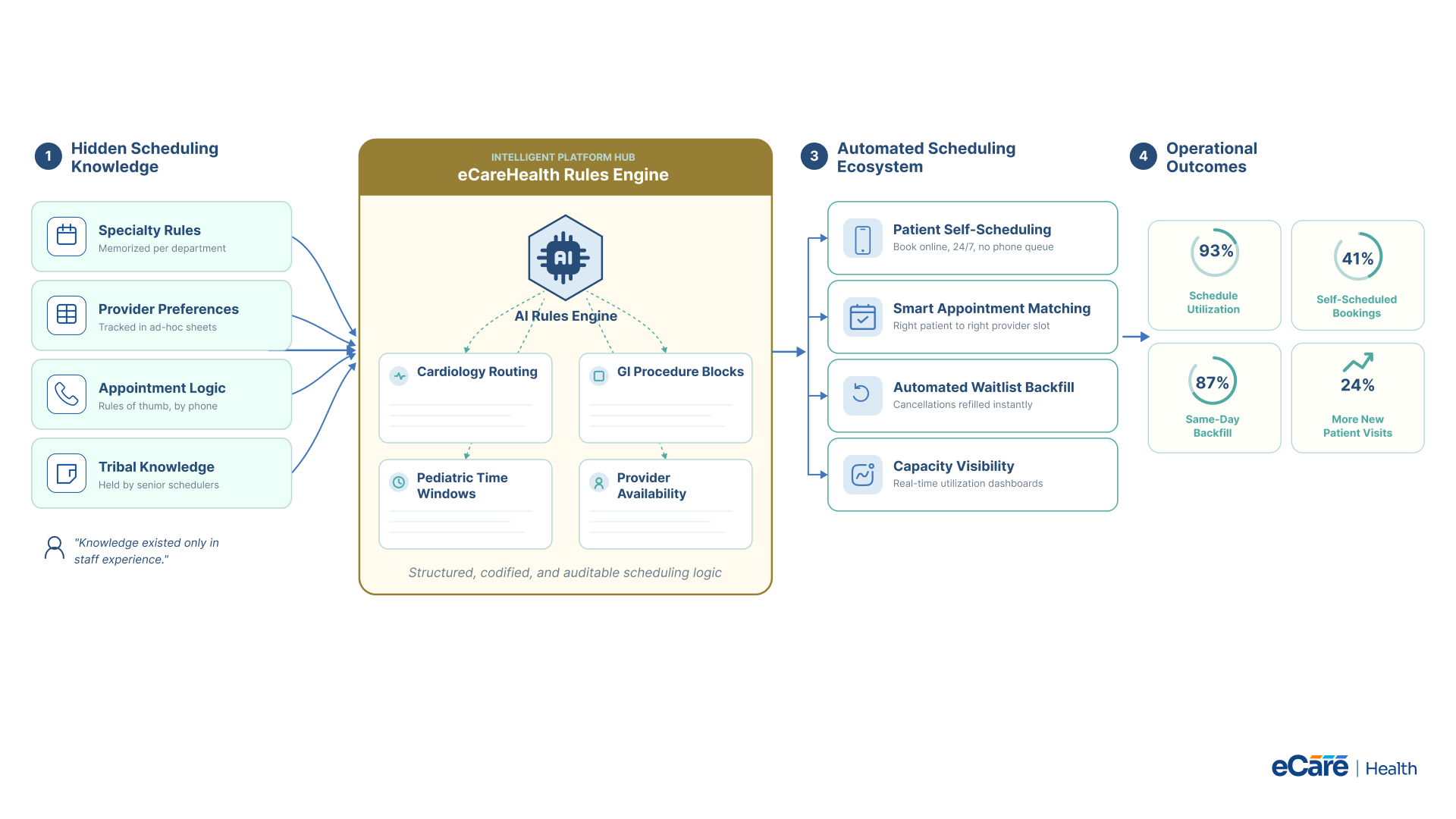
eCareHealth’s scheduling module won the evaluation on two specific capabilities. First, the rules engine was capable of encoding the specialty-by-specialty logic the schedulers had been holding in their heads — Dr. Liu’s preference for complex arrhythmia cases on Tuesdays, the GI group’s preference for procedure days back-to-back, the pediatric scheduling carve-outs for after-school slots. Second, the patient-facing self-scheduling layer respected those rules — patients could book themselves into a slot that the rules actually allowed, instead of generic “open” slots.
The CEO’s procurement decision was made when the eCareHealth deployment lead sat with the two most senior schedulers (Maria Cortez, 14 years; Janet Webb, 11 years) and asked them to dictate the rules. They started talking and didn’t stop for two hours. The deployment lead took notes and built a draft configuration from those notes that Maria and Janet recognized as their own work. That recognition was the unlock.
Value Delivered
The CEO tracked four numbers monthly: utilization, new-patient throughput, self-scheduling adoption, and same-day cancellation backfill. All four moved within the first 90 days of full deployment, and the movement compounded over the following six months.
- Schedule utilization lifted from 71% to 93% across all specialties; the lift was strongest in cardiology (+27 points) and endocrinology (+24 points).
- New-patient visits per quarter rose 24% against the prior baseline.
- 41% of new-patient bookings are now done via patient self-scheduling, up from zero.
- Same-day cancellation backfill rate is now 87%, driven by automated recall-list outreach when a slot opens.
- $2.4M incremental annual revenue from the utilization and throughput lift, against a $310K implementation investment.
Solution Provided
The deployment was structured around the schedulers, not around the providers. The CEO’s instinct — confirmed by the deployment lead — was that the schedulers were the operational center of gravity, and a successful deployment would feel to them like an expansion of their authority rather than a replacement of it.
Weeks 1–2: Intelligent Scheduling Configuration
eCareHealth worked with operational leaders and scheduling teams to document and standardize appointment scheduling rules across all specialties. These workflows were incorporated directly into the platform, ensuring consistent scheduling decisions regardless of staff experience levels.
Weeks 3–5: Patient Self-Scheduling
Patients gained the ability to schedule appointments online based on provider availability and specialty-specific requirements. This reduced scheduling friction while improving access to care.
Weeks 5–8: Specialty Pilots (Cardiology First)
Cardiology piloted first because Dr. Liu was the executive sponsor and the original problem-surface. The pilot ran for two weeks with limited patient self-scheduling and full backstop by Maria and Janet. By week 8, cardiology was fully on the new system, and the original four-month wait was down to two weeks.
Weeks 8–11: Automated Waitlist & Recall Management
The organization replaced manual spreadsheet-based recall processes with automated outreach workflows designed to fill cancellations and open appointment slots more efficiently.
Weeks 11–13: Scheduling Performance Visibility
Leadership gained access to real-time scheduling and utilization metrics, allowing teams to monitor capacity, identify bottlenecks, and make data-driven operational decisions.
Business Value
The leadership reviewed the effect of 12-month engagement, framed it around a question the board had asked at funding: was this a technology project or an operations project? The CEO’s answer became the basis for how he describes the engagement now.
The technology was the smaller half
The platform configuration mattered, but the platform configuration alone wouldn’t have produced the utilization lift. The lift came from the rules being written down, the schedulers being elevated, and the patients being able to participate in scheduling for the first time. The technology was the medium; the operating model was the change.
What the financial picture actually shows
The organization generated an estimated $2.4 million in annual revenue impact through improved utilization, increased patient throughput, and more efficient appointment management. Leadership was also able to maximize existing capacity, reducing the immediate need for costly expansion initiatives.
What happens next
The organization transformed scheduling from a reactive administrative function into a measurable operational discipline. Leadership gained greater visibility into provider capacity and patient demand, enabling more informed decisions around future growth and resource planning.
The line the CEO uses with peers
“We didn’t have a scheduling technology problem. We had a scheduling authority problem. The technology gave us the language to fix the authority problem. That’s what we actually bought.”