Multi-Site Rural Health Network: TEFCA-Ready in 90 Days

A near-medication miss in two of the seven rural clinics for about two years, and this has become a challenge for the network’s CIO. The leadership wanted the problem fixed before something went wrong.
Business Challenges
The patient was a 67-year-old farmer with three chronic conditions and a complicated medication regimen. He saw a primary care physician at the Cody clinic for his diabetes. He saw a cardiologist at the Rawlins clinic for his arrhythmia. The two physicians had each adjusted their beta-blocker dose on the same day without seeing each other’s notes. The patient took both doses for nine days before a third clinic visit caught the duplication. He didn’t have a cardiac event. He could have.
The network’s CIO had been raising this risk for two years. Mountain West Rural Health operated seven clinics across 14 counties in Wyoming and Montana — a service area roughly the size of Tennessee. Each clinic ran an isolated chart system because the network had grown through acquisition over a decade, and the cost of consolidation had never been prioritized. Cross-site visits — common for the rural patient population that drove long distances to specialty care — required fax transfers in 22% of cases.
The near-miss went to the board. The board chair, a cattle rancher who had served on the network’s governance committee for fifteen years, asked one question: “How close was this to a death? How would we explain it if it had been?” The CIO laid out the work. The board funded the project the same meeting.
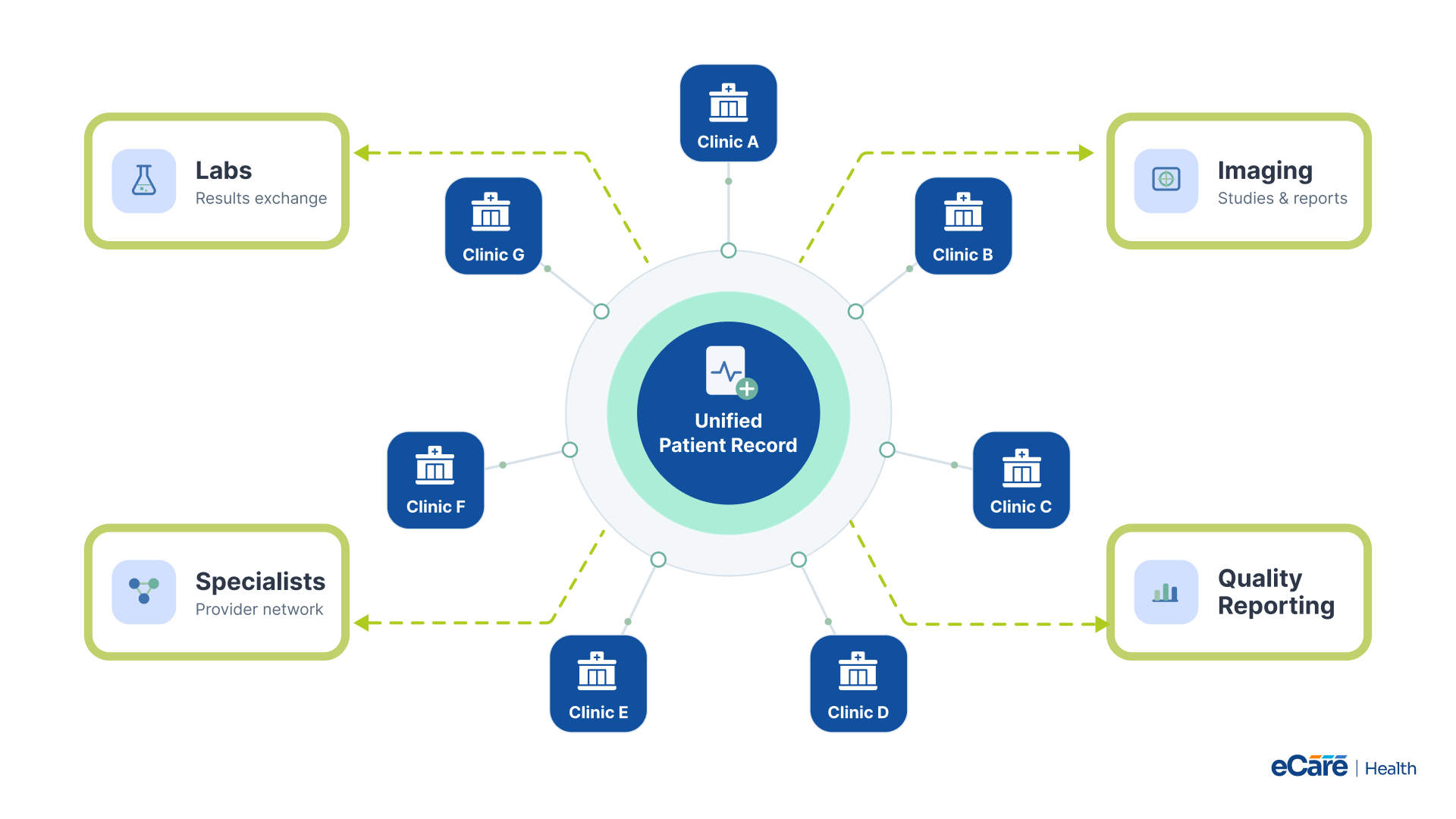
- The near-miss event: a 67-year-old patient took duplicated beta-blocker dosing for 9 days due to non-communicating chart systems across two of the network’s seven clinics.
- 22% of cross-site patient visits required fax-based chart transfer; 14% of those transfers produced reconciliation gaps flagged in QA review.
- Lab and imaging results lagged 3–5 days routing to the correct provider’s queue when ordered from one site and read at another.
- Specialty referrals to the regional academic center failed to close the loop on 38% of cases — the academic center’s consultation note was not finding its way back into the rural patient’s home-clinic chart.
- Quality reporting required 4 FTEs working full-time during the last week of each month to consolidate data across the seven sites manually.
Solution
The CIO’s procurement was driven by one operational constraint that ruled out most platforms: any solution had to work over the broadband infrastructure available in rural Wyoming. Three of the seven clinics had satellite-only connections with throughput caps. A cloud-only EHR that required constant high-bandwidth connectivity would fail in two of the clinics within a week.
eCareHealth was selected partly because of the unified record capability and partly because the deployment team understood the offline-tolerance requirement out of the gate. The other two finalist platforms had treated bandwidth-resilience as an edge-case feature; eCareHealth’s deployment lead had previously worked at a multi-state critical-access hospital network and treated it as a core deployment constraint.
The decision was made in a way most enterprise procurement processes wouldn’t recognize. The CIO took the eCareHealth deployment lead on a tour of three of the rural clinics over a 36-hour windshield-time trip. They met the front desk staff, the medical assistants, and one physician at each site. The deployment lead asked questions that demonstrated he understood what it meant to run a clinic where the nearest IT support was 4 hours away by car. The CIO signed the contract at the diner on the return drive.
Value Delivered
The board had asked for a “fix it before someone dies” outcome. The measurable outcomes the network tracked over 12 months reflected that priority, but went further than the board had asked.
- Handoff errors flagged in QA dropped 81% in the 12 months following unified-record deployment.
- 100% of cross-site patient records are now available at the point of care, with no fax-based transfer required for any in-network visit.
- Lab and imaging results are routed same-day to the ordering provider regardless of which site reads the study.
- Specialty referral loop closure improved from 38% to 92% through structured consult-note routing back to the patient’s home clinic.
- Monthly quality reporting effort dropped from 4 FTEs to 0.5 FTE; the network now produces real-time quality dashboards instead of monthly retroactive ones.
Solution Provided
The deployment took 22 weeks — the longest of any eCareHealth engagement in that fiscal year — driven by the operational reality of rural Wyoming logistics. Site visits required overnight stays. Equipment shipments took 5–7 days. On-site IT support during cutover required the deployment team to relocate.
Pre-Deployment: The Connectivity Audit (4 weeks)
Before any system work began, the CIO and the eCareHealth deployment lead drove to each of the seven sites and audited the actual network connectivity at the clinic location, at peak hours, with actual workloads simulated. Two sites were upgraded to redundant connections before deployment began. One site had its router replaced. This phase wouldn’t have shown up in a standard project plan but it determined whether the deployment would succeed.
Phase 1: The Two Central Sites (Weeks 5–9)
Cody and Rawlins — the two largest clinics, with the highest specialty volume — were deployed first. They were also the two clinics involved in the original near-miss event, so the project visibility was highest. The clinical leads at both sites participated in design reviews.
Phase 2: The Four Secondary Sites (Weeks 9–16)
The four mid-volume clinics were brought up in pairs. The deployment team relocated to the regional hub between cutovers; each site cutover took 4 days onsite. The configuration was largely set by this point; the work was about local training and workflow adaptation.
Phase 3: The Critical-Access Hospital Affiliate (Weeks 16–22)
The seventh site was a critical-access hospital with which the network had a sharing agreement rather than full ownership. Integration required separate governance — a memorandum of understanding had to be redrafted to cover the data-sharing posture. The legal work took longer than the technical work.
Business Value
The CIO presented the 12-month deployment report to the board in November of the following year. The board chair — the cattle rancher who had asked “how close to a death” — opened the meeting by saying he wanted to know two things: what changed, and what the network owed eCareHealth.
What changed about patient safety
The medication-reconciliation gap that drove the original near-miss is now structurally impossible. A primary care physician adjusting a beta-blocker dose sees the cardiologist’s most recent note in the same chart view. The QA team’s incident-tracking dashboard, which historically logged 11–14 medication-reconciliation flags per quarter, has averaged 1–2 since deployment. The board chair specifically called this out as the deliverable that mattered.
What changed about the network’s operating model
Three operational changes followed the deployment that the CIO had not specifically planned for. First, specialty referrals to the academic center became reciprocal — the academic center now refers patients back to Mountain West for follow-up care because the consult-note loop closes reliably. Second, locum coverage across sites became viable — locum physicians can now cover any site because the chart looks the same. Third, the network’s ability to recruit primary care providers improved because the rural-medicine practice environment was no longer compromised by the chart situation.
What the CIO believes is the real lesson
“The board funded this project because of a near-miss. They funded it as a safety investment. What they actually got was an operational platform that changed our growth thesis. The safety case got us in the door. The operating leverage is what justifies the next investment cycle.”
The cost the network avoided
The closest peer rural network had a medication-reconciliation event reach litigation in 2024 — settled for $4.7M. Mountain West’s CIO does not believe the engagement should be primarily valued on litigation avoidance, but the board’s lawyer has noted it more than once.