Cardiology Clinic Lifts Patient Portal Adoption from 28% to 79%

A sudden heart-failure readmission triggered the overhaul for portal-adoption at Bayside Cardiology. The practice wanted a portal that can help patients on time and will be easy to navigate, as the complaint from the family was ‘the portal didn’t help us’.
Business Challenges
Mrs. Eleanor Park was readmitted to the hospital seven days after her discharge for congestive heart failure. She died eleven days later. The morbidity-and-mortality conference that followed surfaced a sentence in her son’s complaint letter that the CMO of Bayside Cardiology Group, Dr. Adrienne Vogel, could not stop thinking about: “We tried to use the portal. It didn’t help us.”
Dr. Vogel pulled the portal’s analytics. Bayside’s adoption rate sat at 18% of active patients — and below 9% of the over-65 cohort that represented two-thirds of the practice’s panel. The portal that the practice had been operating for two years had effectively zero adoption among the patient population that most needed it.
The clinical question Dr. Vogel raised at the M&M conference was simple. If we expect heart failure patients to message us when their weight gains 3 pounds, and 91% of those patients can’t or won’t use the portal, what are we expecting to happen?
- Portal adoption: 18% groupwide; 9% among the over-65 patient cohort that represented 68% of the practice’s panel.
- Heart-failure-specific use cases (post-discharge symptom check-ins, weight reporting, refill requests) showed essentially zero engagement; the portal didn’t surface them at all.
- Front desk fielded approximately 380 routine inquiries per week — refill requests, appointment confirmations, results questions — that the portal was theoretically designed to deflect.
- Cardiac-rehab referrals dropped through process gaps; conversion from referral to first rehab session sat at 32% (national benchmark 64%+).
- The Park family complaint surfaced the issue directly; internal patient satisfaction had been declining for four quarters, but no one had connected it to the portal experience.
Solution
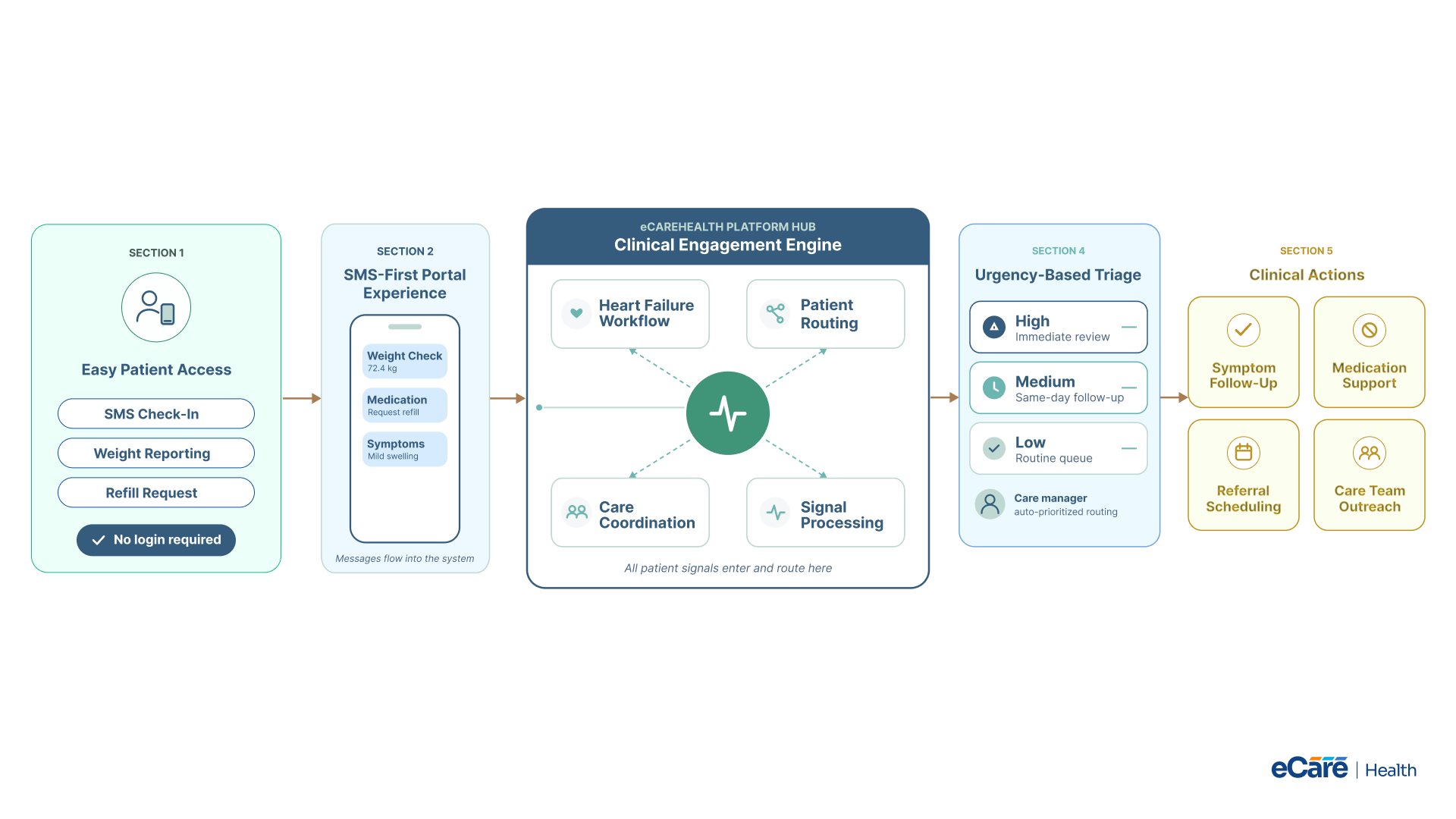
Dr. Vogel framed the portal-overhaul project around one design constraint: the over-75 heart-failure patient cohort had to be able to use it. That meant text-message-first, not portal-login-first. It meant English language at a sixth-grade reading level. It meant the most-used workflows had to be available without a password.
The selection process was driven by Dr. Vogel and the practice’s nursing director, Brenda Cole, not the IT team. They visited two reference customers in person. At the first site, Brenda watched a 78-year-old patient use the portal to report a 4-pound overnight weight gain; the alert was routed to her care manager within 90 seconds. That was the moment Brenda’s vote tipped.
eCareHealth was selected on the strength of three specific capabilities: a heart-failure-specific symptom check-in workflow available via SMS, refill-request handling that didn’t require portal login, and a care-manager dashboard that triaged inbound patient signals by urgency. The practice’s prior portal had been generic; eCareHealth’s was configurable to a chronic-condition cohort.
Value Delivered
The portal-overhaul project had two success criteria written down on day one. First: adoption among the over-65 cohort had to exceed 60% within 90 days. Second: the post-discharge readmission risk for heart-failure patients had to demonstrably decrease. Both happened — but the second metric is what Dr. Vogel cares about.
- Portal adoption lifted from 18% to 74% groupwide in 90 days; from 9% to 71% among the over-65 cohort.
- Front-desk call volume dropped 68% as routine inquiries flowed through digital channels instead.
- Heart-failure 30-day readmission rate fell from 22% to 12% in the six months following deployment.
- Cardiac-rehab referral conversion lifted from 32% to 71% through portal-driven referral confirmation + scheduling.
- CG-CAHPS patient satisfaction score lifted 19 points — the largest single-quarter movement in the practice’s five-year history of tracking it.
Solution Provided
The deployment ran 11 weeks. The pacing was deliberate: Dr. Vogel insisted that no marketing of the new portal go out until the heart-failure-specific workflows were operationally tested.
Weeks 1–3: Heart Failure First
The first three weeks targeted only the heart-failure cohort — roughly 480 patients. Care managers personally onboarded the first 80 patients by phone, walking them through SMS check-in and weight reporting. The objective was to learn what didn’t work for the actual target population before scaling.
Weeks 3–5: Care Manager Workflow Tuning
Once patients started using the system, the care-manager dashboard became the bottleneck. Inbound signals were routing correctly but the triage view wasn’t matched to how care managers actually worked. eCareHealth’s deployment team spent a week reconfiguring the dashboard alongside Brenda and her three care managers.
Weeks 5–8: Full Heart Failure Cohort + Refills
The remaining heart-failure patients came onto the system. Refill-request workflows opened to the broader patient panel at the same time, since they were the most-requested missing feature in the prior portal.
Weeks 8–11: General Cohort + Referral Loop Closure
The system opened to the full practice panel. Cardiac-rehab referrals were re-architected to send portal-based confirmation + scheduling, closing the loop that had been dropping referrals at 68% historically.
What didn’t appear in the standard deployment plan but mattered enormously: Dr. Vogel personally called every heart-failure patient in the first month after launch to ask whether the new system was helping. Twelve patients reported friction. Each issue was fixed within a week. Word spread through the patient community that the practice was actually listening.
Business Value
Dr. Vogel does not discuss this engagement in financial terms when she talks about it publicly. She talks about Mrs. Park.
What has the practice changed about how it sees the portal
The portal was not understood, before the engagement, as a clinical safety system. It was understood as a convenience tool. The reframe — from convenience tool to clinical safety system — is what allowed the practice to invest at the level of leadership attention required to make the deployment work.
The readmission number
The 30-day readmission rate dropping from 22% to 12% represents real lives. The practice ran the math: at Bayside’s patient volume, that delta corresponds to roughly 24 prevented readmissions per year. The hospital systems that admit Bayside’s patients have noticed. Two of them have asked Dr. Vogel to present at their quality committees.
The financial story (which matters too)
The front-desk call deflection saved the practice roughly $180K in annual front-desk operating cost. The patient acquisition lift driven by the satisfaction-score improvement has been roughly $620K in incremental new-patient revenue. The total financial return on the engagement is positive by a margin of 4x, but Dr. Vogel rarely leads with these numbers.
What she says when peers ask her about it
“Now, even a 78-year-old patient can also access the patient portal easily without having to navigate through five menus.” This was the reaction of the clinicians when eCareHealth was implemented.