How to Choose the Best Mental Health EHR: A Complete 2026 Buyer’s Guide

Nearly 70% of digital transformation projects fail to achieve their intended goals, and healthcare organizations are not exceptions.
The main problem here is not the technology itself; it’s actually choosing a solution that does not truly fit the organization’s workflows, goals, or future growth. And because of this, selecting the best EHR for behavioral health deserves careful consideration.
An EHR is not just another piece of software; it’s the system on which your clinicians, front-office staff, and billers can depend every day. Almost every part of your practice, from documenting therapy sessions and coordinating care to managing appointments, claims, and compliance, depends on it.
If you get it correctly, everything can run more seamlessly. However, if you get it wrong, even your routine tasks can become an uphill battle.
The main challenge here is that today’s market is flooded with behavioral health EHR systems that make remarkably similar promises. Almost every vendor claims to have AI-powered documentation, integrated billing, telehealth, patient engagement, and analytics. Looking beyond polished demos, feature lists, and pricing pages is where the actual evaluation begins.
That is exactly where this buyer’s guide comes in. To make the decision easier, here is a practical seven-step framework that helps you compare your options and choose the best EHR for behavioral health.
Step 1: Define Your Behavioral Health Practice Requirements
Before comparing vendors, you should take a step back and evaluate your own practice. The best EHR for behavioral health must always support your existing workflows and give your organization room to grow. The clearer your requirements are, the easier it becomes to separate the right solution from clever marketing.
Here are some of the questions you can always start by answering:
- What type of practice do you run? Consider your care model, specialties, provider roles, patient volume, and whether you operate from one location or multiple sites.
- Where are your current workflow gaps? Identify bottlenecks in documentation, scheduling, billing, patient communication, or follow-up care that slow your team down.
- What does each team need? Clinicians, administrators, billing staff, and practice leaders all use the system differently. Gather their input early to ensure your behavioral health EHR software meets everyone’s day-to-day needs.
- Which features are essential? Separate must-have capabilities from nice-to-have features. This keeps your evaluation focused and prevents you from paying for functionality your practice may never use.
A little planning upfront can save a lot of frustration later. Once you start to define your priorities, comparing behavioral health EHR systems becomes much more straightforward.
Step 2: Compare Behavioral Health EHR Systems Using an Evaluation Checklist
Once you get a clear picture of what your practice requires, the next step is comparing solutions on a level playing field. This is where a behavioral health EMR evaluation checklist for clinic directors becomes invaluable. You can use a consistent framework to evaluate every platform, instead of depending on impressive product demos or vendor promises.
Your checklist must reflect some of the key factors, including how your practice actually operates. Can providers document sessions effectively? Does scheduling integrate seamlessly with billing? Is patient information easily accessible throughout the care journey?
If you look at the complete workflows rather than individual features, it gives you a much clearer picture of how the software will perform in everyday practice.
As you evaluate different behavioral health EHR systems, here are some of the typical patient journeys, including:
- Appointment scheduling
- Clinical documentation
- Billing and claims processing
- Patient follow-up and engagement
Comparing options becomes much easier when every platform is measured against the same criteria. Finally, the best EHR for behavioral health must improve the entire workflow, and not just one part of it.
Here is the checklist to make the evaluation more structured and objective:
| Evaluation Area | What to Evaluate | Key Buyer Question |
|---|---|---|
| Clinical Documentation | SOAP, DAP, BIRP, treatment plans, and DSM-5/ICD-10 workflows | Does the EHR match how our behavioral health clinicians document care? |
| Measurement-Based Care | PHQ-9, GAD-7, C-SSRS, and longitudinal outcome tracking | Can clinicians track patient progress and treatment response over time? |
| Practice Management | Scheduling, patient engagement, and administrative workflows | Can daily operations run without disconnected tools? |
| AI & Automation | AI-assisted draft notes, human review, and workflow automation | Does AI reduce measurable administrative work while keeping clinicians in control? |
| Billing | CPT 90791, 90834, 90837, and authorization tracking | Does the platform support behavioral health reimbursement workflows? |
| Security | HIPAA Security Rule, role-based access controls, and audit logs | Does the platform protect sensitive behavioral health information? |
| Compliance | 42 CFR Part 2 privacy requirements and 2026 compliance considerations | Can the EHR support applicable behavioral health record privacy requirements? |
| Connected Care | Labs, billing, referral partners, and secure data exchange | Can the EHR support connected workflows across the care ecosystem? |
| Scalability | Providers, locations, permissions, and supervision workflows | Can the system support increasing organizational complexity? |
| Cost & Value | Subscription model, implementation costs, and total cost of ownership | Does the platform deliver sustainable value beyond the monthly price? |
Instead of treating every feature equally, you can focus on the areas that have the greatest impact on your practice. A platform may shine in one category, but the best EHR for behavioral health is the one that can consistently perform well across your entire clinical and operational workflow.
Step 3: Check Whether the EHR Can Scale with Your Behavioral Health Practice
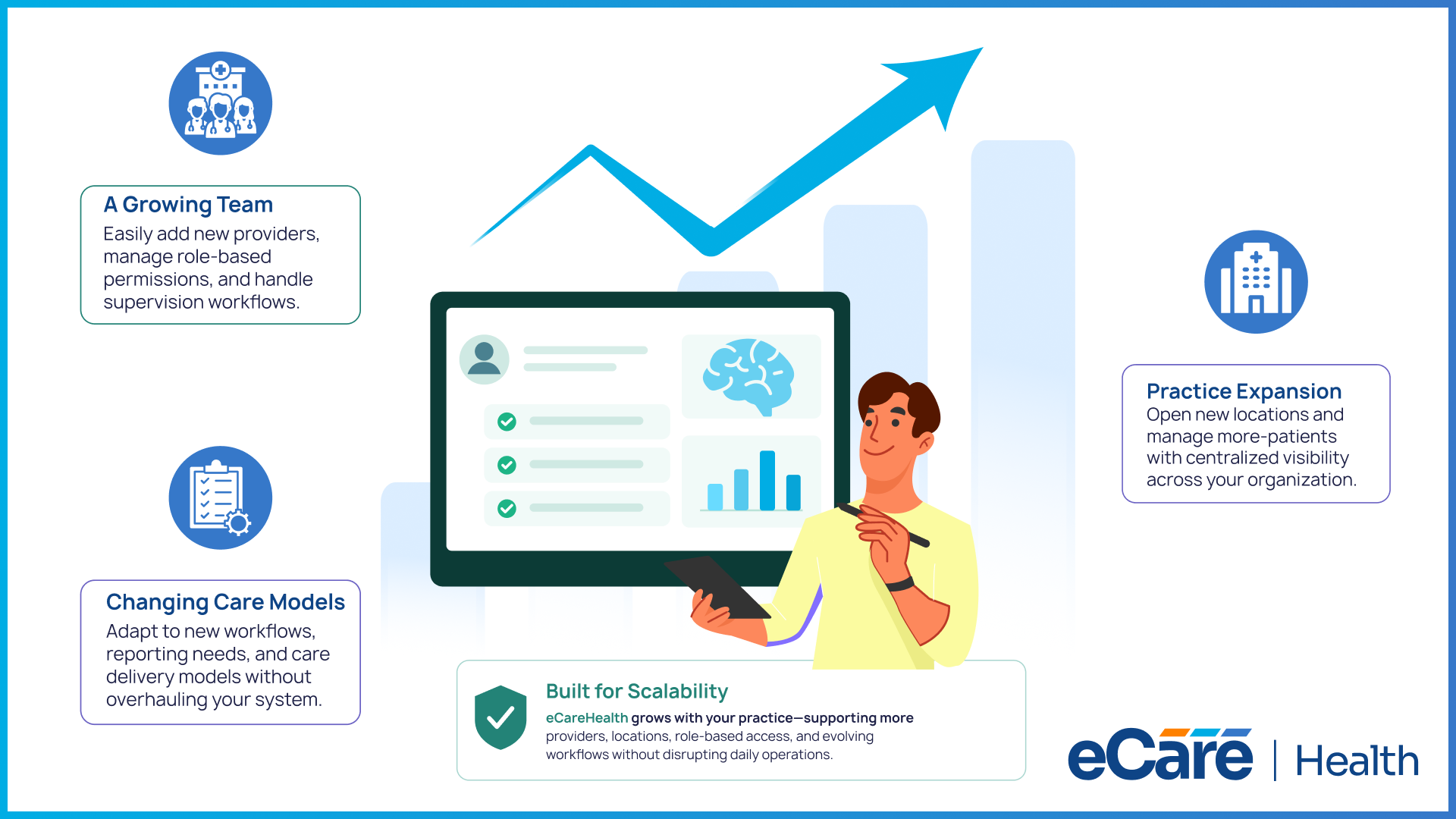
Choosing an EHR is not just about solving today’s challenges; it’s all about preparing for tomorrow’s growth. As your practice expands, the right platform must grow with you rather than becoming a roadblock.
When evaluating behavioral health EHR software, you should consider whether it can support:
- A growing team: Can you easily onboard new providers, assign role-based permissions, and manage supervision workflows without disrupting daily operations?
- Practice expansion: Whether you’re opening another location or handling higher patient volumes, the system should maintain centralized visibility across your organization.
- Changing care models: As behavioral health services evolve, your EHR should adapt to new workflows, reporting requirements, and care delivery models without requiring a complete system overhaul.
If you’re running a group practice, learn how to choose an EHR that can scale with your clinic in our guide, Mental Health EHR for Group Practices: How to Choose Software That Scales with Your Clinic.
Think of it this way: switching EHRs every few years is easier said than done. Investing in a scalable platform today can save your practice significant time, cost, and disruption in the future. The best EHR for behavioral health must support where your practice is today and where you want it to be tomorrow.
Built with scalability in mind, eCareHealth supports growing behavioral health organizations by making it easier to add providers, locations, role-based access, and evolving workflows without disrupting daily operations.
Step 4: Evaluate Implementation & Go-Live Readiness
If implementation is not handled properly, even the most advanced behavioral health EHR software can fall short. Careful planning, clear communication, and realistic expectations from both your team and the vendors are some of the factors on which a successful go-live depends.
Before moving forward, you should always answer the following questions:
- How long will implementation take? Understand the expected timeline, data migration process, workflow configuration, and staff training schedule.
- Who is responsible for what? Clarify which tasks will be handled by the vendor and which require input from your practice to avoid last-minute surprises.
- Is the system ready for real-world use? Confirm that key workflows have been tested, users are comfortable with the new system, and your team is prepared for a smooth transition on day one.
One thing to keep in mind is that a successful implementation is not measured by how quickly the software goes live; it is measured by how confidently your team can use it from day one.
For a step-by-step look at planning your EHR implementation, explore Mental Health EHR Implementation: Step-by-Step Guide for a Smooth Go-Live.
Step 5: Assess the Risks of Switching Mental Health EHR Systems
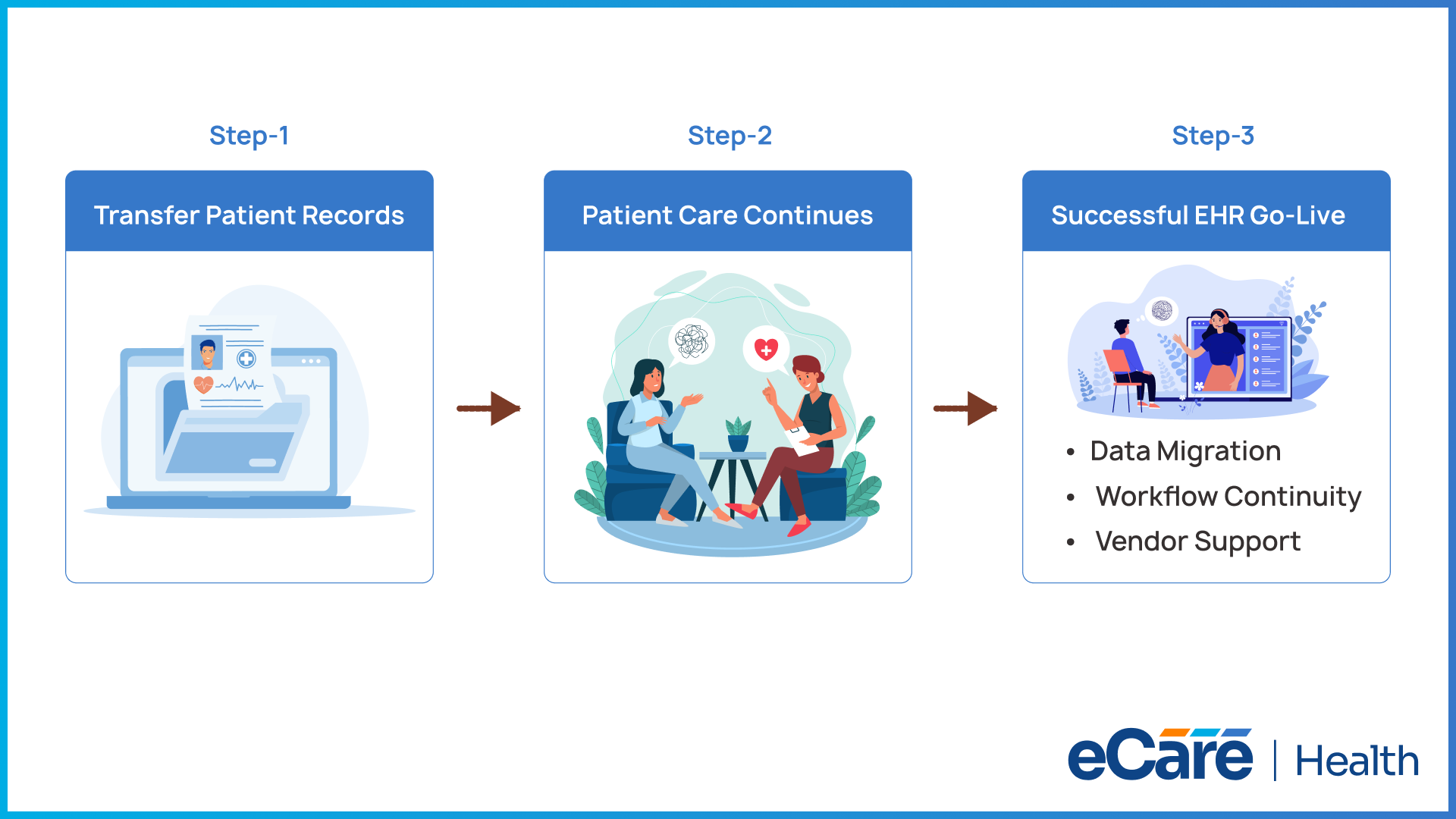
As moving to a new EHR is a major transition, it is important to look beyond the benefits while preparing for the challenges. A well-planned migration can reduce disruption while helping your practice to maintain continuity of care throughout the process.
Here are three key areas you must pay close attention to:
- Data migration: Ensure patient records, clinical notes, treatment plans, and historical information can be transferred accurately without compromising data integrity.
- Workflow continuity: Consider how the transition could affect ongoing appointments, documentation, billing, and reimbursement. The goal is to keep both patient care and revenue cycles running smoothly.
- Migration support: Ask what assistance the vendor provides during the transition, including data validation, staff guidance, troubleshooting, and post-go-live support.
Planning to switch EHRs? Read How to Switch to eCareHealth: A Mental Health EHR Migration Guide Without Losing Revenue for practical guidance on making the transition smoothly.
Changing systems does not have to feel like starting from scratch. The right migration strategy and vendor support help your practice make the switch with minimal disruption.
Step 6: Evaluate Connected Behavioral Health Care Capabilities
An EHR should not operate in isolation. If your system is more connected, it becomes easier for you to deliver coordinated care and reduce unnecessary administrative work. To evaluate different behavioral health EHR systems, you should look beyond internal features while assessing how well the platform connects with the broader healthcare ecosystem.
- Clinical and operational integrations: Does the EHR seamlessly connect with labs, billing systems, pharmacies, and referral partners to keep information flowing across teams?
- Secure information exchange: Make sure the platform supports secure data sharing while protecting sensitive behavioral health information and meeting applicable privacy requirements.
- Connected workflows: A well-integrated system reduces duplicate data entry, minimizes fragmented patient records, and gives providers a more complete view of each patient’s care journey.
Want to see how these connections work in practice? Explore Connected Behavioral Health Care: How eCareHealth Works with Your Labs, Billing, and Referral Partners.
When information flows seamlessly between systems, your team is more likely to spend less time chasing records and more time focusing on patient care.
eCareHealth supports connected behavioral healthcare through secure interoperability with laboratories, billing systems, referral partners, and other healthcare technologies, helping practices improve care coordination while reducing administrative effort.
Step 7: Compare Total Cost of Ownership & Long-Term Platform Value
It is a fact that the lowest-priced solution is not always the best investment. Rather than comparing subscription fees alone, you must consider the total cost of ownership and the long-term value each platform can deliver. An enterprise behavioral health platform features and comparison must account for not only costs, but also operational benefits.
Here are the factors you need to consider for comparing your shortlisted solution:
| Evaluation Area | What to Compare | Why It Matters |
|---|---|---|
| Subscription Costs | Monthly or annual licensing fees | Understand the platform's baseline cost. |
| Implementation & Training | Data migration, onboarding, staff training, and support | Identify upfront costs and prepare for a smoother transition. |
| Operational Efficiency | Automation, reduced manual work, and workflow improvements | Measure how much time and effort the platform can save. |
| System Consolidation | Ability to replace disconnected tools and reduce duplicate work | Lower technology costs and improve productivity. |
| Scalability | Support for additional providers, locations, and growing patient volumes | Ensure the platform can grow with your practice. |
| Long-Term Value | ROI, flexibility, and future-ready capabilities | Evaluate whether the investment will continue to deliver value over time. |
Conclusion
Finding the best EHR for behavioral health isn’t about choosing the platform with the longest feature list. It’s about selecting a solution that fits your clinical workflows, supports compliance, scales with your practice, and delivers long-term value.
Use this guide as your roadmap for how to choose the best electronic health record for mental health and make a confident, informed decision.
Ready to find the right solution for your practice? Contact us to explore eCareHealth’s behavioral health EHR software.
Frequently Asked Questions
1. What is the best EHR for behavioral health practices?
The best EHR is one that aligns with your clinical workflows, documentation needs, billing processes, compliance requirements, and long-term growth plans. Rather than choosing a platform based on features alone, evaluate how well it supports your providers, staff, and patients in everyday practice.
2. How do I choose the best electronic health record for mental health?
Start by identifying your practice requirements, then compare vendors using a structured evaluation checklist. Assess clinical documentation, billing, compliance, AI capabilities, scalability, implementation support, connected care, and total cost of ownership before making a decision.
3. What should be included in a behavioral health EMR evaluation checklist for clinic directors?
A comprehensive checklist should cover clinical documentation, measurement-based care, scheduling, billing, security, compliance, AI capabilities, interoperability, scalability, implementation readiness, and long-term costs. Using consistent evaluation criteria makes vendor comparisons more objective.
4. What features should I compare in behavioral health EHR systems?
Focus on features that directly support your practice, including behavioral health documentation templates, telehealth, patient engagement, appointment scheduling, billing, reporting, AI-assisted documentation, interoperability, and secure data sharing.
5. How important is AI when choosing behavioral health EHR software?
AI can improve efficiency by assisting with documentation, workflow automation, and administrative tasks. However, it should complement clinical decision-making rather than replace it, with providers always maintaining control over patient records.
6. Does a behavioral health EHR need to support 42 CFR Part 2?
Yes. If your practice handles substance use disorder records covered by 42 CFR Part 2, your EHR should support applicable privacy and consent requirements in addition to HIPAA compliance.
7. What should group practices look for in behavioral health practice management software?
Group practices should evaluate multi-provider scheduling, role-based permissions, centralized reporting, supervision workflows, billing management, and the ability to support multiple locations as the organization grows.
8. What should I evaluate before implementing a mental health EHR?
Review implementation timelines, data migration, workflow configuration, staff training, user testing, and vendor support. A well-planned implementation helps reduce disruption and improves user adoption.
9. What are the risks of switching mental health EHR systems?
Potential risks include incomplete data migration, workflow disruptions, staff learning curves, temporary productivity loss, and billing delays. Careful planning and strong vendor support can minimize these challenges.
10. How does an EHR support connected behavioral health care?
A connected EHR integrates with labs, billing systems, referral partners, and other healthcare technologies, enabling secure information sharing, reducing duplicate data entry, and improving care coordination.
11. How should behavioral health practices compare EHR total cost of ownership?
Look beyond subscription fees and consider implementation, training, support, integrations, maintenance, and operational efficiencies. The true value of an EHR comes from its long-term impact on productivity and patient care.
12. How do I compare enterprise behavioral health platform features?
Evaluate each platform using the same criteria, including clinical workflows, AI capabilities, interoperability, compliance, scalability, reporting, implementation support, and long-term value instead of relying solely on product demonstrations.
13. How do I know if a behavioral health EHR can scale with my practice?
A scalable EHR should support additional providers, growing patient volumes, multiple locations, role-based access, evolving workflows, and future organizational needs without requiring a major system replacement.