Connected Behavioral Health Care: How eCareHealth Works with Your Labs, Billing, and Referral Partners
It is a fact that behavioral health providers don’t struggle because they lack data; they actually struggle because their data is scattered.
In fact, clinicians spend almost 28 hours every week on administrative tasks, leaving less time for patient care. And for behavioral health organizations, the challenge becomes even greater when EHRs, labs, billing systems, and referral partners start to operate independently, rather than working together.
Because of this, connected care behavioral health quickly becomes the new standard. With eCareHealth, your organization can bring disconnected workflows into one connected ecosystem through behavioral health EHR integration. Rather than switching between multiple platforms or chasing missing information, you can coordinate care more effectively while reducing administrative burden.
Seamless data exchange is no longer a nice-to-have as EHR interoperability in behavioral health continues to advance. Today, it has become necessary to improve care coordination, streamline operations, and deliver better patient outcomes.
So, what does a truly connected behavioral health ecosystem look like, and how can the right behavioral health EHR software make it possible?
Let’s dive into the blog to explore how eCareHealth can connect labs, billing partners, and referral networks to create a truly integrated behavioral healthcare experience.
What Powers Connected Behavioral Health Care?
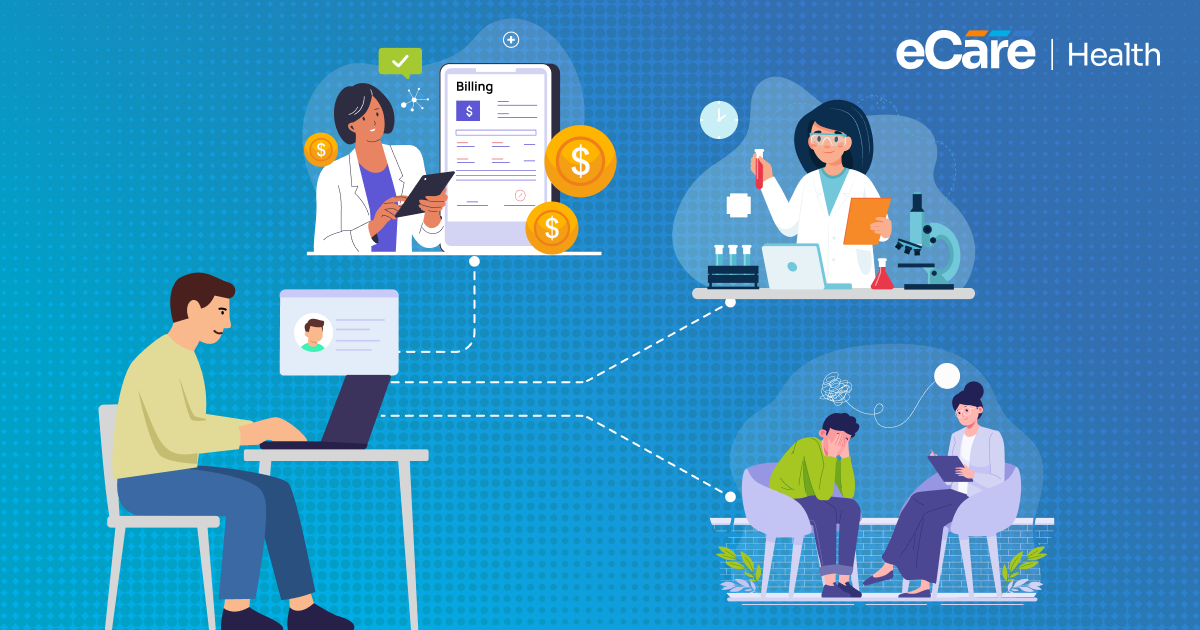
In simple terms, connected care behavioral health means making every part of the care journey work together. Connected platforms allow providers, labs, billing teams, payers, and referral partners to securely share data and stay on the same page, rather than keeping patient information in separate systems. By following this approach, eCareHealth helps to reduce delays, enhance collaboration, and support better patient care.
Behavioral health EHR integration is a key part of this. It further connects behavioral health providers with the external systems they depend on every day by eliminating repetitive data entry and reducing the risk of communication gaps.
Ultimately, clinicians can spend less time managing information and more time focusing on patients. This seamless connectivity is powered by modern interoperability technologies like:
Our guide on How to Choose the Best Mental Health EHR: A Complete 2026 Buyer’s Guide covers these key considerations to help practices evaluate their options with greater confidence.
- HL7 behavioral health for securely exchanging clinical and administrative information between healthcare systems.
- FHIR mental health for enabling faster, real-time data sharing across different applications.
- APIs for connecting EHRs with labs, billing platforms, referral networks, and other healthcare solutions.
- Modern interoperability frameworks keep information accurate, secure, and accessible across connected systems.
Moving forward, as behavioral healthcare becomes more collaborative, EHR interoperability in behavioral health becomes the standard. eCareHealth combines all these technologies into one platform to help your organization deliver more coordinated care and improve operational efficiency.
How Does Behavioral Health EHR Integration Connect Clinical Systems?
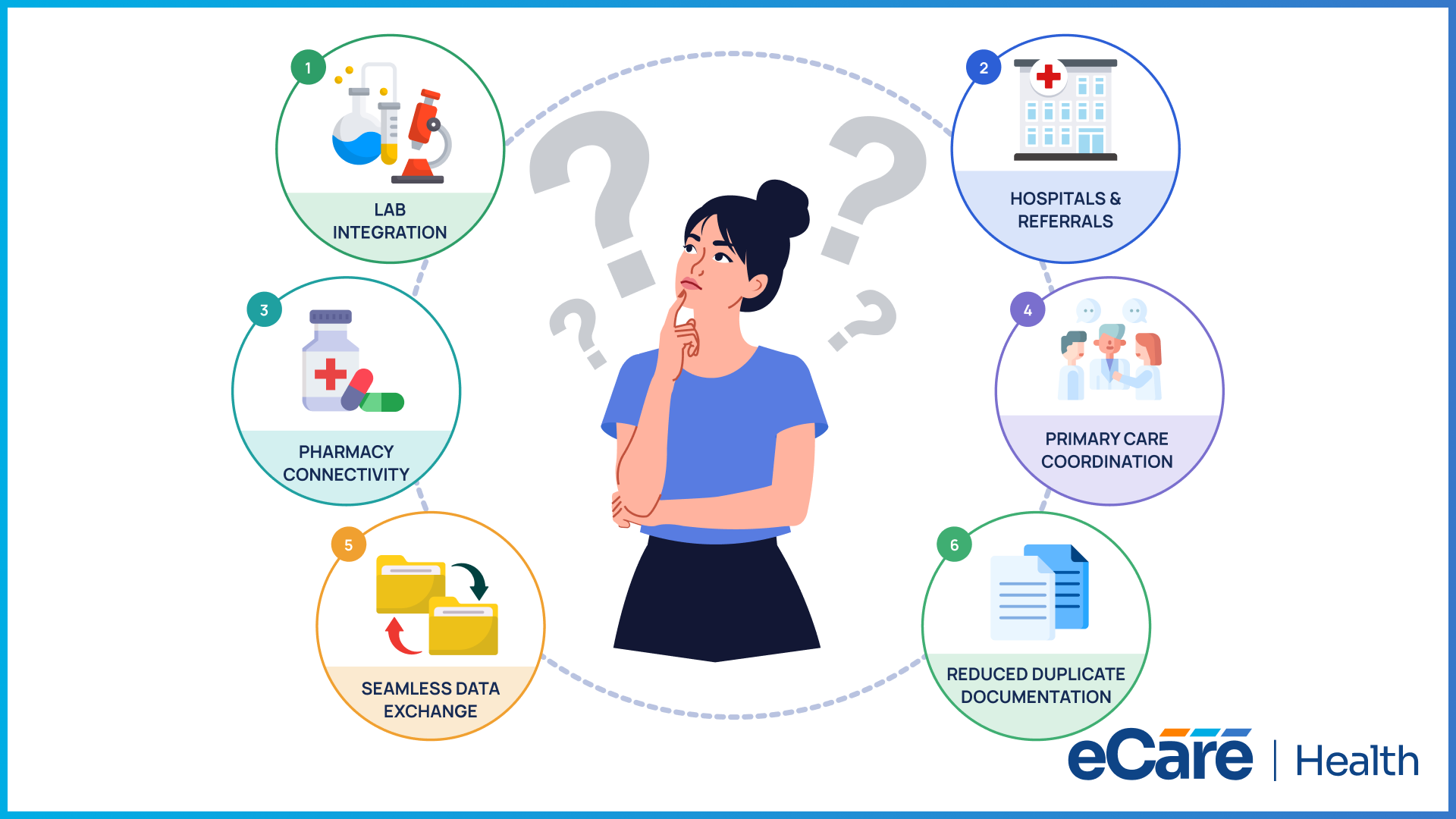
Clinical decisions are only as good as the information available at the right time. Because of this, behavioral health EHR integration emphasizes connecting the systems clinicians use every day. With eCareHealth, you can access critical patient information more effectively, while reducing delays and improving collaboration across the care continuum.
Let’s see how eCareHealth can connect the essential clinical system that can support coordinated behavioral health care:
- Connecting Behavioral Health Software with Medical Labs: Connecting behavioral health software with medical labs helps providers to directly send electronic lab orders and receive results within the EHR. This can further eliminate manual follow-ups and speed up clinical decision-making, while keeping patient records up to date.
- Integrating Pharmacies, Hospitals, & External Care Providers: Behavioral health care often involves multiple organizations. To make it easier to exchange relevant clinical information securely and efficiently, eCareHealth integrates pharmacies, hospitals, and external providers into everyday workflows.
- Supporting Coordinated Care with Primary Care Organizations: Mental and physical health are closely connected. With secure information sharing between behavioral health providers and primary care organizations, everyone can stay on the same page. This can result in better care coordination and more informed treatment decisions.
- Reducing Duplicate Documentation: Patient information flows across connected systems through mental health software integration, rather than being entered multiple times. This can minimize administrative work and enhance record accuracy, while giving clinicians more time to focus on patient care.
How Does Integration Improve Billing & Revenue Cycle Workflows?
Disconnected billing workflows can result in delayed claims, payment errors, and unnecessary administrative work. By integrating clinical and financial systems, eCareHealth helps behavioral health organizations to create a seamless revenue cycle from patient eligibility to payment reconciliation.
A connected billing workflow looks like this:
Verify Insurance Eligibility
Before services are delivered, real-time 270/271 eligibility verification confirms a patient’s coverage, helping practices avoid preventable claim issues.
Submit Claims Electronically
By understanding how to integrate electronic health records with clearinghouse billing, providers can generate and submit 837 claims directly from the EHR. This can further reduce manual effort and improve claim accuracy.
Receive Payments Faster
Electronic 835 remittance advice automatically updates payment information, making reconciliation quicker and minimizing manual posting.
Reduce Denials and Improve Cash Flow
When eligibility, claims, and payments are connected, practices can identify errors earlier, reduce claim denials, and strengthen overall financial performance.
eCareHealth brings every step of the revenue cycle into one connected workflow, which can help behavioral health organizations to spend less time on managing billing and more time on delivering quality patient care.
How Does Connected Care Strengthen Referral Management?
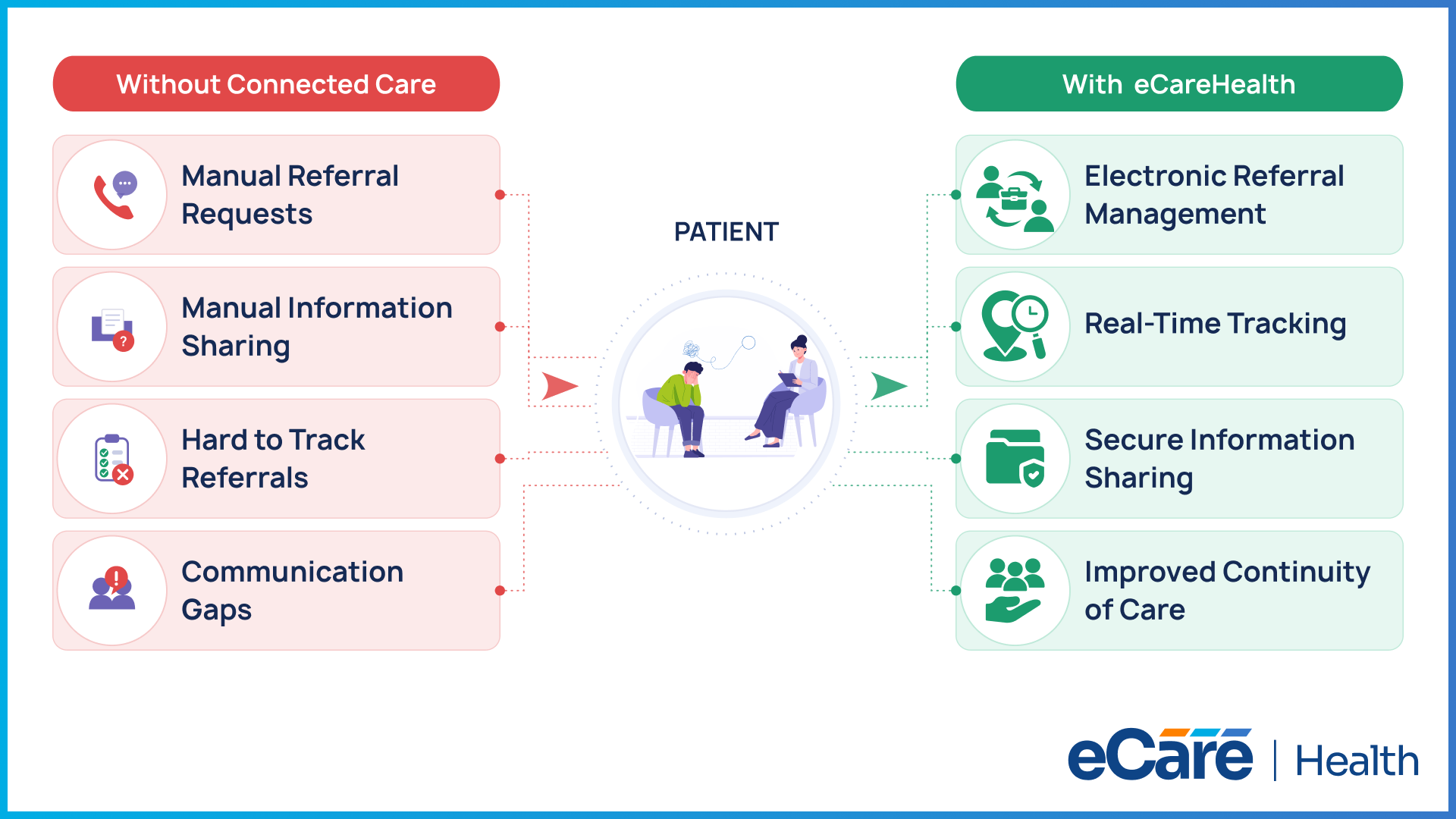
To ensure your patients are receiving the right care at the right time, every referral plays a key role. However, if referrals are managed through disconnected systems, it can result in communication gaps and delays, which can further interrupt the care journey. Here, the difference between traditional and connected referral workflows is clear.
Without Connected Care:
- Referral requests are handled through phone calls, faxes, or emails.
- Patient information has to be requested or shared manually.
- Incoming and outgoing referrals are difficult to track.
- Communication gaps can delay treatment and follow-up care.
With eCareHealth:
- Secure referral management solutions for psychiatric practices allow providers to manage referrals electronically from one platform.
- Incoming and outgoing referrals are tracked in real time, making follow-ups faster and more organized.
- Patient information is shared securely between behavioral health providers, primary care physicians, and other healthcare partners.
- Connected referral workflows improve continuity of care by helping every provider stay informed throughout the patient's treatment journey.
Rather than wondering where a referral stands, care teams can focus more on what matters the most. This further helps patients to receive timely and coordinated care.
How Do You Secure an Interoperable Behavioral Health Ecosystem?
Building a connected behavioral health ecosystem is not just about sharing information; it’s actually about sharing it securely. As organizations expand their integrations, they should evaluate whether their technology can protect sensitive patient data while supporting long-term growth.
| What to Evaluate | Why It Matters |
|---|---|
| Encryption, Authentication & Role-Based Access Controls | Protect sensitive patient information by ensuring only authorized users can access connected systems. |
| HIPAA & 42 CFR Part 2 Compliance | Support secure behavioral health information exchange while meeting federal privacy and consent requirements. |
| Audit Trails & Activity Monitoring | Track who accessed patient records, monitor data movement, and strengthen accountability across integrated systems. |
| Interoperability & Scalability | Ensure the platform can integrate with future technologies, healthcare partners, and growing organizational needs without disrupting workflows. |
With eCareHealth, your organization doesn't have to choose between connectivity and security. By combining robust interoperability with built-in security measures, it helps behavioral health providers confidently exchange information and protect patient privacy.
Conclusion
A connected behavioral healthcare ecosystem does more than streamline technology—it strengthens collaboration, improves operational efficiency, and supports better patient outcomes. By connecting clinical systems, billing, labs, and referral partners, providers can spend less time managing workflows and more time delivering quality care.
With eCareHealth, organizations gain an interoperable platform built for today's needs and tomorrow's growth.
Explore how mental health EHR software from eCareHealth can help create a more connected, efficient, and future-ready behavioral health practice.
Frequently Asked Questions
1. What is connected care in behavioral health?
Connected care in behavioral health is the seamless exchange of patient information between behavioral health providers, primary care physicians, laboratories, pharmacies, billing systems, and referral partners. By connecting these systems, providers can coordinate care more effectively, reduce administrative work, and improve patient outcomes.
2. What is the difference between HL7, FHIR, and X12?
HL7, FHIR, and X12 are healthcare data standards, but they serve different purposes. HL7 enables the exchange of clinical and administrative information between healthcare systems, FHIR supports modern, API-based data sharing for faster interoperability, and X12 is primarily used for electronic billing transactions such as claims submission, remittance advice, and eligibility verification.
3. How does behavioral health EHR integration improve patient care?
Behavioral health EHR integration gives clinicians access to timely and accurate patient information by connecting clinical systems, laboratories, referral partners, and other healthcare providers. This improves care coordination, reduces duplicate documentation, and supports more informed treatment decisions.
4. How do behavioral health EHRs connect with medical laboratories?
Behavioral health EHRs connect with medical laboratories through interoperability standards such as HL7 and FHIR. This allows providers to send electronic lab orders, receive test results directly within the EHR, and reduce delays caused by manual processes.
5. How does clearinghouse billing integration improve revenue cycle management?
Integrating an EHR with a clearinghouse streamlines revenue cycle workflows by automating eligibility verification, electronic claims submission, payment reconciliation, and denial management. This helps improve billing accuracy, accelerate reimbursements, and reduce administrative effort.
6. How can behavioral health providers securely exchange referral information?
Behavioral health providers can securely exchange referral information through interoperable EHR platforms that support encrypted data transmission, role-based access controls, and regulatory requirements such as HIPAA and 42 CFR Part 2. This enables faster referrals while protecting patient privacy.
7. What security standards should connected behavioral health platforms support?
Connected behavioral health platforms should support encryption, multi-factor authentication, role-based access controls, audit trails, HIPAA compliance, and 42 CFR Part 2 requirements. These safeguards help protect sensitive behavioral health information and maintain secure data exchange.
8. How do APIs improve mental health software integration?
APIs enable different healthcare applications to communicate and exchange data securely. They simplify integration with laboratories, billing systems, referral networks, and other healthcare solutions, reducing manual data entry and improving workflow efficiency.
9. What should organizations evaluate before choosing an interoperable behavioral health platform?
Organizations should evaluate interoperability standards, security capabilities, regulatory compliance, scalability, integration options, and vendor support. Choosing a platform that can connect with existing and future healthcare systems helps ensure long-term operational efficiency and coordinated patient care.