Measurement-Based Care in Mental Health: Tracking Patient Outcomes with EHRs
Imagine your patient, who is being treated for depression, walks into a therapy session looking better than the last few weeks.
You notice that he seems more engaged, speaks with more confidence, and reports fewer difficult days. You start to assume that treatment is working well, but one question is still being overlooked: How much has he actually improved?
In behavioral healthcare, this question is becoming more important, as more than 23.4% of U.S. adults experienced mental illness in 2024. If you just depend on clinical impressions, it becomes difficult for you to see small but meaningful changes over time.
This is where measurement-based care mental health practices are changing the way clinicians evaluate progress. Rather than relying only on conversations and clinical judgment, measurement-based care (MBC) uses standardized assessments at regular intervals for capturing symptoms, monitoring changes, and supporting treatment decisions. A patient’s score can highlight what may not be obvious during a single session.
For example, if the same clinician reviews a patient’s PHQ-9 scores across several visits. A steady decline in the score shows a clearer picture of progress. On the other hand, if the score stays the same or increases, it may signal that the treatment plan calls for a further review. The numbers not only replace clinical judgment; they actually give it more context.
However, collecting these measures is only half of the story. Clinicians also require more practical ways for recording, reviewing, and tracking the information without adding another administrative work layer. And this is where modern mental health EHR software can bring assessments, patient records, progress notes, and outcome data into a connected workflow.
Let’s dive into the blog to explore how MBC mental health practices can turn patient data into meaningful insights and how technology can help clinicians connect the dots between measurement and better-informed care.
What Is Measurement-Based Care in Mental Health?
As we discussed earlier, you can see that your patient is doing better. But how much better? And is the improvement consistent from one visit to the next?
This is where MBC mental health care moves the needle.
Simply put, measurement-based care (MBC) means using standardized assessments regularly across your patient’s treatment. The clinician can begin with a baseline, check progress between follow-up visits, and continue measuring outcomes through discharge. This can give your care team a more consistent way to see how symptoms can change over time.
At the same time, clinical conversations and observations still matter the most. Even though your patient may seem positive during a session or say they are feeling better, those signs are not enough to show the full picture. Standardized scores allow you to add another layer of information while making changes easier to spot.
Here, the process is simple: collect the data, review the results, and adjust treatment whenever required. The clinician has measurable evidence of progress if a patient’s scores improve. Meanwhile, if they remain unchanged or worsen, the result deserves a closer look.
It’s fair enough to say that MBC does not replace judgment; rather, it gives clinicians another smart tool to support it.
What Mental Health Outcomes Can Be Measured?
After a clinician starts to look beyond a general “better” or “worse,” there are numerous ways to understand how your patient is actually doing. Patient outcome measures that mental health providers use can capture everything from specific symptoms to how those symptoms affect everyday life.
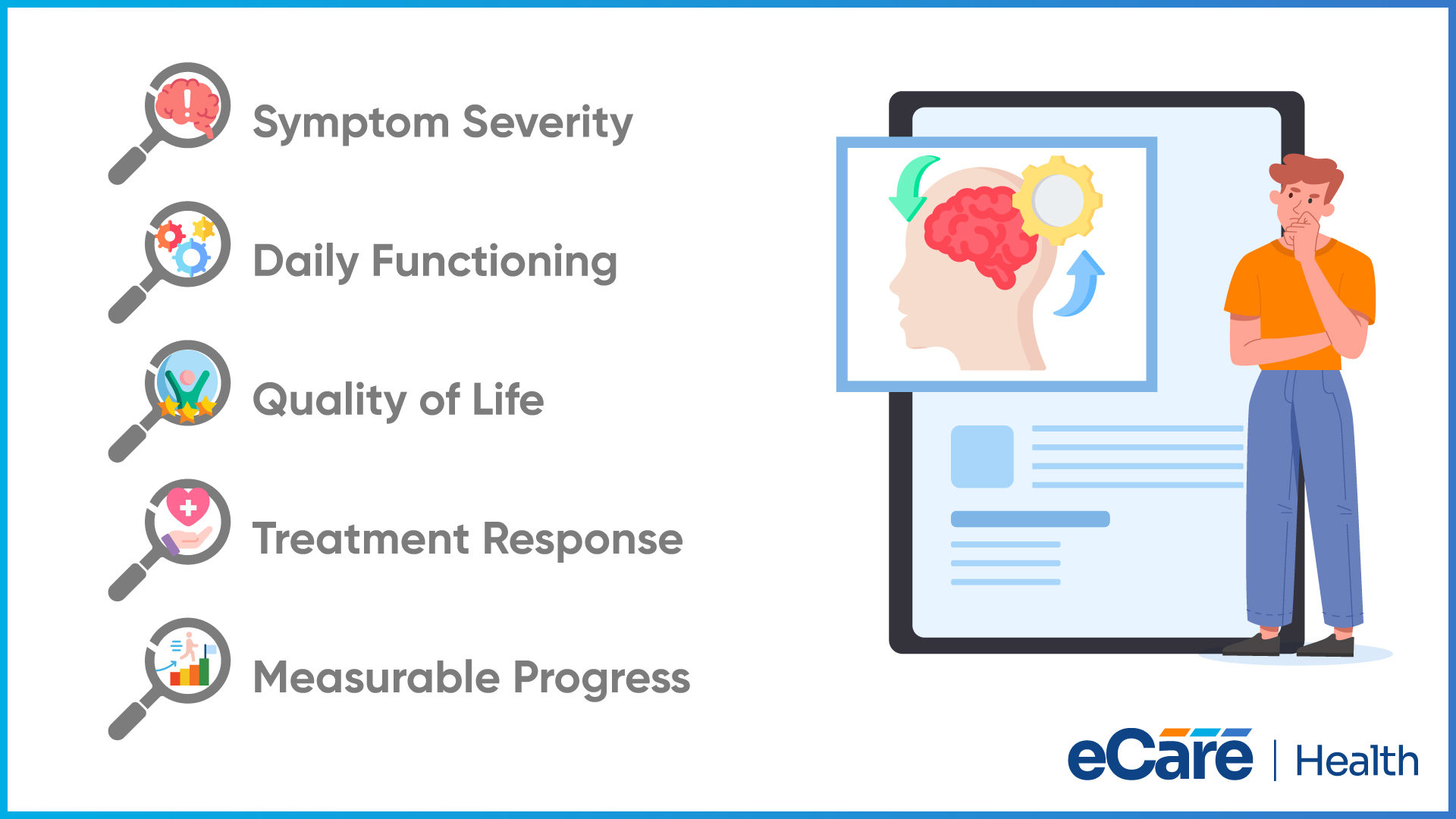
Symptom severity is one of the most common areas. Different standardized measures focus on different conditions. The PHQ-9 is usually used for assessing depression symptoms, and GAD-7 measures anxiety. On the other hand, for patients with PTSD, the PCL-5 can help to assess symptom severity, and the Brief Addiction Monitor (BAM) can be used for monitoring substance use and related areas.
Despite this, symptoms are only one part of the equation. Functional and quality-of-life outcomes can highlight whether the treatment is making everyday life easier. Measures might look at areas including the patient’s ability to function, social engagement, relationships, and overall satisfaction with care.
All these outcomes can further help to show treatment response. During a course of care, your patient may experience clear improvement, remain stable, show only a partial response, or see little change. By looking at these patterns, clinicians can get a more complete view of the patient’s progress.
Finally, together, these measurement-based care tools can turn a broad idea of “the patient is doing better” into more specific and measurable outcomes.
How to Track Mental Health Outcomes in an EHR
Now imagine, a few weeks later, the patient returns for another appointment. His latest PHQ-9 score is already in the EHR, showing a drop from 18 to 11. This is where mental health outcome tracking becomes a key part of the everyday EHR workflow.
The process can actually start before the appointment. Your practice can send screeners via the patient portal, which further allows patients to complete them at home. In the case of in-person visits, assessment can also be completed on a tablet.
After submission, the results can flow directly into your patient’s record, while reducing the requirement for manual data entry. From there, the EHR can turn individual scores into a longer-term view.
Instead of searching through previous notes to remember the earlier score, the clinician can see the change directly in the patient’s chart. The progression from 18 to 11 is now part of the patient’s clinical record. A stable improvement, a plateau, or a sudden increase in symptoms becomes easier to spot.
In between visits, these trends can appear alongside the patient’s encounter documentation. For example, with PHQ-9 EHR integration, it becomes easy for clinicians to review depression scores and document the current session. Furthermore, this keeps the patient’s recent progress in view rather than switching between different systems.
Then, the results can support treatment planning. A concerning change can prompt a closer clinical review, while continued improvement can help guide conversations about the next step in care.
The core goal is not to make the EHR another place to store numbers. It’s actually to make those numbers useful at the right moment, when the clinician and patient are deciding what comes next.
Benefits of Measurement-Based Care
For the patient in this example, the change from 18 to 11 gives the clinician a reason to look more closely at what is working and what still needs attention. The measurement does not provide the answer by itself, but it helps start a more informed conversation about the next step.
The information collected at each visit starts to become more useful, as the patient continues treatment. Rather than looking at only one score in isolation, clinicians can see patterns, identify changes, and use them to have more meaningful conversations about care. This is where the practical benefits of measurement-based care become clear.
| Benefit | How It Helps |
|---|---|
| Early Identification | Regular measurements can help clinicians recognize worsening symptoms or limited treatment response earlier. This gives them an opportunity to review the patient’s progress and consider changes to the care plan. |
| Patient Engagement | Sharing progress over time can help patients see whether their symptoms are improving. A clearer view of their progress can encourage them to stay involved in treatment and follow through with their care plan. |
| Quality & Payer Reporting | Consistent outcome data can support quality initiatives, value-based care, and applicable reporting requirements. It also gives practices documented information about patient progress that can support these efforts. |
| Cross-Provider Alignment | Shared outcome information can help therapists, psychiatrists, and other care team members understand the same picture of patient progress. This makes it easier to coordinate care when multiple providers are involved. |
For the patient in our example, all these benefits can add up to a more informed care journey. His clinician can see when progress is happening, recognize when something requires attention, and discuss the next steps with greater clarity.
Measurement-based care EHR integration allows this information to remain connected to the patient’s record, while becoming part of the broader care process, and not another task sitting outside it.
Challenges to Consider & How to Overcome Them
For the patient in our example, completing a short assessment may seem simple. But when a practice is doing this for dozens or hundreds of patients, collecting every measure, entering the results, and reviewing unnecessary alerts can quickly add up.
| Challenge | How to Overcome It |
|---|---|
| Administrative Burden & Alert Fatigue | Digital screening can reduce manual data entry by capturing results directly in the patient record. At the same time, practices should limit notifications to clinically meaningful changes so providers are not overwhelmed by unnecessary alerts. |
| Patient & Clinician Engagement | Keep assessments concise, relevant, and easy to complete. When results clearly support clinical decisions, both patients and clinicians are more likely to see their value. |
| Selecting Population-Specific Tools | Standardized tools provide consistency, but one measure may not fit every patient or condition. Practices should select assessments that match the population, symptoms, and clinical goals being addressed. |
| Avoiding Score Isolation | A score is one piece of the clinical picture, not the whole picture. Clinicians should consider assessment results alongside patient conversations, history, observations, and other relevant clinical information. |
For the patient we have been following, the numbers are more helpful as they add context to what he shared during each visit. However, they never tell the full story on their own. When technology keeps the process simple and clinicians use the results alongside their professional judgment, measurement becomes a useful part of care rather than another box to check.
How eCareHealth Supports Outcome Tracking
By this point, the patient’s record tells a clearer story. The PHQ-9 score has moved from 18 at the start of treatment to 11 during follow-up, and the clinician can review that change alongside encounter history and clinical documentation.
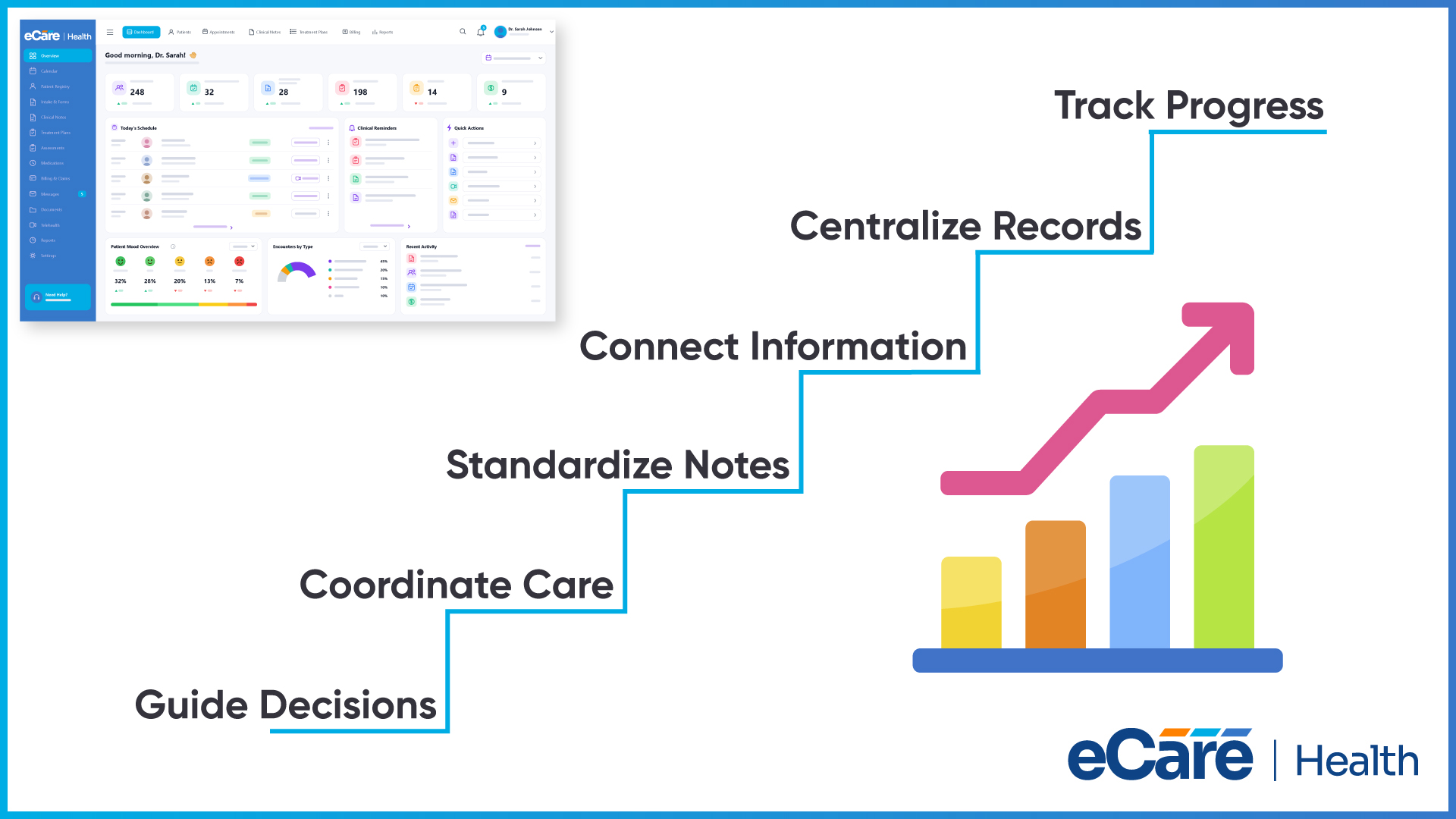
eCareHealth brings these elements together through a centralized behavioral health EHR. Providers can maintain clinical documentation and patient records in one place, making it easier to review relevant information alongside the patient’s encounter history. Instead of searching through separate systems to understand what happened before, clinicians can have the information they need within the same workflow.
This centralized approach can also make outcome monitoring more organized. Structured documentation gives providers a consistent way to record and review patient information, while the broader patient record provides the context behind those findings. This can help reduce unnecessary back-and-forth and make it easier to follow a patient’s progress over time.
For practices using a Psychiatric EHR, having clinical information connected in one system can be especially useful when multiple encounters and providers contribute to a patient’s care. The goal is simple: keep the information organized so clinicians can spend less time looking for the right details and more time using them to support patient care.
At a later assessment, the score reaches 7, giving the care team another measurable point in the patient’s treatment journey. His clinical information stays connected, giving the care team a clearer foundation for understanding his progress and planning what comes next.
Conclusion
The patient we followed started with a simple challenge: feeling better is important, but knowing how much she has improved is even more useful. By using standardized assessments alongside clinical conversations, his care team can see changes more clearly and make treatment decisions with better information. That is the value of measurement-based care in mental health.
For behavioral health practices, the process becomes much easier when outcome measures, clinical notes, and patient records are connected within the same workflow. Instead of adding another task to an already busy day, an EHR can help providers collect, review, and follow patient progress as part of routine care.
A well-connected psychiatric EHR can bring that information together, giving providers a clearer view of each patient’s journey. In the end, MBC is not about following numbers blindly. It is about using meaningful information to understand progress, support better conversations, and keep patient care moving in the right direction.
Frequently Asked Questions (FAQs)
1. What is measurement-based care in mental health?
Measurement-based care in mental health uses standardized assessments at regular points during treatment to measure symptoms and patient progress. Clinicians review these results alongside clinical observations and patient feedback to understand whether treatment is working and determine when adjustments may be appropriate.
2. Why is measurement-based care important in behavioral health?
Measurement-based care gives behavioral health providers consistent information about patient progress instead of relying only on subjective observations. Regular assessments can reveal improvement, stalled progress, or worsening symptoms earlier, helping clinicians make more informed treatment decisions while giving patients a clearer understanding of their care journey.
3. What mental health outcomes can be measured?
Patient outcome measures mental health providers use can assess depression, anxiety, PTSD, substance use, functioning, quality of life, and overall satisfaction. Common tools include the PHQ-9 for depression, GAD-7 for anxiety, PCL-5 for PTSD, and BAM for monitoring substance use and related concerns.
4. What is PHQ-9 EHR integration?
PHQ-9 EHR integration connects the depression screening questionnaire with a patient’s electronic health record. Completed assessments can be captured within the patient record, allowing clinicians to review scores alongside clinical documentation and track changes over time without relying on separate forms or manual data entry.
5. How does an EHR support measurement-based care?
An EHR can support measurement-based care by collecting standardized assessments, storing results in the patient record, and making progress easier to review across visits. Integrated workflows can also help clinicians view relevant scores alongside encounter documentation, creating a more organized approach to monitoring patient outcomes.
6. What are the primary benefits of measurement-based care?
The primary benefits include earlier identification of worsening symptoms, better visibility into treatment response, stronger patient engagement, and improved communication across care teams. Consistent outcome data can also support quality initiatives and applicable reporting requirements while giving clinicians additional information to guide treatment discussions.
7. How often should mental health outcomes be measured?
The frequency depends on the patient, condition, treatment setting, and assessment being used. Outcomes are often measured at baseline and repeated during follow-up visits to monitor changes. Clinicians should determine an appropriate schedule based on clinical needs rather than applying the same frequency to every patient.
8. What are common challenges when implementing measurement-based care?
Common challenges include adding administrative work, low patient or clinician engagement, choosing inappropriate assessment tools, and relying too heavily on scores. Practices can address these issues by using concise assessments, streamlining digital collection, selecting population-appropriate tools, and treating measurements as a complement to—not a replacement for—clinical judgment.