AI in Behavioral Health EHR: How Artificial Intelligence Is Transforming Mental Health Documentation
In behavioral health, AI is no longer just a future possibility.
In fact, 56% of psychologists stated that they used AI tools to assist with their work in the past year, while 29% said they use AI at least monthly.
Well, it doesn’t stop there. AI is now becoming a fundamental aspect of the tools clinicians already use, including mental health EHR software. It can assist in creating documentation, handling repetitive work, and making information easier to review.
An AI behavioral health EHR brings all these capabilities into one of the most important parts of your daily routine. It has the ability to change the overall way notes are written. Rather than spending the same amount of time on repetitive tasks, it allows you to take something off your hands while focusing more on your patients.
Meanwhile, AI-generated information cannot simply be accepted without review. Mental health documentation frequently relies on context, nuance, and clinical understanding, which needs human judgment. And this is where real conversation starts.
The value of AI is just meant to do more work faster. It’s also about understanding where it can genuinely make a difference and where clinicians need to stay firmly in control.
So, what does this shift actually mean for your behavioral health practice?
Let’s explore how AI is used in behavioral health EHR systems, including documentation assistance, workflow automation, data analysis, and clinical support. We’ll also look at the benefits of AI in behavioral health EHR, the risks and limitations that come with it, and the key things providers should consider before adopting AI-enabled technology.
What Is an AI Behavioral Health EHR?
Simply put, an AI behavioral health EHR is a behavioral health electronic health record system that uses AI to make everyday tasks easier. It still performs the core functions of a traditional EHR, including storing your patient records, managing documentation, tracking treatment information, and supporting daily practice operations.
The key difference here is that AI adds another layer of assistance. For example, rather than depending on manual work, the system helps to create documentation, handle repetitive tasks, review large amounts of information, or highlight useful information. It’s fair enough to say that AI works alongside the EHR, instead of replacing it.
And this is where AI mental health software starts to change the day-to-day experience. AI can help with documentation, automating parts of the workflow, analyzing available data, and providing support when you need it to review patient information.
Furthermore, it also becomes easier to understand where it is already being used within behavioral health EHRs and how all these capabilities start to shape mental health documentation and everyday workflow.
How AI Is Used in Behavioral Health EHRs
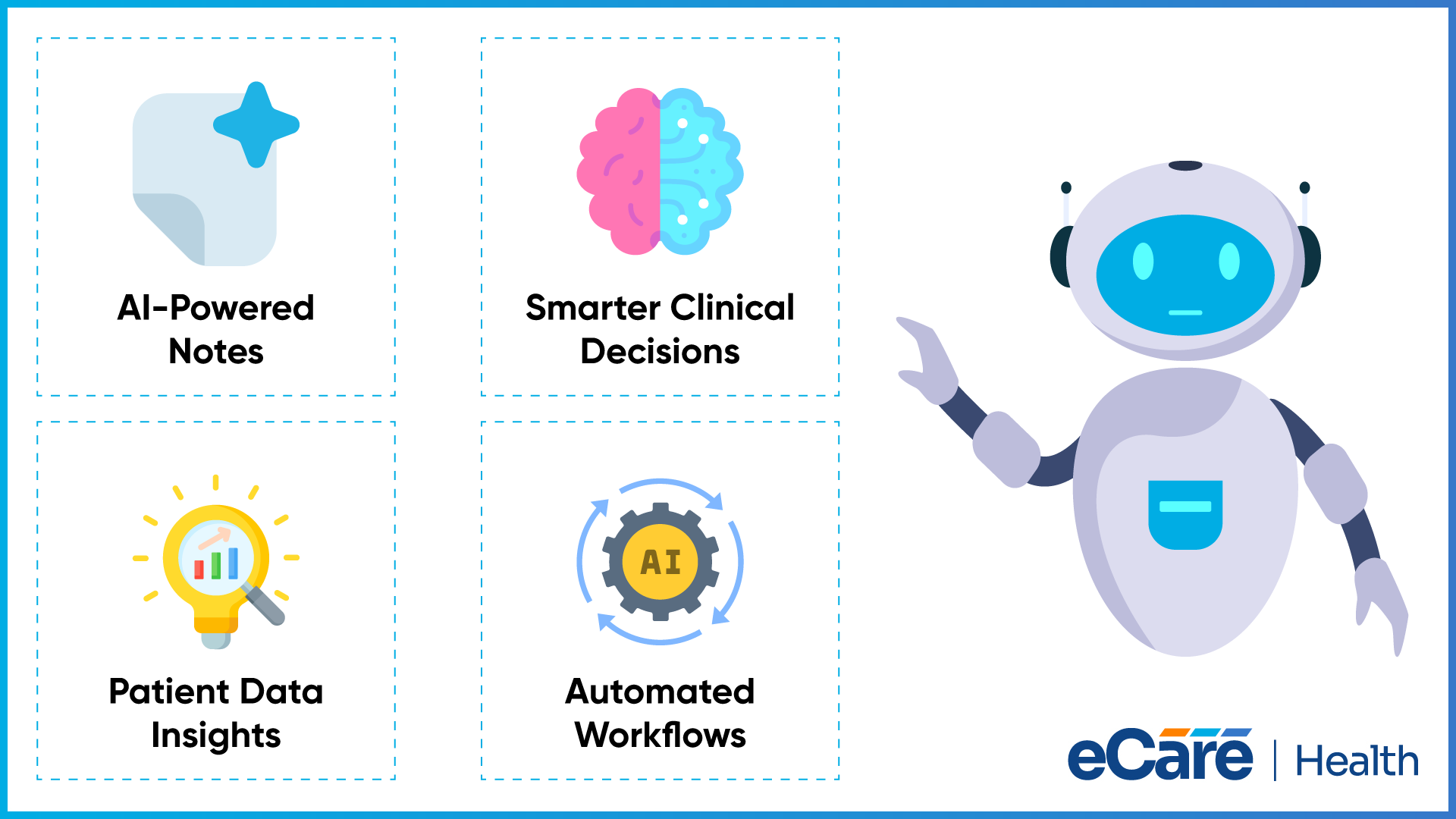
As we discussed what an AI-enabled EHR can do, now let’s have a look at where AI actually fits into everyday behavioral health workflows. AI has the ability to support several parts of the process, from documentation to patient insights, without replacing the clinician behind it.
AI-Assisted Clinical Documentation
Documentation is one of the first areas where AI can make a significant difference. With AI, it becomes easy for clinicians to capture conversations, organize information, and create structured clinical notes. This further helps to reduce some of the time spent on manual documentation.
This can be seen in AI scribes and automated note-generation. These tools help to turn information from a patient encounter into a draft note that you can review, edit, and also finalize. Even though the final responsibility remains with the clinician, AI can assist in making the process less time-consuming.
Clinical Decision and Workflow Support
Behavioral health holds a large amount of information collected over time. AI helps to organize this information and bring relevant details to your attention whenever needed.
For example, it helps to identify patterns in patient records, summarize relevant information, or make it easier to review past documentation. However, all these insights are meant to support clinical decision-making and not to replace it. AI can provide information, but you still need to apply your experience, judgment, and understanding of your patient’s individual situation.
Patient Data and Outcome Insights
Furthermore, AI can also help to make better use of the data already stored in an EHR. Analyzing patient information over time helps in the identification of trends, changes, or patterns that are not always easy to spot manually.
This also further supports measurement-based care, where providers track patient outcomes regularly and use that information to guide treatment. When EHR data is easier to analyze and review, it becomes easier for clinicians to get a clearer picture of how your patient is progressing and whether changes may require attention.
Administrative Workflow Automation
In a behavioral health practice, not each task needs clinical expertise. There are a number of repetitive activities that can take up valuable time throughout the day. AI can help to automate parts of these workflows, reduce manual effort, and help your team stay on top of routine work.
Within a behavioral health EHR, this can also involve assisting with documentation-related tasks, organizing information, managing follow-ups, or helping staff handle routine administrative processes. If you automate some of this work, it helps your team save time and keep everyday operations moving without getting caught up in the same repetitive tasks.
Benefits of AI in Behavioral Health EHR
In behavioral health EHR, the value of AI is not limited to simply making documentation faster. Clinicians and their teams are more likely to spend more time on the work that needs their attention when routine work is reduced, and information becomes easier to manage.
Let’s have a quick look at some of the key benefits of AI in behavioral health EHR systems:
Reduced Documentation Burden
It is a fact that documentation can take up a significant portion of a clinician’s day. For example, when every note requires repetitive typing, reviewing, and organizing. By helping to create notes, summarize information, and organize clinical details, AI can take some of the load off.
However, it doesn’t mean that clinicians have to give up control of their documentation. Rather, they can start with an AI-generated draft, review it, make any necessary changes, and move on. Over time, these saved minutes start to add up, allowing clinicians to focus more on patient conversations and care.
Improved Workflow Efficiency
Moving forward, AI can also help your practice cut down on repetitive tasks across your daily workflows. Tasks that once required staff to manually sort information, enter details, or keep track of routine processes can be automated.
Ultimately, your practice starts to experience a seamless workflow with fewer small tasks getting in the way. When your teams are not constantly struggling with repetitive tasks, they are more likely to spend their time on tasks that need human interaction.
Better Use of Patient Data
As we discussed earlier, behavioral health EHRs can hold years of patient information; however, having the data is half of the story. Finding useful patterns within it can be more difficult when providers have to go through large amounts of information manually.
With AI, it becomes easier to make that information available for interpretation by identifying trends, changes, and patterns across patient records. This can give a bigger picture of your patient’s progress, while helping to focus attention where it may be required the most.
More Consistent Information Management
Behavioral health information comes from many sources involving clinical notes, assessments, treatment plans, and outcome measures. However, keeping all of this information organized can become challenging as a practice grows.
AI-supported workflows help structure and process information more consistently, which makes records easier to manage and review.
Risks and Challenges of Using AI in Behavioral Health
Even though the benefits of AI are promising, behavioral health demands a certain level of care that makes careful use essential. As patient records contain deeply personal information, even a small gap in documentation or interpretation can snowball into major issues.
That’s why before bringing AI into these workflows, you must understand where the risks can arise and how to manage them.
| Risk | What It Means for Behavioral Health |
|---|---|
| Privacy and Data Security | Behavioral health records contain highly sensitive information. Providers need to understand how AI tools collect, process, store, and share patient data. |
| Accuracy and AI Errors | AI can miss details or generate incorrect information. Every AI-generated note or insight should be reviewed by a clinician before it becomes part of the patient record or influences care. |
| Bias and Fairness | AI can reflect biases found in the data used to train it. Providers should monitor outputs and make sure technology does not lead to unfair or one-sided conclusions. |
| Lack of Transparency | Providers should have a basic understanding of how an AI tool reaches its outputs so they can question, review, or reject information that does not seem right. |
| Human Oversight | AI should assist with documentation, organization, and insights—not independently diagnose patients or determine treatment. Clinical decisions should remain with qualified professionals. |
These risks do not mean that AI has no place in behavioral health. They actually show why it is necessary to choose the right technology and use it responsibly. You must know what AI is doing, what information it uses, and when a human needs to step in.
How AI Supports Collaborative Documentation in Mental Health
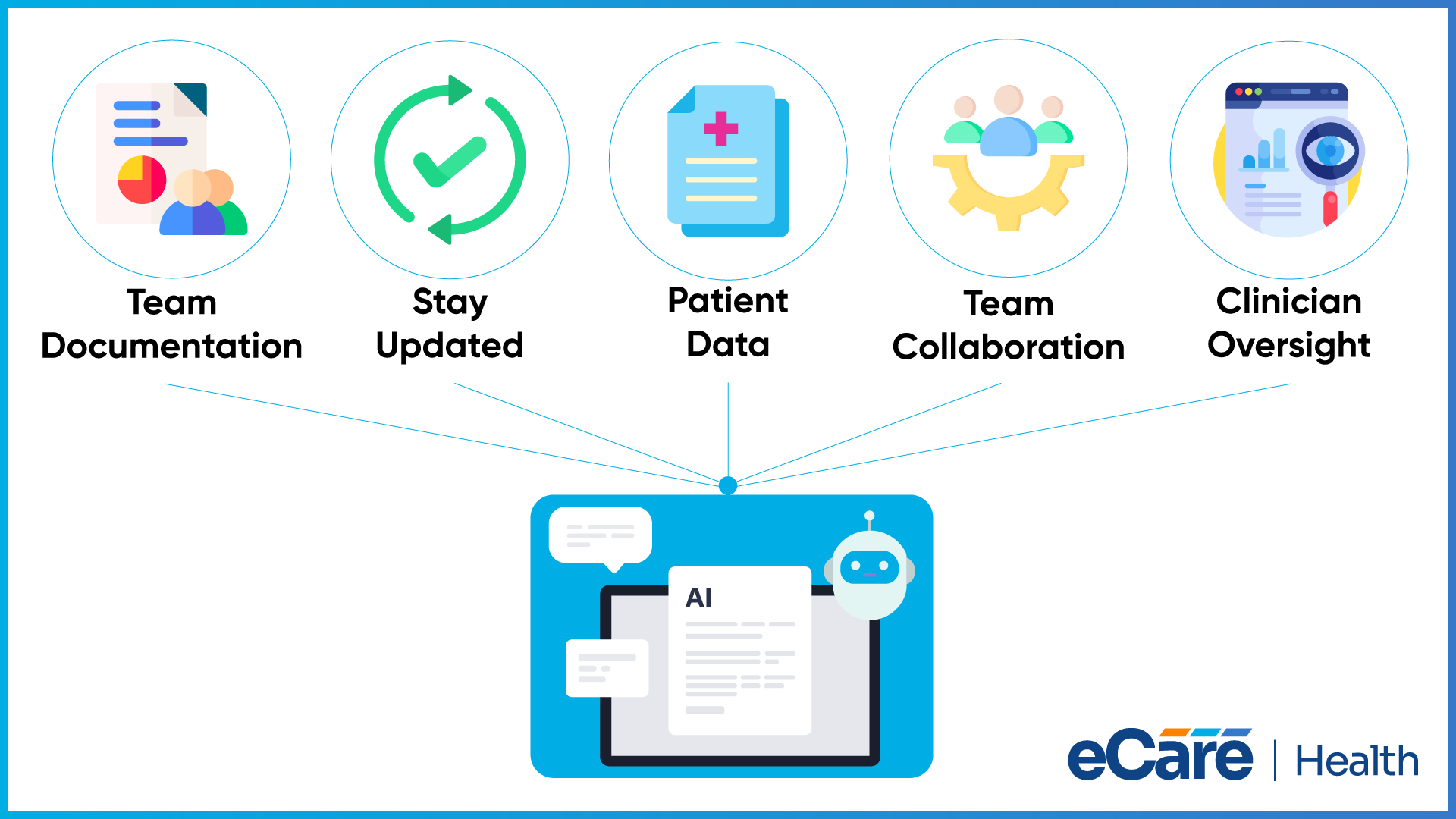
As mental health care involves more than one provider, keeping everyone updated can be challenging. For example, a therapist may add progress notes, a psychiatrist may update the treatment plan, and another team member may record an important patient update.
By organizing notes, summarizing recent updates, and surfacing relevant information when a clinician reviews the patient’s record, AI can help to bring all these pieces together. This can also make it easier to understand what has changed without going through each note from scratch.
Furthermore, AI can also help to organize and route documentation or progress updates by reducing some of the back-and-forth involved in keeping team members informed. Collaboration can become seamless and more consistent when everyone has access to the right information at the right time.
Even so, AI must remain in the background. Clinicians and authorized team members should review AI-generated summaries and documentation before depending on them. This helps to catch missing details or errors, while keeping accountability with the people responsible for patient care.
What to Consider Before Adopting AI in a Behavioral Health EHR
AI may sound promising on paper, but choosing an AI-enabled EHR is not about picking the system with the most features. The bigger question is whether it actually fits the way your practice works.
Start with the problem you want to solve. If documentation is taking too much time, for example, look for AI that can genuinely reduce that workload instead of adding another tool for staff to manage. The same goes for workflow automation and data analysis; the technology should make everyday work easier, not create another hurdle.
Accuracy should be another priority. Providers need to know how AI-generated notes, summaries, or insights are reviewed and corrected before they become part of the clinical workflow. Privacy matters just as much. Before adopting the technology, understand how patient information is handled, stored, and protected.
Integration is also worth a close look. AI works best when it fits into the EHR your team already uses rather than forcing clinicians to jump between disconnected systems. And even a powerful tool will fall flat if no one knows how to use it. Make sure clinicians and staff receive enough training to understand the technology and use it confidently.
In short, the right AI solution should fit the workflow, protect patient information, support clinicians, and make everyday work simpler, not more complicated.
How eCareHealth Supports Behavioral Health EHR Workflows
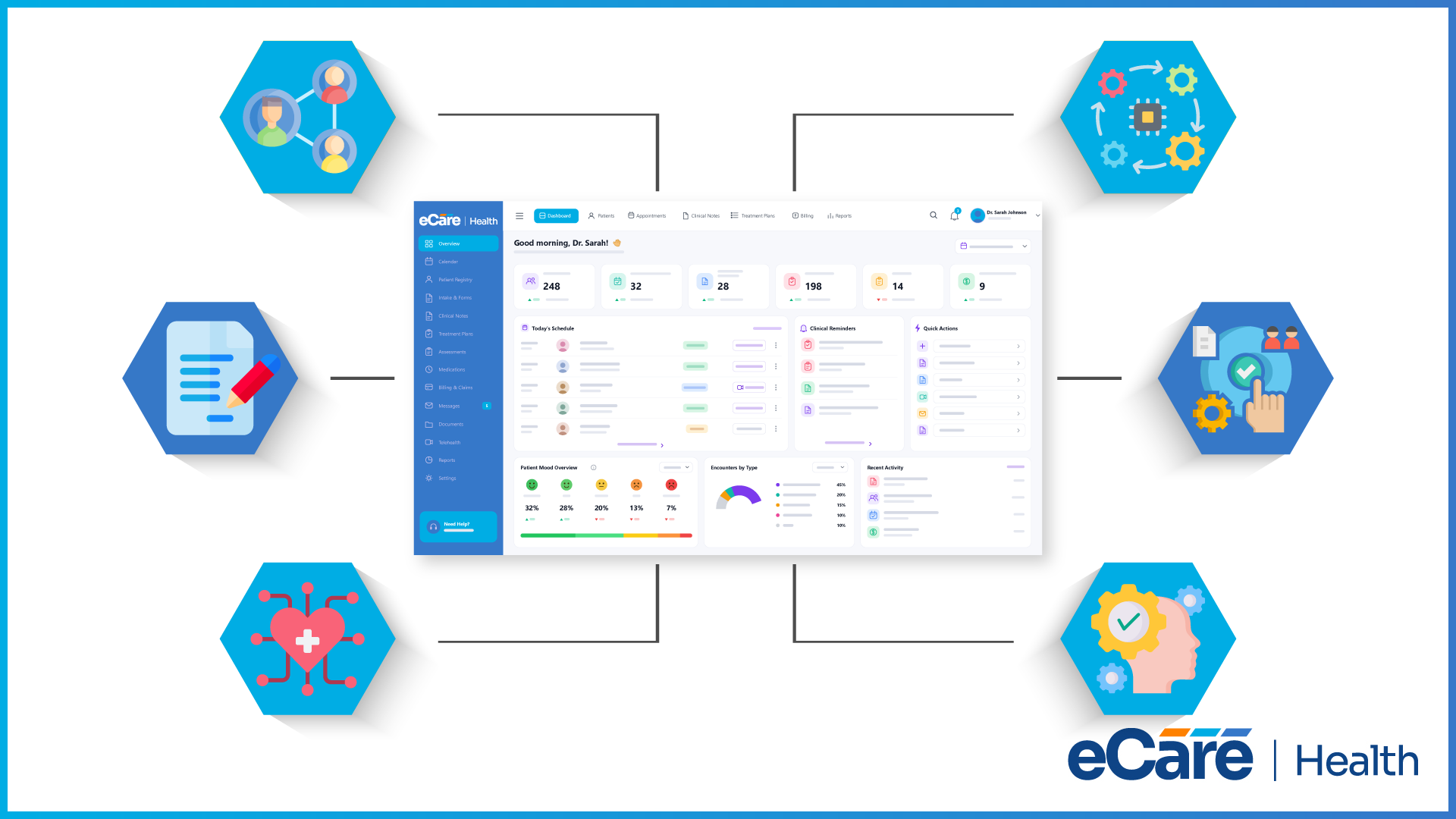
The right EHR must make behavioral health workflows easier to manage and not add another layer of work. eCareHealth is specifically designed to bring clinical documentation, scheduling, patient records, communication, billing, and other practice workflows together in one platform.
For behavioral health practices, eCareHealth supports documentation with SOAP, DAP, and BIRP templates, along with specialty-focused workflows for different types of mental health care.
It also brings together patient records, scheduling, telehealth, secure messaging, reminders, and other tools that help teams manage care without constantly moving between separate systems.
This kind of connected setup also creates a stronger foundation for AI-enabled workflows. When clinical information and everyday tasks already live within an organized EHR, AI can assist with the areas where it is most useful without creating another disconnected process.
Still, technology should remain just that—a support system. Whether AI is helping with documentation or making information easier to manage, clinicians remain responsible for reviewing the information and making decisions based on their professional judgment.
For practices looking for Behavioral Health EHR Software, the goal should be simple: choose technology that fits the way your team works, keeps information connected, and gives clinicians more room to focus on patient care.
The Future of AI and Behavioral Health EHRs
AI in behavioral health EHRs is still evolving, and what we see today may only be the starting point. As the technology improves, AI could become more closely woven into everyday EHR workflows, helping practices handle documentation, routine tasks, and patient information more efficiently.
At the same time, the future will not be about AI alone. Connected systems and interoperability will become increasingly important, allowing information to move more easily between the tools involved in patient care. Automation may take more repetitive work off staff members’ plates, while better use of patient data could help providers understand trends and outcomes more clearly.
The goal is not to make behavioral health care more automated for the sake of automation. It is to build connected, efficient workflows where technology handles more of the routine work while clinicians remain focused on the human side of care.
Conclusion
AI is changing the way behavioral health practices approach documentation and everyday EHR workflows. An AI behavioral health EHR can reduce repetitive work, make patient information easier to manage, and support clinicians throughout their day. At the same time, privacy, accuracy, bias, and human oversight cannot be overlooked.
The goal is not to hand clinical decisions over to AI. Instead, providers should choose AI capabilities that solve real workflow problems, fit naturally into existing systems, protect sensitive patient information, and remain easy for clinicians and staff to use. When the technology works with the team rather than getting in its way, the benefits become much more meaningful.
For practices considering behavioral health EHR software, the right solution should bring technology and clinical expertise together. AI can take some of the busywork off clinicians’ plates, but the judgment, context, and human connection behind behavioral health care should always remain at the center.
Frequently Asked Questions (FAQs)
1. What is an AI behavioral health EHR?
An AI behavioral health EHR is an electronic health record system that uses artificial intelligence to assist with everyday behavioral health workflows. It can help with tasks such as documentation, information organization, workflow automation, and data analysis. Unlike a standalone AI tool, it works alongside core EHR functions while clinicians continue to oversee patient care and make clinical decisions.
2. How is AI used in behavioral health EHRs?
AI can be used in several areas of a behavioral health EHR, including clinical documentation, workflow automation, patient data analysis, and care-team collaboration. For example, AI may help create draft notes, summarize information, identify patterns in patient records, or reduce repetitive administrative work. These capabilities are designed to support clinicians rather than make independent decisions about diagnosis or treatment.
3. What are the benefits of AI in behavioral health?
AI can reduce the amount of repetitive work clinicians and staff handle each day, particularly around documentation and information management. It can also make large amounts of patient data easier to review and help streamline routine workflows. When used appropriately, these benefits can give providers more time to focus on patients while making everyday practice operations more efficient.
4. Can AI help with mental health documentation?
Yes, AI can assist with several parts of the documentation process. Depending on the technology, it may help capture relevant information, create draft notes, summarize encounters, or organize clinical details. However, AI-generated documentation should not be treated as final without review. Clinicians should check the content, correct errors or missing information, and make sure the final note accurately represents the patient encounter.
5. Are AI tools safe for behavioral health records?
AI tools can support behavioral health workflows safely when appropriate privacy and security measures are in place. Because mental health records contain highly sensitive information, providers should understand how an AI solution collects, processes, stores, and shares patient data. They should also evaluate access controls, security practices, compliance requirements, and how the technology fits into their existing data-protection processes.
6. Can AI replace mental health clinicians?
No. AI can assist with documentation, data organization, workflow tasks, and other routine activities, but it cannot replace the clinical judgment and human understanding required in mental health care. Clinicians need to consider context, patient history, individual circumstances, and other factors that technology may not fully understand. AI should therefore remain a support tool, with qualified professionals responsible for diagnosis, treatment decisions, and patient care.
7. What should providers consider before adopting AI in an EHR?
Providers should first determine whether AI addresses a genuine workflow problem rather than simply adding another technology to the practice. They should evaluate accuracy, human review processes, privacy and security, EHR integration, ease of use, and staff training. The right solution should fit naturally into existing workflows and make everyday work easier rather than creating additional steps.
8. What is the future of AI in behavioral health EHRs?
AI is likely to become more closely connected with behavioral health EHR workflows as the technology continues to develop. Future applications may focus on smarter documentation, greater automation, better use of patient data, and stronger connections between different healthcare systems. However, the focus should remain on using these capabilities responsibly while maintaining privacy, accuracy, interoperability, and human oversight.
9. How can AI reduce the documentation burden for behavioral health providers?
AI can reduce documentation work by helping clinicians create draft notes, summarize patient encounters, organize clinical information, and handle some repetitive documentation tasks. Instead of starting every note from scratch, a clinician may be able to review and refine an AI-generated draft. This can save valuable time while keeping the clinician responsible for the accuracy and final content of the record.
10. What are the risks of using AI for mental health documentation?
The main risks include inaccurate information, missing details, privacy concerns, bias, and overreliance on AI-generated content. An AI system may misunderstand part of a conversation or produce a note that sounds correct but does not fully reflect the encounter. That is why providers should use appropriate safeguards and ensure that clinicians review AI-generated documentation before it becomes part of the patient record.
11. How should clinicians review AI-generated mental health documentation?
Clinicians should compare the AI-generated note with the actual patient encounter and check whether important information has been captured correctly. They should look for missing details, incorrect statements, misleading summaries, or information that does not match the patient’s situation. Any errors should be corrected before the documentation is finalized, ensuring that the clinician—not the AI—is ultimately responsible for the record.
12. Can AI integrate with an existing behavioral health EHR?
AI can integrate with an existing behavioral health EHR depending on the capabilities of both systems and how the technology is implemented. Providers should determine whether the AI solution can work within their current documentation and workflow processes rather than forcing staff to switch between disconnected tools. Good integration should reduce extra steps and make AI assistance available where clinicians already work.