Mental Health EHR for Group Practices: How to Choose Software That Scales with Your Clinic

U.S. physicians spend an estimated 125 million hours each year outside regular working hours completing medical documentation.
Administrative work has become one of the biggest challenges in healthcare today, especially for growing mental health practices. This burden becomes even heavier as more clinicians, patients, and locations are added.
At first, software designed for a solo provider or a small team may seem more than enough. However, growth has a way of exposing its limitations. For example, shared calendars become difficult to manage, documentation lacks consistency across providers, billing workflows become increasingly fragmented, and keeping everyone on the same page starts taking more effort than it should.
Rather than supporting your clinic, the software can slowly become another obstacle. That’s why selecting a mental health EHR group practice platform is not simply a technology upgrade; it’s a long-term operational decision.
With the right behavioral health EHR software, it becomes easier for clinics, administrators, and billing teams to work together and support your practice as it continues to expand. After all, it is obvious that a system that works well for five providers may not check all the boxes for twenty.
In this guide, we'll explore why growing practices eventually outgrow basic systems, what features truly matter in an EHR for behavioral health, and how to evaluate a scalable solution that can support your clinic today and well into the future.
What Makes a Mental Health EHR Scalable for Group Practices?
Along with your practice, demands on EHR also grow. If a system supports a small team, it may not be able to support multiple clinicians, locations, or increasing patient volumes. And that’s where scalability starts to gain momentum.
A scalable behavioral health EHR software solution must simplify collaboration, standardize workflows, and adapt to your clinic’s growth without disrupting daily operations. If you are feeling like an uphill battle while adding new providers, managing schedules, or tracking performance, your current system may already be limiting your practice.
Let’s see how EHR requirements change as behavioral health organizations expand:
| Evaluation Area | Small Group (2–10 Providers) | Growing Practice (10–50 Providers) | Enterprise / Multi-Location (50+ Providers) |
|---|---|---|---|
| Scheduling | Shared provider calendars | Cross-location scheduling and room management | Enterprise scheduling across multiple clinics and telehealth |
| Clinical Documentation | Shared templates and standardized notes | Supervisor review workflows and AI-assisted documentation | Organization-wide documentation governance |
| Provider Management | Basic provider administration | Credentialing, onboarding, workload management | Enterprise workforce management across locations |
| Security & Access | Role-based permissions | Granular permissions by department and clinic | Enterprise RBAC, audit trails, and location-based access |
| Revenue Cycle | Centralized billing | Authorization tracking and payer credentialing | Multi-entity billing and enterprise revenue cycle management |
| Reporting & Analytics | Provider productivity reports | Operational dashboards | Executive dashboards with multi-location performance metrics |
| Scalability | Supports early growth | Expands without workflow disruption | Supports continued organizational expansion |
Clinical Workflows that Improve Collaboration Across Care Teams
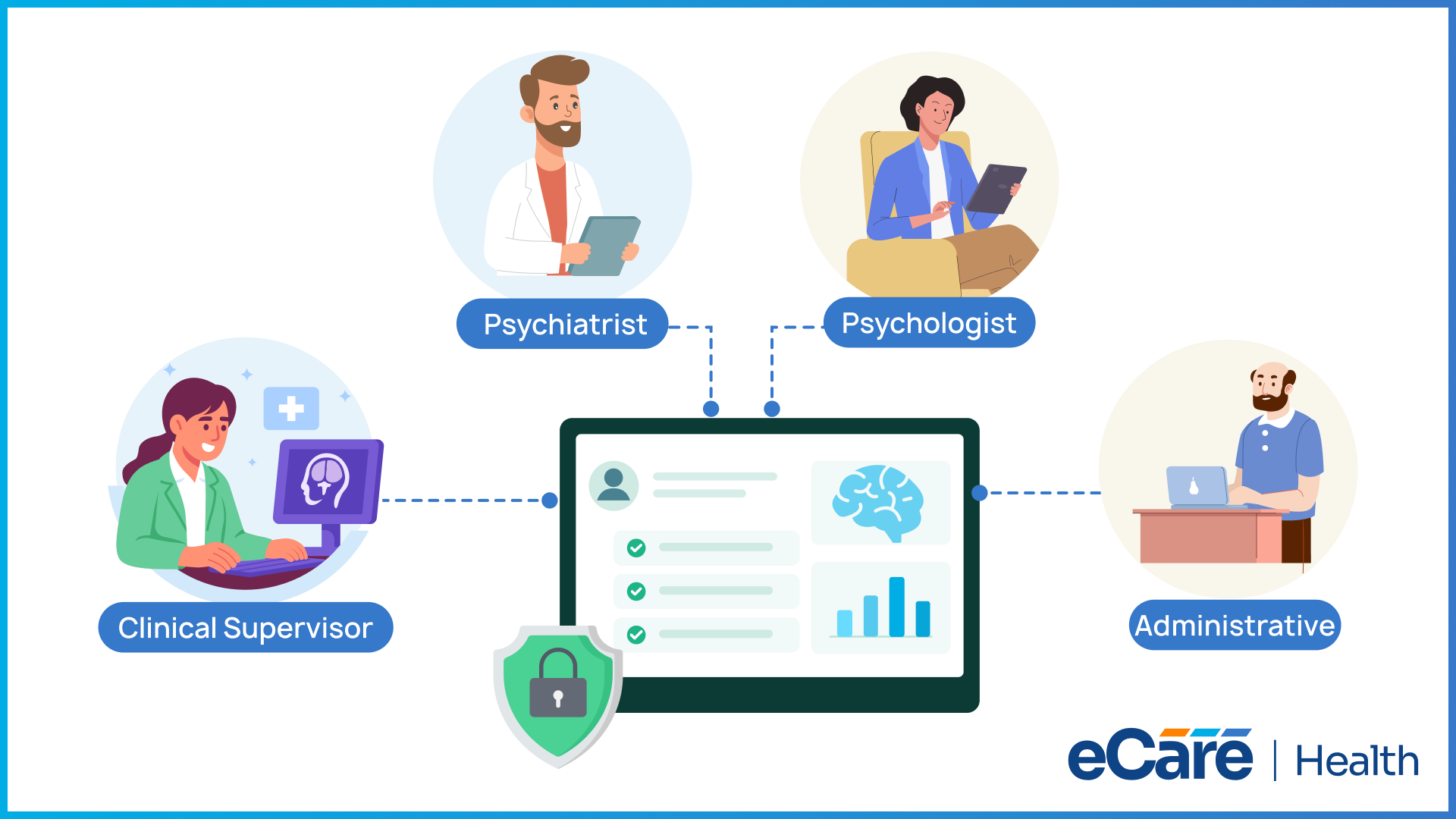
Collaboration becomes as important as clinical expertise as mental health practices grow. With the right workflows, every team can stay connected and reduce administrative bottlenecks while delivering consistent patient care.
- Support every role: A scalable mental health EHR group practice platform should connect therapists, psychiatrists, psychologists, supervisors, and administrative staff through unified workflows.
- Shared patient records: Secure, role-based access ensures each team member sees the information they need while protecting sensitive patient data.
- Supervisor review workflows: Built-in review and co-sign capabilities help maintain documentation quality and simplify clinical oversight.
- AI-assisted documentation: AI-powered clinical documentation for large mental health teams reduces repetitive note-taking, helping clinicians spend more time with patients and less time on paperwork.
- Collaborative group sessions: Integrated group therapy notes software simplifies documenting shared sessions while keeping individual patient records accurate and organized.
Collaboration becomes seamless, workflows stay consistent, and your clinic is better prepared to grow when every care team works from the same playbook.
Managing Multi-Provider Operations as Your Clinic Grows
Daily operations become even more complex as your practice expands. The right behavioral health practice management software must help your team stay organized without adding unnecessary administrative work.
To support that growth, your EHR must help simplify the following key operational areas:
- Centralized scheduling across every care setting: Manage appointments from a single scheduling system, especially for multiple providers, clinic locations, and telehealth services. This can reduce scheduling conflicts while keeping everyone on the same page.
- Smarter day-to-day practice management: With built-in multi-provider practice management tools, practices can simplify provider coordination, staff assignments, and administrative workloads. This makes it easier to manage a growing team.
- Better resource & room utilization: Coordinate therapy rooms, shared resources, and provider availability more efficiently to avoid double bookings, while improving clinic operations.
- Support for multi-location growth: Scalable electronic health records for multi-location mental health clinics help to make sure patient records, documentation, and workflows remain connected, regardless of where care is delivered.
- Actionable operational insights: Organization-wide dashboards help practice leaders to get a clear view of provider productivity, scheduling trends, and overall clinic performance. This further helps them to make informed decisions as the organization grows.
eCareHealth helps simplify multi-provider operations by centralizing scheduling, documentation, billing, reporting, and administrative workflows, making it easier for behavioral health practices to manage growth across teams and locations.
Billing, Credentialing, & Revenue Operations
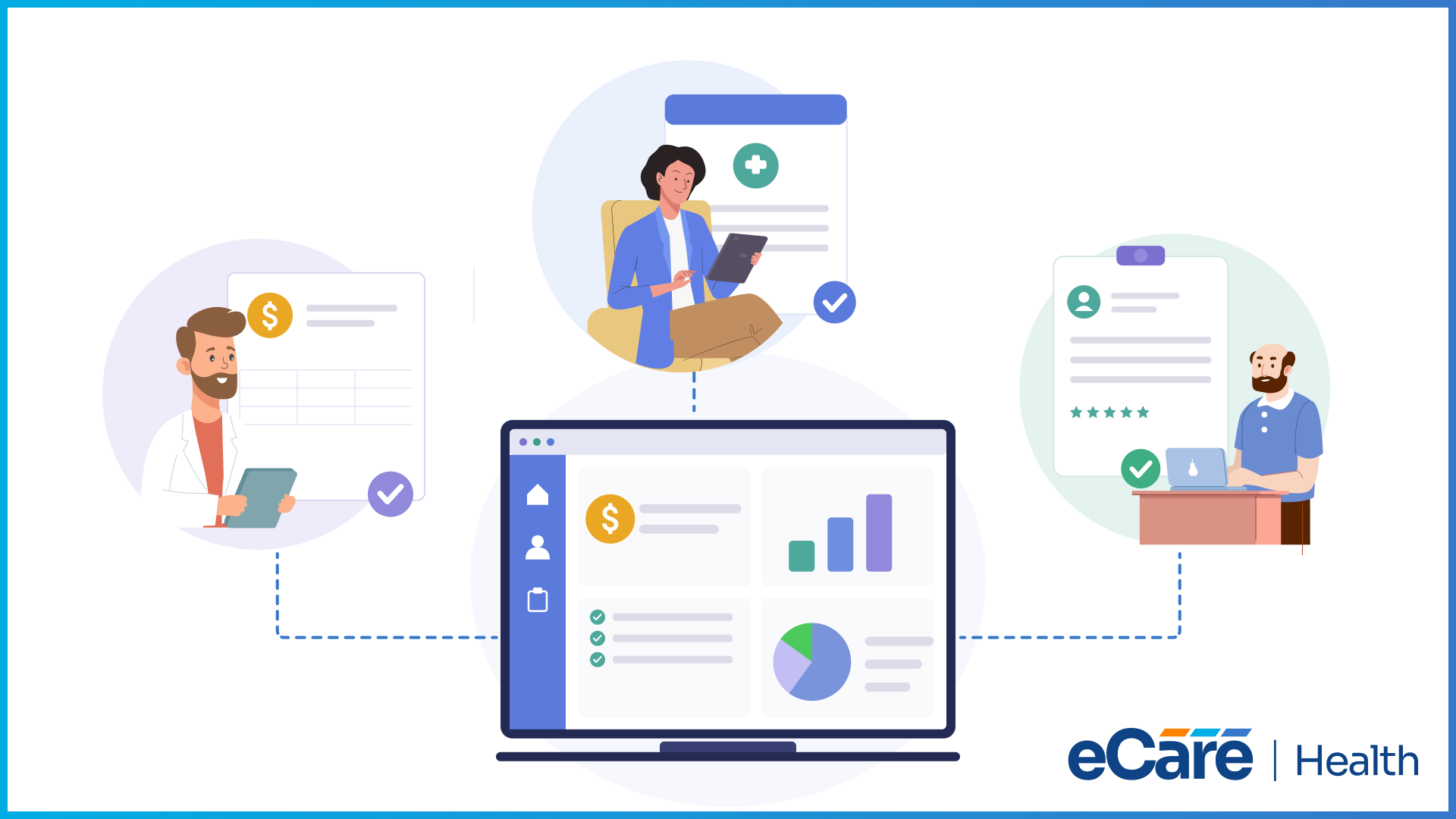
As your team grows, administrative tasks grow with it. Without the right systems, billing, credentialing, and reimbursement workflows can become time-consuming and difficult to manage.
- Centralize billing operations: With robust behavioral health practice management software, practices can bring billing, claims, and payment tracking into one system. This further helps to reduce manual work and enhance revenue cycle efficiency.
- Simplify provider onboarding & credentialing: Adding new clinicians should not slow your practice down. Built-in credentialing and onboarding workflows can keep provider information organized, while supporting faster payer enrollment.
- Stay on top of authorizations: Tracking prior authorizations and reimbursement requirements within the same platform can help to reduce delays, minimize claim issues, and keep behavioral health billing workflows moving seamlessly.
- Scale without adding administrative burden: The right platform helps to automate routine administrative tasks and standardize workflows. This allows your organization to grow without increasing operational complexity or placing any additional burden on your staff.
For example, eCareHealth integrates billing, provider management, and revenue cycle workflows into a single platform, helping growing behavioral health organizations reduce administrative effort while supporting efficient financial operations.
Security & Compliance for Growing Behavioral Health Organizations
Protecting patient information becomes even more important as your practice expands. A scalable EHR for behavioral health must help your organization stay compliant and support secure collaboration across providers and locations.
A secure platform should include:
- Support for HIPAA & 42 CFR Part 2: Protect behavioral health records by meeting privacy and security requirements while managing sensitive patient information appropriately.
- Role-based access controls: Give clinicians, supervisors, billing teams, and administrative staff access only to the information they need to perform their roles.
- Comprehensive audit trails: Track user activity, record access, and document changes to strengthen accountability and simplify compliance monitoring.
- Secure information sharing: Enable authorized providers across departments or clinic locations to collaborate safely without compromising patient privacy.
- A compliance framework that grows with your organization: Choose a platform that supports expanding teams, additional locations, and evolving regulatory requirements without creating unnecessary compliance challenges.
How Should You Evaluate Group Practice Software Before You Buy?
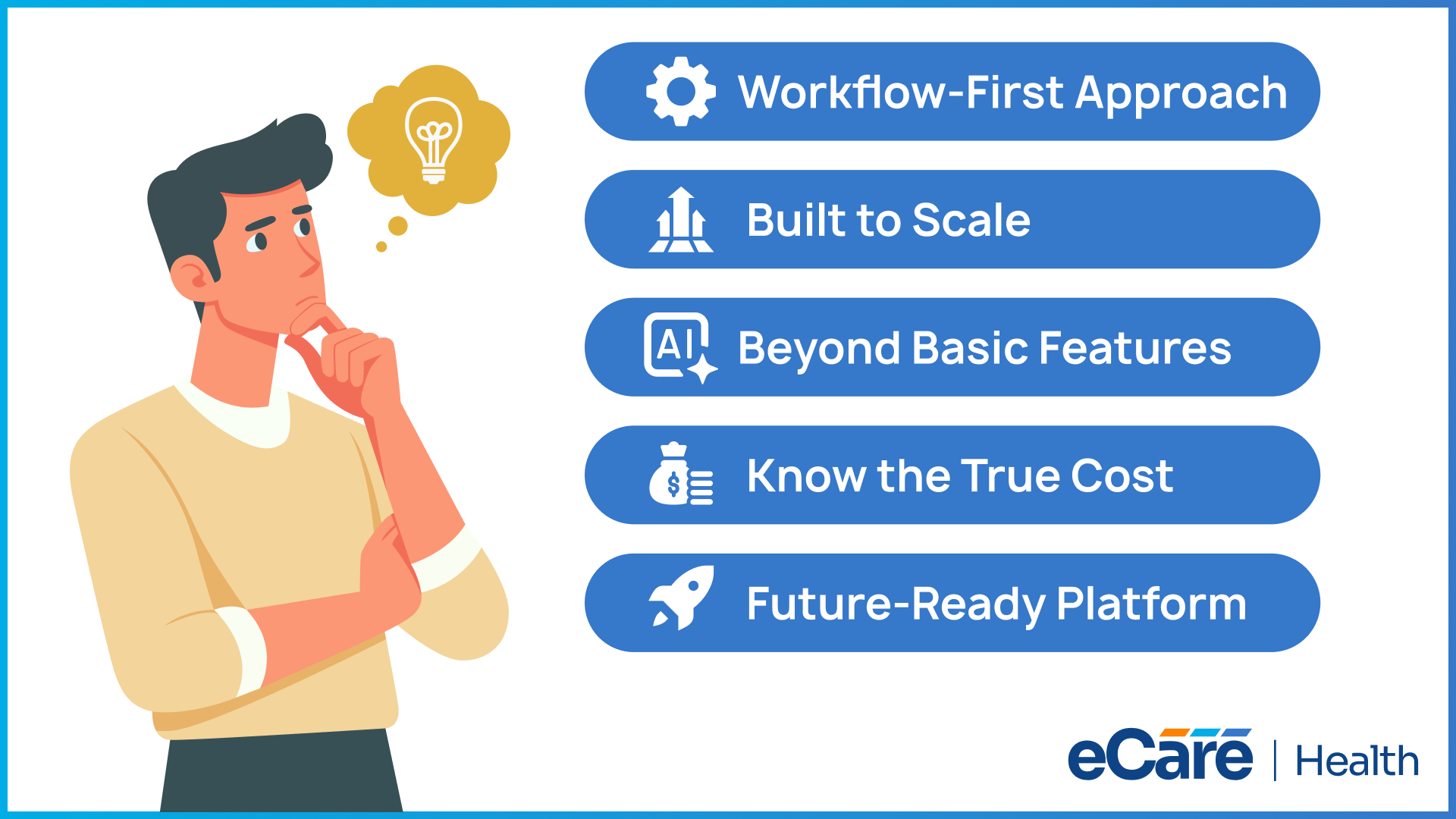
Before making a decision, don't just compare feature lists. Focus on whether the platform can support your practice as it grows. Here are a few key areas to evaluate:
- Start with your workflows, not the features: Look for software that fits your clinical, administrative, and billing processes instead of forcing your team to change how they work.
- Think beyond your current size: Consider whether the platform can support more providers, additional clinic locations, new specialties, and expanding services without disrupting operations.
- Evaluate more than basic functionality: Compare AI capabilities, reporting tools, vendor support, implementation assistance, and ongoing product updates—not just core EHR features.
- Calculate the total cost of ownership: Don't base your decision on subscription fees alone. Consider implementation, training, integrations, support, and future upgrade costs before making an investment.
- Plan for tomorrow, not just today: If you're already experiencing workflow bottlenecks, manual workarounds, or limited reporting, your current system may already be showing signs that you've outgrown it. Choose a platform that can grow alongside your organization.
If you're comparing EHR options for your growing practice, our guide How to Choose the Best Mental Health EHR: A Complete 2026 Buyer’s Guide can help you evaluate the factors that matter before making a decision.
Conclusion
Choosing the right behavioral health practice management software isn't just about solving today's challenges; it's about preparing your practice for tomorrow's growth. As your team, services, and locations expand, a scalable platform can help streamline clinical workflows, simplify operations, strengthen compliance, and support long-term financial success.
Before making a decision, look beyond feature lists and choose a solution that fits your workflows today while supporting where your organization is headed next.
Ready to find a scalable EHR for your growing behavioral health practice? Contact us to explore eCareHealth.
Frequently Asked Questions
1. What is the best mental health EHR for group practices?
The best mental health EHR for group practices is one that can grow with your organization. Look for software that supports multiple providers, role-based access, shared scheduling, clinical documentation, billing, reporting, telehealth, and compliance while scaling across multiple locations.
2. What makes a mental health EHR scalable?
A scalable mental health EHR supports provider growth, additional clinic locations, increasing patient volumes, and expanding services without disrupting workflows. Features like centralized scheduling, AI-assisted documentation, role-based permissions, and advanced reporting are key indicators of scalability.
3. How do I choose software for a growing behavioral health group practice?
Start by evaluating how well the software fits your clinical and administrative workflows. Then assess its ability to support future growth, implementation services, reporting capabilities, AI features, compliance, and long-term costs rather than focusing only on the subscription price.
4. What should behavioral health organizations evaluate before expanding to multiple locations?
Before expanding, organizations should assess whether their EHR can support centralized scheduling, shared patient records, secure information sharing, organization-wide reporting, role-based access controls, and standardized workflows across all locations.
5. What are multi provider practice management tools?
Multi provider practice management tools help coordinate daily operations across multiple clinicians. They typically include provider scheduling, resource management, billing, reporting, task management, and administrative workflows that improve efficiency in growing practices.
6. How does AI powered clinical documentation help large mental health teams?
AI-powered clinical documentation reduces manual note-taking by assisting with clinical documentation, improving consistency, and minimizing administrative workload. This allows clinicians to spend more time with patients while maintaining accurate records.
7. Why is provider credentialing important for growing behavioral health organizations?
Provider credentialing verifies that clinicians meet payer and regulatory requirements before delivering care. An organized credentialing process helps reduce onboarding delays, supports timely reimbursement, and ensures compliance as the organization expands.
8. How do HIPAA and 42 CFR Part 2 affect multi-provider behavioral health practices?
HIPAA protects the privacy and security of patient health information, while 42 CFR Part 2 provides additional protections for substance use disorder treatment records. Behavioral health organizations must ensure secure access controls, audit trails, and proper consent management to comply with both regulations.
9. How should psychiatric providers evaluate group practice software?
Psychiatric providers should evaluate software based on workflow compatibility, scalability, clinical documentation capabilities, billing and credentialing support, reporting tools, AI features, security, compliance, vendor support, and total cost of ownership. The right platform should meet current needs while supporting future growth.