Behavioral Health Billing in 2026: How to Reduce Denials and Get Paid Faster
Hospitals and health systems in the U.S. spend almost $20 billion every year trying to overturn denied claims. This shows that getting paid is not always as simple as submitting a claim.
This can become even more serious for behavioral health practices as even a small documentation error, incorrect mental health billing codes, or a missed payer requirement can result in delayed reimbursement and create extra work for already busy teams.
In 2026, behavioral health billing becomes harder to manage as more insurers update their billing rules and compliance requirements. What once worked may no longer be enough, while small mistakes can silently snowball into denied claims, payment delays, and unnecessary revenue loss.
Even so, you can avoid most of these challenges with accurate documentation, better billing workflows, and solutions like eCareHealth. It helps your practices to simplify behavioral health billing, enhance claim accuracy, and get paid faster.
So, how can your practice stay ahead of changing payer requirements while keeping claims denials to a minimum?
To find out answers to your questions, let’s walk through the common reasons behavioral health claims are denied and share practical ways to reduce billing errors, strengthen reimbursement, and improve your overall billing performance.
What Does the Behavioral Health Billing Workflow Look Like?
A successful behavioral health billing process is not just built around one task; it is actually a series of connected steps. If each stage is handled properly, claims can move seamlessly through the revenue cycle.
Let’s see what the typical billing workflow actually looks like:
- Patient Registration: Collect accurate patient demographics and insurance information to avoid billing errors later.
- Insurance Eligibility Verification: Confirm the patient's coverage and benefits before treatment begins.
- Prior Authorization: Obtain payer approval for services that require authorization before the appointment.
- Clinical Documentation & Coding: Complete detailed clinical notes and assign the correct mental health billing codes and mental health CPT codes 2026.
- Claim Submission: Submit clean, accurate claims that meet payer requirements.
- Payment Posting: Record reimbursements and reconcile payments with submitted claims.
- Denial Management: Review denied claims, fix the issue, and resubmit them promptly to avoid payment delays.
Even though the workflow looks straightforward, revenue can leak at almost any stage. Incomplete documentation, eligibility errors, missed authorizations, coding mistakes, or delayed follow-ups can result in slower reimbursements and denied claims.
And this is exactly where solutions like eCareHealth can make a huge difference. It can bring patient registration, documentation, coding, claims, and denial management into one connected platform, while simplifying behavioral health billing, reducing manual work, and helping practices to get paid faster.
Why Are Mental Health CPT Codes Critical for Accurate Behavioral Health Billing?
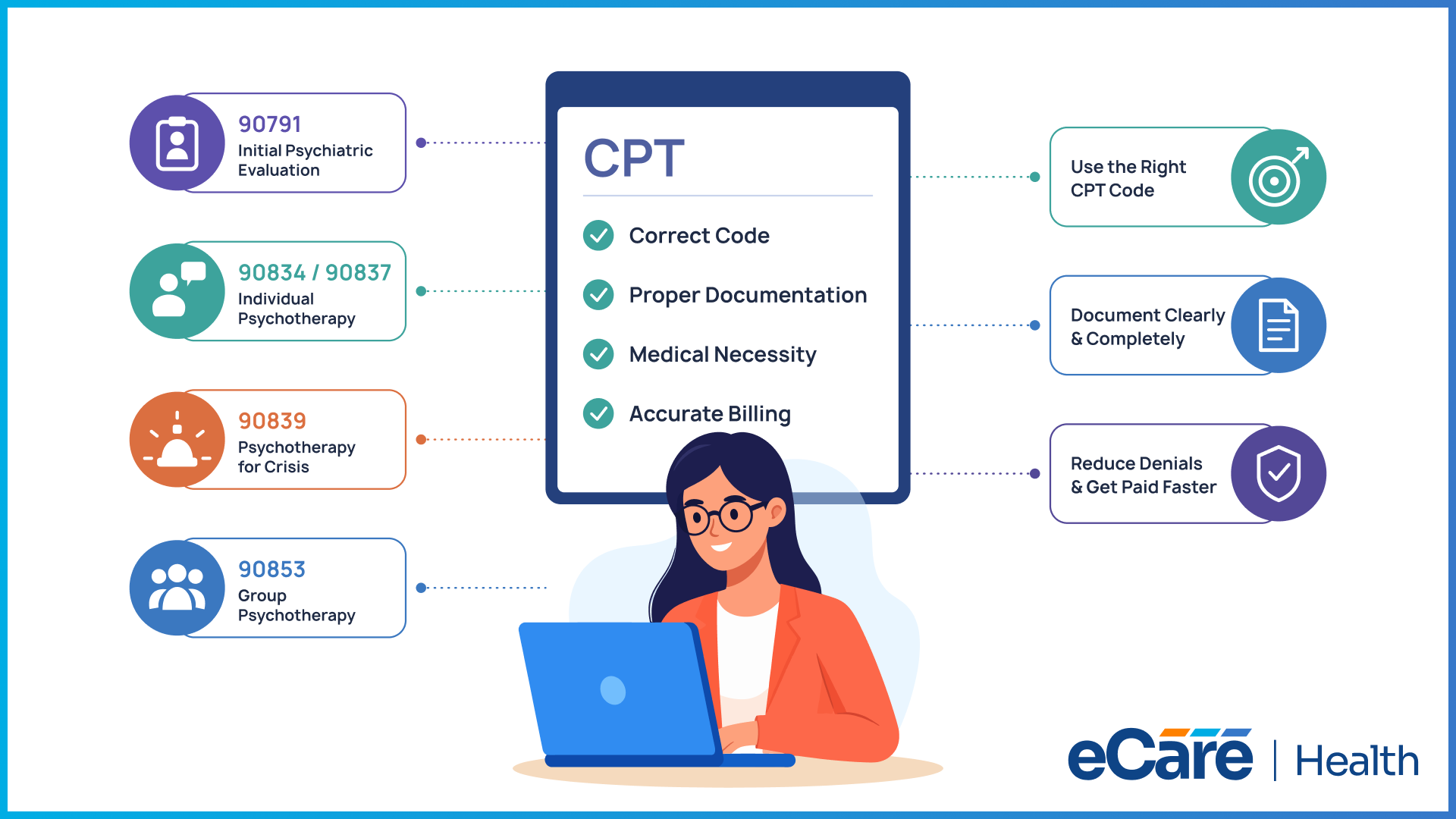
Every claim tells a story, and in that story, CPT codes are a key part. CPT codes tell insurance payers what services were provided, how they were delivered, and whether they meet the requirements for reimbursement. Choosing the wrong code or using the right code without proper documentation can result in delayed payments or claim denials.
Let’s see some of the most commonly used mental health CPT codes 2026 in behavioral health practices:
- 90791 – Psychiatric Diagnostic Evaluation: Used for an initial psychiatric assessment without medical services.
- 90834 / 90837 – Individual Psychotherapy: Used for standard psychotherapy sessions based on the time spent with the patient.
- 90839 – Psychotherapy for Crisis: Reported when providers deliver urgent, crisis-focused psychotherapy.
- 90853 – Group Psychotherapy: Used when therapy is provided to multiple patients in a group setting.
While these are some of the commonly used codes, behavioral health billing involves specific coding requirements that can vary based on the service provided and payer guidelines. For a more detailed breakdown, explore our guide on Mental Health CPT Codes in 2026: How to Bill Accurately and Avoid Claim Denials.
However, using the correct CPT code is only half the job. Your clinical documentation must clearly support the service provided, such as session length, treatment details, and medical necessity. If documentation fails to match the selected code, the claim can be questioned or denied during review.
To help reduce these coding errors, eCareHealth supports intelligent billing workflows that validate documentation against selected CPT codes before submitting the claims. This further helps practices to improve billing accuracy and reduce manual corrections, while strengthening their behavioral health revenue cycle management.
How Do Mental Health Diagnosis Codes and Billing Modifiers Improve Claim Accuracy?
Even though it is important to submit a claim with the right mental health billing codes, it is only one part of the equation. To confirm the services billed match the patient’s condition and the care provided, insurance payers should also look at the diagnosis code and any required billing modifiers.
Here is how each piece contributes to a clean claim:
- ICD-10-CM Diagnosis Codes: Explain why the patient received treatment by identifying the diagnosed mental health condition.
- CPT Codes: Describe the service performed, such as a psychotherapy session or psychiatric evaluation.
- Billing Modifiers: Provide additional details about how the service was delivered, helping payers process claims according to their specific requirements.
All three of these elements should work together. To understand how mental health billing codes, diagnosis codes, and other claim requirements fit into the overall reimbursement process, explore our guide on Mental Health Billing Codes in 2026: How to Code Claims Correctly and Get Reimbursed Faster.
All three of these elements should work together. For example, the payer can reject or deny the claim if the diagnosis does not support the service billed or a required modifier is missing. That’s why it is important to review coding carefully before submitting every claim.
Moving forward, many practices also face another key challenge that every insurance payer may have slightly different billing requirements. If you try to keep up with those challenges manually, it can increase the risk of coding inconsistencies and payment delays.
To reduce all these errors, eCareHealth uses automated validation to review coding before claims are submitted. Furthermore, it helps practices to enhance claim accuracy, reduce rework, and strengthen behavioral health revenue cycle management by checking diagnosis codes, billing modifiers, and supporting documentation together.
What Are the Most Common Mental Health Billing Mistakes?
It is a fact that even the most experienced billing teams can make mistakes. The problem is that even a small error can result in delayed payments, trigger claim denials, and create unnecessary rework. Even so, when you know where mistakes are typically made, you can avoid most of them.
Let’s see some of the common billing mistakes and how they can affect reimbursement:
| Common Billing Mistake | How it Affects Reimbursement |
|---|---|
| Incomplete or missing documentation | Claims may be denied because medical necessity cannot be verified. |
| Incorrect mental health billing codes or CPT codes | Results in coding errors, underpayments, or claim rejections. |
| Skipping eligibility verification | Claims may be denied if the patient's coverage is inactive or doesn't include the service. |
| Missing prior authorization | Payers may refuse reimbursement for services requiring pre-approval. |
| Mismatched diagnosis and procedure codes | Claims may fail payer edits or require additional review. |
| Late claim submission | Missing payer deadlines can result in lost reimbursement opportunities. |
| Ignoring denied claims | Delayed follow-up can reduce the chances of recovering payment. |
These mistakes may seem small individually, but over time, they can directly affect your practice's revenue and create unnecessary administrative work. To explore these issues in greater detail and learn practical ways to address them, read our guide on Mental Health Billing Mistakes That Cost Your Practice Revenue (And How to Fix Them).
Preventing these errors starts long before a claim reaches the payer. eCareHealth helps practices to automate key billing checks, validate documentation and coding, and identify potential issues before claims are submitted. Catching mistakes early can further help to reduce denials, enhance claim accuracy, and strengthen their behavioral health revenue cycle management.
How Can Behavioral Health Revenue Cycle Management Improve Cash Flow?
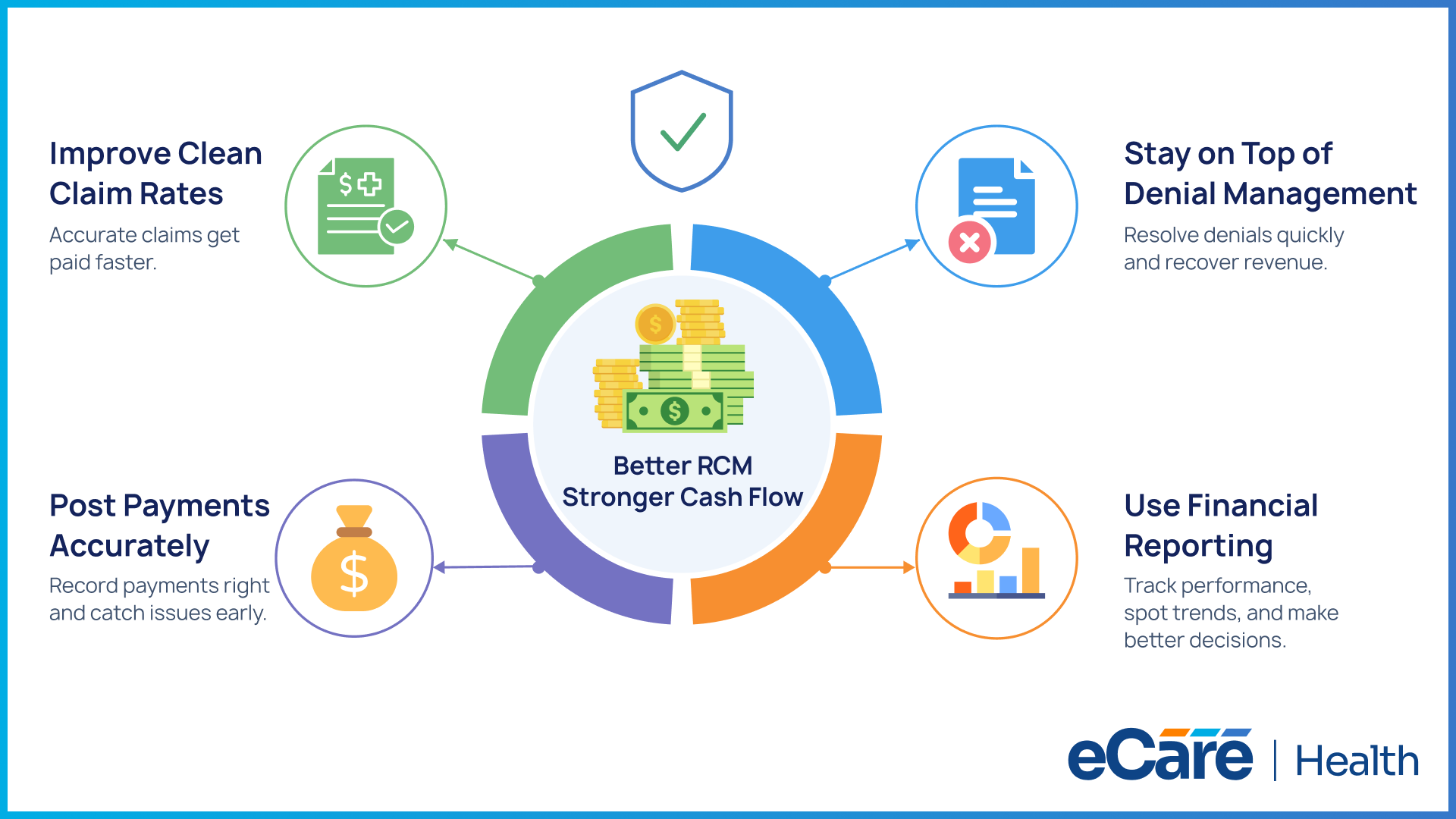
A healthy cash flow never relies on one successful claim; it relies on how well your entire billing process performs, and that’s exactly where behavioral health revenue cycle management comes in. Improvement of every stage of the revenue cycle allows practices to reduce payment delays, recover revenue faster, and build a more predictable financial future.
Each stage from claim submission to payment collection plays a key role in reducing delays and improving reimbursements. Let’s explore the building blocks of an efficient revenue cycle:
Improve Clean Claim Rates
If your claims are more accurate, they are more likely to be accepted for the first time. By reviewing documentation, coding, and payer requirements before the submission, errors and unnecessary rework can be avoided.
Stay on Top of Denial Management
Claim denials should never be treated as the end of the process. If you identify why claims are denied, correct the issues quickly and resubmit them on time, you can recover revenue that might otherwise be lost.
Post Payments Accurately
With accurate payment posting, you can ensure that reimbursements are recorded correctly, highlight outstanding balances, and help practices identify underpayments or payment discrepancies before they become larger issues.
Use Financial Reporting to Make Better Decisions
Financial reports offer valuable insights into claim status, reimbursement trends, collections, and overall billing performance. With all these insights, practices can identify bottlenecks, monitor key metrics, and improve their revenue cycle continuously.
Managing these different stages effectively requires a broader revenue cycle strategy. To explore how behavioral health practices can improve cash flow, reduce claim denials, and optimize each stage of the billing process, read our guide on Behavioral Health Revenue Cycle Management: How to Optimize Cash Flow and Cut Claim Denials.
However, as patient volumes grow, managing each of these activities manually can become time-consuming. However, eCareHealth brings claims, payment posting, denial tracking, and reporting into one connected platform, while simplifying behavioral health revenue cycle management.
Built-in automation and real-time analytics help practices reduce administrative work, enhance collections, and maintain a healthier cash flow.
How Can Modern Billing Automation Help Reduce Claim Denials?
Along with behavioral health practices, the volume of claims, documentation, and payer requirements also grows. Managing everything manually can take a lot of time, while increasing the risk of errors that can delay reimbursements. Because of this, many practices start to turn to billing automation to enhance accuracy and reduce administrative workload.
Modern billing automation supports the entire billing process by helping practices:
- Verify insurance eligibility automatically to identify coverage issues before the patient visits.
- Streamline prior authorization workflows so required approvals are completed on time.
- Use AI-powered claim scrubbing to identify coding errors, missing information, or payer-specific issues before claims are submitted.
- Simplify payment reconciliation by matching reimbursements with submitted claims and quickly identifying outstanding balances or underpayments.
Rather than spending valuable time fixing denied claims, billing teams can focus more on submitting cleaner claims for the first time. It can result in fewer billing errors, stronger compliance, faster reimbursement, and a more efficient billing process.
Built with behavioral health practices in mind, eCareHealth combines AI-powered billing automation with intelligent workflows to simplify behavioral health billing. From eligibility verification and prior authorization to claim validation and payment tracking, the platform helps practices reduce denials, improve claim accuracy, and accelerate reimbursement.
Conclusion
Reducing claim denials starts with getting the basics right—accurate coding, complete documentation, standardized workflows, and effective behavioral health revenue cycle management. When every step of the billing process works together, practices can improve reimbursement, strengthen cash flow, and spend less time on rework.
That’s where eCareHealth makes a difference. As a comprehensive mental health practice management software, it streamlines behavioral health billing with intelligent automation, accurate coding support, and integrated revenue cycle workflows, helping behavioral health practices reduce denials, improve billing accuracy, and get paid faster.
Frequently Asked Questions
1. What is behavioral health billing?
Behavioral health billing is the process of submitting and managing insurance claims for mental health and substance use disorder services. It includes patient eligibility verification, prior authorization, clinical documentation, coding, claim submission, payment posting, and denial management to ensure providers receive accurate reimbursement.
2. Why is behavioral health billing different from medical billing?
Behavioral health billing often involves time-based services, psychotherapy sessions, specialized documentation, and payer-specific requirements. Providers must also follow mental health coding guidelines and, in many cases, additional privacy regulations, making the billing process more complex than general medical billing.
3. What does the behavioral health billing workflow include?
A typical behavioral health billing workflow includes patient registration, insurance eligibility verification, prior authorization, clinical documentation, coding, claim submission, payment posting, and denial management. Each step helps ensure claims are accurate and reimbursements are received on time.
4. How do mental health CPT codes affect reimbursement?
Mental health CPT codes describe the services provided, such as psychotherapy or psychiatric evaluations. Using the correct CPT code, supported by complete documentation, helps improve claim acceptance and reduces the risk of denials or underpayments.
5. How do ICD-10 diagnosis codes and billing modifiers improve claim accuracy?
ICD-10 diagnosis codes explain why treatment was provided, while billing modifiers add important details about how the service was delivered. When used correctly with CPT codes, they help create clean, accurate claims that meet payer requirements.
6. What are the most common causes of behavioral health claim denials?
Common causes include incomplete documentation, incorrect coding, missing prior authorization, eligibility verification errors, mismatched diagnosis and procedure codes, and submitting claims after payer deadlines.
7. How can behavioral health practices reduce claim denials?
Practices can reduce denials by verifying insurance eligibility, obtaining prior authorizations, maintaining accurate documentation, using the correct billing codes, reviewing claims before submission, and following up on denied claims promptly.
8. What is behavioral health revenue cycle management?
Behavioral health revenue cycle management is the process of managing the financial side of patient care, from scheduling and insurance verification to claim submission, payment collection, denial management, and financial reporting. Its goal is to improve reimbursement and maintain healthy cash flow.
9. How can billing automation improve reimbursement?
Billing automation reduces manual errors by automating tasks such as eligibility verification, claim validation, coding checks, prior authorization workflows, and payment reconciliation. This helps improve claim accuracy and speeds up reimbursement.
10. What is a good clean claim rate for a behavioral health practice?
While benchmarks vary, many practices aim for a clean claim rate of 95% or higher. A higher clean claim rate means more claims are accepted on the first submission, reducing rework and improving cash flow.
11. Which billing KPIs should behavioral health organizations monitor?
Key billing KPIs include clean claim rate, claim denial rate, days in accounts receivable (A/R), first-pass claim acceptance rate, collection rate, reimbursement turnaround time, and denial recovery rate.
12. How do electronic prior authorization workflows improve reimbursement?
Electronic prior authorization workflows help practices submit authorization requests faster, track approval status, and reduce delays caused by manual paperwork. This improves compliance and lowers the risk of claims being denied due to missing authorizations.
13. How can AI-powered billing automation reduce administrative work?
AI-powered billing automation identifies coding errors, validates claims before submission, automates routine billing tasks, and flags potential issues early. This reduces manual effort, minimizes claim denials, and allows staff to spend more time on patient care instead of correcting billing errors.