AI Therapy Notes: How AI Scribes Are Changing Mental Health Clinical Documentation
You, as a therapist, may spend an hour talking with your patient, but the work does not always end when the session does.
Before you move on to the next patient, there are notes to write, details to remember, and records to update.
For busy behavioral health providers, this routine can quickly add up. When documentation starts to take more time than expected, it can follow clinicians throughout the day. With an already busy schedule, clinicians may complete notes in between appointments or after working hours.
The challenge here is not just writing things down simply; it’s actually documenting each session clearly and accurately without losing more time to administrative work. So, what if some of that note-taking work could be done with a little help?
This is exactly where AI therapy notes come into the spotlight. With an AI scribe, it becomes easy to capture important information from therapy sessions while turning it into draft clinical notes. Rather than starting with a blank page after every appointment, you can get a structured starting point and spend your time reviewing what actually matters.
Here you might be thinking about: Can AI take your job?
Well, no, AI is not there to take over your role. Clinical judgment still cannot be put on autopilot. The provider still remains responsible for reviewing, editing, and approving the final note to ensure it accurately reflects the session. With mental health EHR software, AI scribes can make therapy documentation easier and less time-consuming.
Let this blog be your comprehensive guide to exploring how AI therapy notes work, how they can help therapists, and what to keep in mind before using AI clinical documentation.
Why AI Therapy Notes Matter in 2026
Documentation is a major part of a mental health provider’s day. Every therapy session needs to be recorded clearly, accurately, and in a way that supports ongoing patient care. If you add scheduling, patient communication, billing, and other administrative tasks to the mix, it becomes clear why providers are looking for ways to work more effectively.
This is where AI therapy notes become increasingly relevant. Rather than replacing clinical documentation, AI helps to make the process faster and more organized. For example, AI clinical documentation tools for mental health can help in creating draft notes and organizing key information. This further helps providers to spend less time on routine paperwork.
Still, speed alone is not enough. As mental health documentation involves sensitive patient information, privacy and clinical oversight must remain a priority. Providers should review AI-generated content while ensuring the tools they use actually support secure and responsible documentation.
That’s why AI therapy notes are becoming a fundamental part of behavioral health. Practices are moving toward technology-assisted workflows, which help to reduce administrative work and keep clinicians in control of their patient care.
Simply put, AI is not a magic wand, but when used responsibly, it helps you document one less thing for providers to worry about.
How AI Scribes Work for Mental Health Documentation
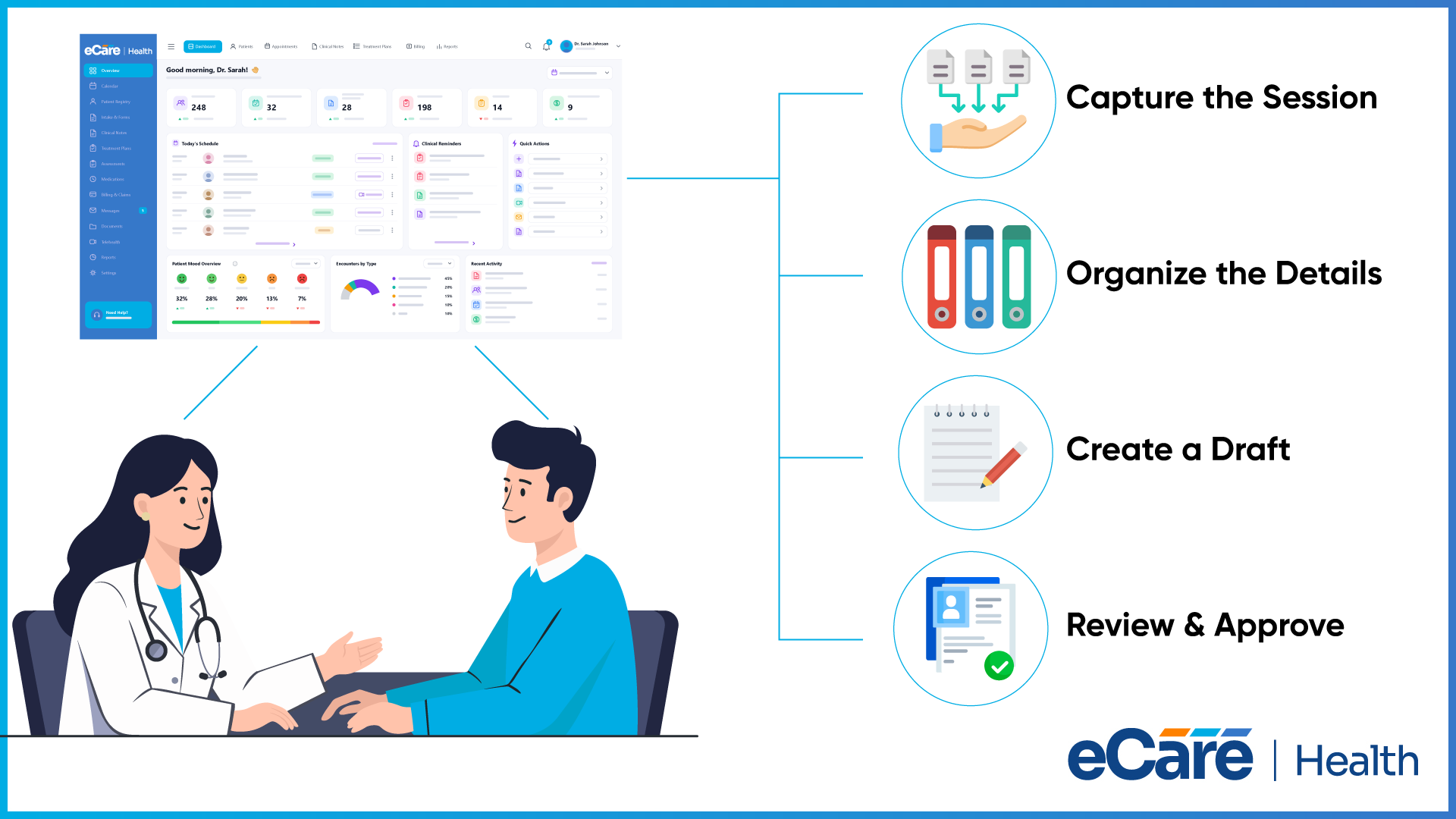
AI scribes do not simply turn a therapy conversation into a note. Between the session and the final documentation, there are some key steps, with the clinician guiding the process along the way.
Capturing Session Information
With AI scribe behavioral health tools, it becomes easy to capture relevant information from a therapy session when it has been properly configured and the patient has given the required consent. Ambient documentation is one approach, where AI has the ability to listen to the conversations and identify information that may be useful for the clinical note.
This is where ambient AI therapy notes can change the scenario. Rather than stopping throughout the session to write everything down, therapists can stay focused on the conversations, while AI helps to capture important information in the background.
Organizing Clinical Information
After the session information is captured, the AI can sort through the conversation and identify details that may belong in the clinical record. It can also separate relevant observations, patient concerns, interventions, responses, and other information, rather than leaving the therapist with a long block of unorganized text.
The information can then be arranged around the documentation format used by the practice, such as SOAP, DAP, or BIRP notes. This gives the clinician a more useful starting point for completing the record.
Generating Draft Notes
Once the information is organized, AI can further turn it into a draft therapy or progress note. For example, with AI progress notes, mental health workflows bring relevant session details together in a structured format. This can help to reduce the requirement of writing every section manually.
Clinician Review and Finalization
This final step involves keeping the therapists at the center of the process. The clinician reviews the draft, corrects anything that is inaccurate or incomplete, adds details where needed, and approves the final note.
Simply put, even though AI helps with the heavy lifting, therapists still remain responsible for the documentation. This balance enables your practice to gain efficiency without handing clinical judgment over to a machine.
Benefits of AI Therapy Notes
The real value of AI therapy notes is not just simply writing notes faster. It is also about making the entire documentation process easier to manage, so it becomes convenient for therapists to spend less time on repetitive tasks and more on doing what they do best.
Reduced Documentation Time
If you write the same types of notes after every session, it might become a headache for you. However, by organizing session details and creating a draft note, AI can handle some of the repetitive tasks. This gives you a start on the right foot, rather than building each note from a blank page.
The time you spend less on typing and organizing information will help you reduce the administrative load that follows you throughout your day.
More Efficient Clinical Workflows
Documentation must support the clinical workflow and not constantly interrupt it. By helping capture and organize information and reducing the need to switch back and forth between patient care and note-taking, AI-assisted documentation can fit into existing therapy.
This can set the stage to focus on the patient, review the note, make the necessary changes, and move on.
Consistent Note Organization
Furthermore, AI can help to organize information in a consistent format on the basis of the documentation structure a practice uses. This can also help to make notes easier to review, while keeping information organized from one session to the next.
Even so, consistency does not mean that the note is automatically correct. You still need to review the content and ensure it accurately reflects your patient’s session and clinical requirements.
Greater Focus on Patient Care
Perhaps the most meaningful benefit is the time it can give back to clinicians. When less effort goes into repetitive documentation, therapists may have more room to focus on patient interaction, preparation, and the other parts of care that require their attention.
HIPAA, Privacy, and Security Considerations for AI Therapy Notes
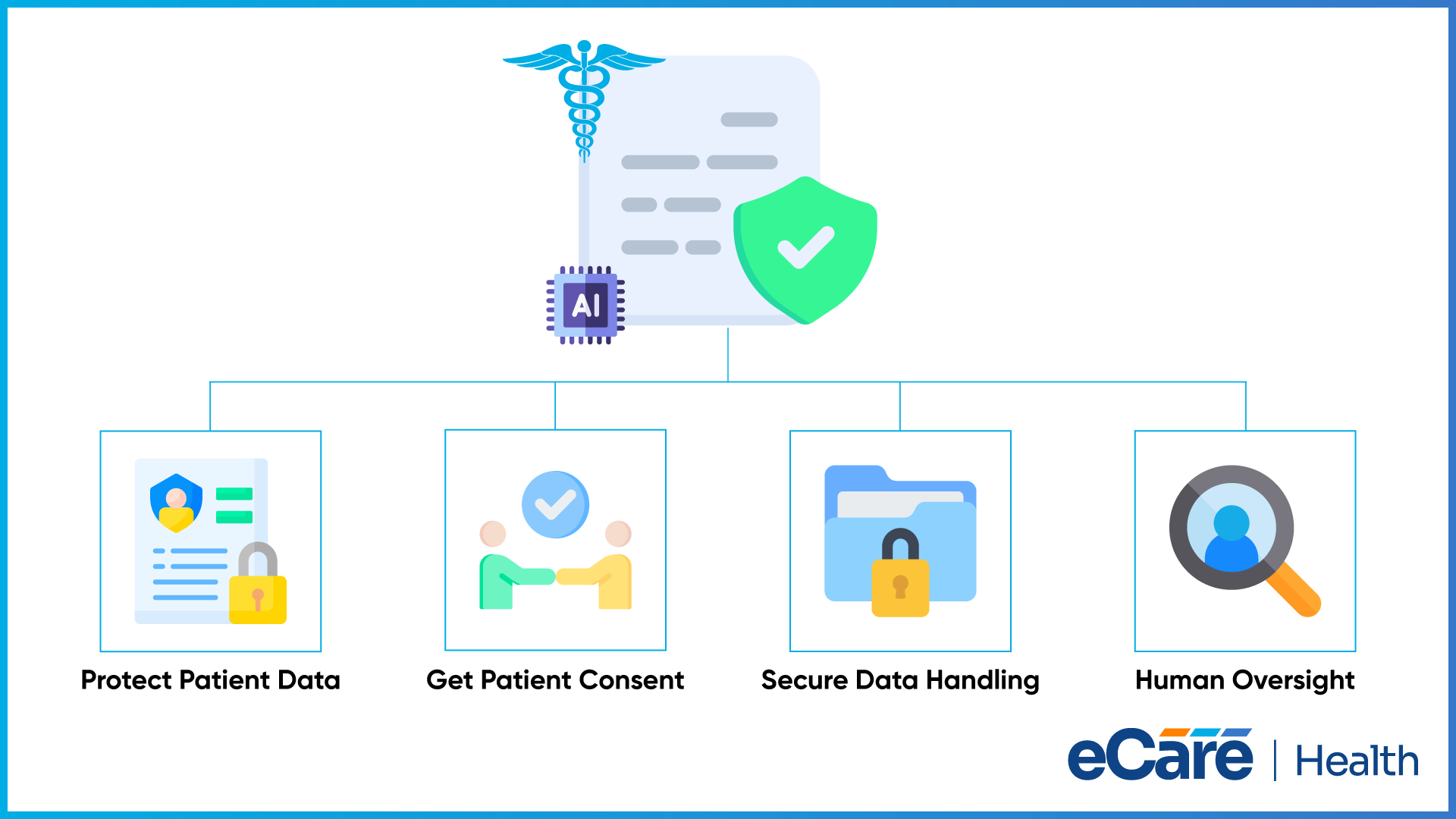
The AI convenience never changes the fact that therapy documentation contains some of the most private information in your patient’s record. Conversations usually involve personal experiences, emotions, diagnoses, medications, family concerns, and other details that require careful protection. Together, these factors make privacy and security a fundamental part of any AI documentation workflow.
Protecting Sensitive Mental Health Information
When an AI tool captures or processes a therapy session, that information needs to be handled securely from the moment it is collected through processing, storage, and access. Providers also must look beyond what the tool can actually do, while understanding how it protects the information it handles.
Consent and Appropriate Use
Furthermore, your patients should also know when AI is being used for capturing and processing information from their sessions. Providers should follow applicable consent, privacy, and organizational requirements before introducing AI into therapy documentation. Clear communication helps your patients to understand how the technology can fit into their care.
Data Handling and Storage
Where does the session information go after it is captured? How long is it kept? Who can access it? These are questions providers should be able to answer before choosing an AI tool.
Providers considering HIPAA-compliant AI therapy notes should review the tool’s data-handling practices, security measures, storage policies, and access controls rather than relying on the label alone. Understanding what happens to patient information behind the scenes can help practices make a more informed choice.
Human Oversight
Security is only one part of responsible AI documentation. Clinicians also need to review every AI-generated note before it becomes part of the patient’s record. AI can help organize information and reduce documentation work, but the provider remains responsible for making sure the final note is accurate, appropriate, and complete.
How eCareHealth Supports Mental Health Documentation
AI can make documentation easier; however, it still requires a well-organized clinical environment to work within. This is where the EHR becomes important. A centralized system helps to keep patient information, clinical documentation, and workflows organized in one place. This further helps to spend less time searching through disconnected systems.
eCareHealth supports behavioral health practices with an organized environment to manage your patient records and clinical workflows. This structure can further provide a practical foundation for practices exploring AI-assisted documentation, including the use of a behavioral health AI documentation assistant where appropriate.
The key here is to keep technology in its proper role. No matter if documentation is created manually or with AI assistance, clinicians remain responsible for reviewing the information and making the final clinical decision. With the right behavioral health EHR software, technology can support that process without getting in the way of clinical judgment.
Conclusion
Documentation will always be part of mental health care, but it does not have to take up more time than necessary. AI therapy notes can help reduce repetitive work, organize session information, and make clinical workflows easier to manage.
Still, convenience should never come at the cost of accuracy or privacy. Every AI-generated note needs careful clinician review, and providers should make sure the tools they use handle sensitive patient information securely.
The goal is not to replace therapists with AI. It is to give them a helping hand with the paperwork so they can spend more time where it matters most: caring for their patients. With the right behavioral health EHR software, AI-assisted documentation can become a useful part of a more connected and efficient clinical workflow.
Frequently Asked Questions (FAQs)
1. What are AI therapy notes?
AI therapy notes are clinical notes created with the assistance of artificial intelligence. Depending on the tool, AI can capture relevant information from a therapy conversation, identify important details, organize them, and prepare a draft note. This can reduce the amount of manual writing therapists need to do after each session. However, AI-generated documentation is not a finished clinical record. The therapist still needs to review the content, make corrections or additions, and approve the final version before it is added to the patient’s record.
2. How do AI scribes work for therapists?
AI scribes help therapists by capturing and organizing relevant information from a therapy session. With the appropriate configuration and patient consent, some tools can listen to a conversation and identify details that may be useful for documentation. The information can then be arranged into a format used by the practice and turned into a draft note. Rather than replacing the therapist’s documentation process completely, the AI acts as a starting point. The therapist reviews the draft, makes any necessary changes, and finalizes the note.
3. Are AI therapy notes HIPAA compliant?
AI therapy notes are not automatically HIPAA compliant simply because they are created using AI. Compliance depends on the tool’s design, security controls, data-handling practices, and how the provider uses it. Before using an AI documentation tool, practices should understand how protected health information is collected, processed, stored, and accessed. They should also review the vendor’s privacy and security policies and determine whether the appropriate agreements and safeguards are in place. These steps can help providers use AI while protecting sensitive mental health information.
4. Can AI generate mental health progress notes?
Yes, AI can help generate draft mental health progress notes from information captured during a therapy session. It can identify relevant details from the conversation and organize them into the format used by the practice, such as SOAP, DAP, or BIRP documentation. This can give therapists a useful starting point and reduce repetitive writing. Still, the generated note should never be treated as final without review. Therapists need to check the information, correct inaccuracies, add important clinical details, and make sure the final note accurately represents the session.
5. What are the benefits of using AI for therapy notes?
The main benefit is reducing the amount of repetitive documentation work therapists have to handle. AI can help capture session information, organize details, and prepare draft notes, which may shorten the time spent creating documentation after appointments. It can also support more consistent note organization and reduce the need to constantly switch between patient interaction and administrative tasks. Over time, these small improvements can make the overall workflow easier to manage and potentially give therapists more time to focus on patient care.
6. Can AI therapy notes replace therapist documentation?
No. AI therapy notes are designed to support the documentation process, not replace the therapist’s professional responsibility. AI may misunderstand context, leave out important details, or include information that needs to be corrected. For this reason, therapists should treat AI-generated notes as drafts rather than final documentation. The clinician must review the content, make necessary edits, and approve the final note. This keeps clinical judgment and accountability with the therapist while allowing AI to handle some of the more repetitive parts of documentation.
7. How does AI protect sensitive therapy-session information?
The level of protection depends on the AI tool, its security measures, and how the practice configures and uses it. Providers should understand what happens to session information after it is captured, including where it is processed, whether it is stored, how long it is retained, and who can access it. Because therapy conversations can contain highly sensitive personal and clinical information, privacy should be considered before implementation rather than afterward. Practices should carefully evaluate an AI vendor’s data-handling and security practices before allowing it to process patient information.
8. Do therapists need to review AI-generated therapy notes?
Yes. Therapist review is an important part of responsible AI-assisted documentation. An AI tool can save time by preparing a draft, but it does not have the therapist’s complete clinical understanding of the patient or the session. The therapist should check the note for accuracy, missing information, incorrect interpretations, and anything that needs additional context. Once the necessary changes have been made, the provider can approve the final version. This keeps the clinician in control of the patient’s record while still benefiting from AI-assisted documentation.