Mental Health Billing Codes in 2026: How to Code Claims Correctly and Get Reimbursed Faster
Are you aware that even a single wrong billing code can hold up reimbursement long after a patient’s treatment is complete?
And especially in behavioral health, where diagnoses, documentation, and treatment plans are often more detailed, even one small coding mistake can result in claim denials, payment delays, or hours spent correcting and resubmitting claims.
The stakes are even higher in 2026. As per FY2026 ICD-10-CM updates, behavioral health providers must stay current with mental health billing codes, documentation requirements, and payer guidelines. An outdated diagnosis code, a missing modifier, or incomplete clinical notes can lead to a denied claim.
However, getting coding right is not about memorizing hundreds of codes; it’s all about understanding how diagnoses, CPT codes, modifiers, and documentation work together. Pairing that with reliable psychiatry billing software helps providers to reduce billing errors, improve claim acceptance rates, and spend less time chasing reimbursements.
Here you might be questioned about exactly where you should begin and which codes truly matter for accurate reimbursement in 2026.
Well, this guide brings everything you need in just one place. From the latest behavioral health billing codes and mental health ICD-10 codes billing updates to CPT codes, modifiers, documentation best practices, and common coding mistakes, you'll learn how to submit cleaner claims, stay compliant, and get reimbursed faster in 2026.
What Are Mental Health Billing Codes and Why Do They Matter?
Imagine mental health billing codes as the common language between behavioral health providers and insurance payers. They can communicate what condition was diagnosed, what treatment was provided, and why the service qualifies for reimbursement. Without accurate coding, even high-quality patient care fails to translate into timely payment.
Let’s see how they work together:
| Component | Purpose |
|---|---|
| DSM-5-TR | Helps clinicians identify and document a mental health diagnosis. |
| ICD-10-CM | Converts that diagnosis into standardized mental health diagnosis billing codes required for insurance claims. |
| CPT Codes | Describe the services provided, such as evaluations or psychotherapy sessions. |
| Payer Guidelines | Determine whether the claim meets medical necessity and reimbursement requirements. |
When all these pieces work together, it becomes easy for providers to submit cleaner claims, demonstrate medical necessity, and reduce avoidable denials. Meanwhile, incorrect diagnosis codes, unsupported documentation, or coding mismatches can delay payments and increase rework.
Due to this, many practices start to rely on integrated psychiatry billing software like eCareHealth. It helps providers to select appropriate diagnosis codes, support accurate claims, and enhance reimbursement efficiency by connecting clinical documentation with billing workflows.
Which Mental Health Billing Codes Are Most Commonly Used in 2026?
While behavioral health providers work with hundreds of diagnosis codes, a handful appear in daily clinical practice far more often than others. Selecting the correct mental health ICD-10 codes for billing can support medical necessity and help to ensure cleaner claims and faster reimbursement.
Let’s have a quick look at the table, which highlights some of the most commonly used mental health diagnosis billing codes in 2026:
| ICD-10-CM Code | Diagnosis | Common Clinical Use |
|---|---|---|
| F32.1 | Major Depressive Disorder, Single Episode, Moderate | Patients experiencing a first moderate depressive episode. |
| F33.1 | Major Depressive Disorder, Recurrent, Moderate | Used when moderate depression has occurred in multiple episodes. |
| F41.1 | Generalized Anxiety Disorder (GAD) | Persistent and excessive anxiety affecting daily functioning. |
| F43.10 | Post-Traumatic Stress Disorder (PTSD), Unspecified | Patients experiencing trauma-related symptoms that meet PTSD diagnostic criteria. |
| F90.2 | ADHD, Combined Type | Individuals showing both inattentive and hyperactive-impulsive symptoms. |
Note: You should always assign the ICD-10-CM code that best reflects the patient’s documented diagnosis and current clinical condition. The most accurate code is not always the most commonly used one.
When documentation and billing work together, selecting the right diagnosis code becomes much easier. With intelligent coding support, eCareHealth helps providers identify appropriate diagnosis codes and reduce manual coding errors while creating cleaner claims without interrupting clinical workflows.
How Do You Crosswalk DSM-5-TR Diagnoses to ICD-10-CM Billing Codes?
A DSM-5-TR diagnosis alone is not enough to submit an insurance claim. For billing purposes, you should translate that clinical diagnosis into the corresponding ICD-10-CM code recognized by payers. Fortunately, to make this process more straightforward, the DSM-5-TR includes ICD-10-CM references.
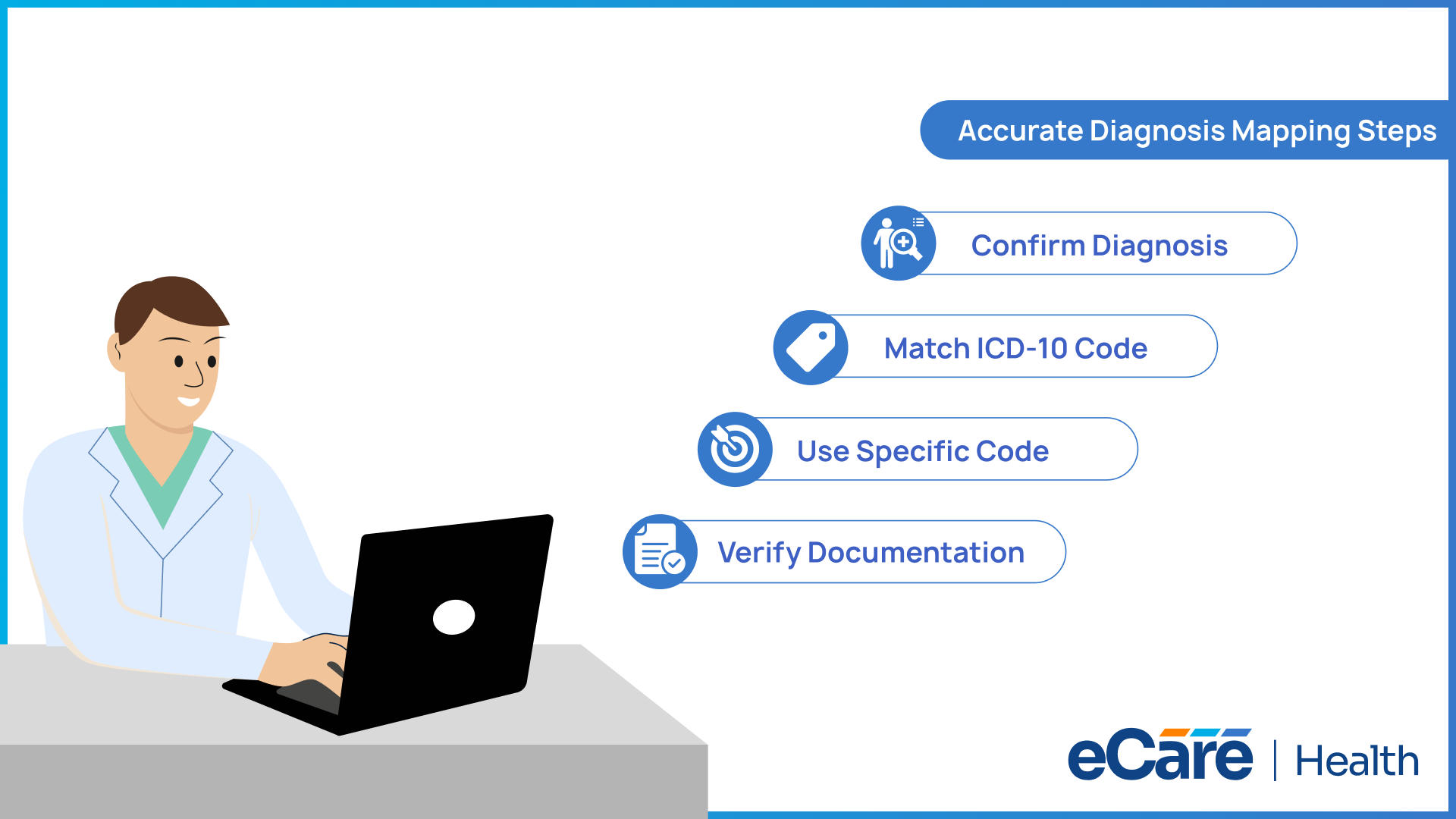
You must follow the following steps for accurate diagnosis mapping:
1. Start with the clinical diagnosis.
Evaluate the patient's symptoms, history, and assessment findings before assigning a DSM-5-TR diagnosis.
2. Identify the matching ICD-10-CM code.
Use the ICD-10-CM reference listed in the DSM-5-TR and confirm that it reflects the patient's documented condition.
3. Choose the most specific code available.
Whenever possible, select a code that captures details such as episode type, severity, or recurrence instead of relying on general or unspecified diagnoses.
4. Make sure your documentation supports the code.
Clinical notes should clearly explain the diagnosis, medical necessity, and treatment provided. If the documentation doesn't support the code, the claim may not either.
Here are some of the common coding mistakes:
- Using unspecified diagnosis codes when a more specific option is supported by the documentation.
- Selecting a code that doesn't match the patient's current clinical condition.
- Failing to update diagnosis codes when the patient's condition changes over time.
- Submitting claims with documentation that doesn't support the reported diagnosis.
If you get the diagnosis right from the start, you can save time later. And by keeping this approach in mind, eCareHealth helps providers to streamline how to crosswalk DSM-5-TR to ICD-10 codes through integrated clinical documentation and intelligent coding workflows, by reducing manual effort and improving coding accuracy.
How Should Billing Modifiers Be Used for Behavioral Health Claims?
Billing modifiers provide additional details about a service that diagnosis and CPT codes alone cannot. They can tell payers whether a service was delivered via telehealth, who provided the service, or whether special billing circumstances apply. The right modifier helps ensure accurate reimbursement, while missing or incorrect modifiers can result in claim denials.
Here are some of the common modifiers used in behavioral health:
- HJ – Identifies services provided by a clinical psychologist (payer-specific).
- HO – Indicates services provided by a master's degree-level behavioral health professional.
- 95 – Synchronous audio-video telehealth service.
- 93 – Audio-only telehealth service (when allowed).
- GT – Telehealth modifier required by certain payers.
- FQ – Audio-only telecommunications modifier for applicable programs.
- POS 02 – Telehealth provided outside the patient's home.
- POS 10 – Telehealth provided in the patient's home.
Best Practice: When you use billing modifiers HJ and HO for behavioral health claims, you should always follow payer-specific requirements and sequence modifiers correctly while ensuring they match the documented service to avoid reimbursement delays.
With eCareHealth, you can simplify this process as it validates modifiers before claims are submitted, helping you to identify potential coding issues early and reduce preventable billing errors.
What Are the Most Common Diagnosis Coding Errors That Cause Claim Denials?
As we discussed earlier, even a well-documented claim can be denied if the diagnosis code is inaccurate or does not meet payer requirements. However, most common diagnostic coding mistakes in mental health billing are avoidable with the right coding practices and claim review process.
Let’s have a quick look at the table below:
| Coding Error | How It Affects Claims | How to Prevent It |
|---|---|---|
| Selecting the wrong ICD-10-CM code | May lead to claim rejection or incorrect reimbursement. | Verify the diagnosis against the latest ICD-10-CM guidelines before billing. |
| Using outdated diagnosis codes | Claims may be denied if obsolete codes are submitted. | Stay current with annual ICD-10-CM updates. |
| Choosing unspecified codes when greater specificity is available | Payers may question medical necessity or request additional information. | Use the most specific diagnosis code supported by the clinical documentation. |
| Documentation doesn't support the diagnosis | Creates mismatches that can delay or deny reimbursement. | Ensure clinical notes clearly support the reported diagnosis and treatment. |
| Ignoring payer-specific coding requirements | Claims may fail payer edits even when the diagnosis is clinically correct. | Review individual payer policies before claim submission. |
Catching them before a claim reaches the payer is the easiest way to avoid all these errors. eCareHealth can automatically review diagnosis coding against clinical documentation and billing rules. Along with this, it also helps providers to identify potential issues early and submit clear claims with greater confidence.
How Can Psychiatry Billing Software Improve Diagnosis Coding Accuracy?
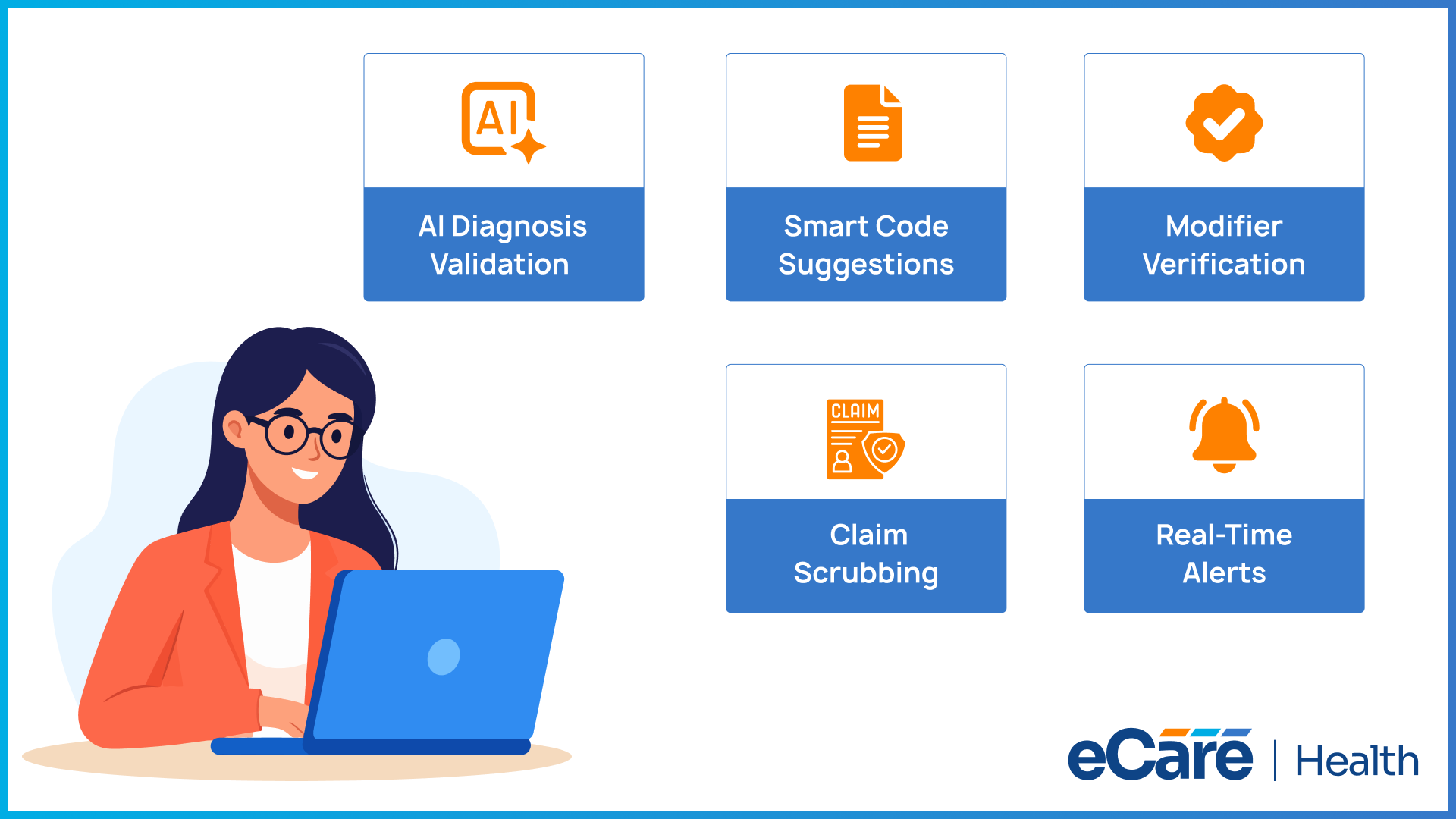
Managing mental health billing codes manually can open the door for coding errors, missing documentation, and claim rework. However, by using AI-assisted diagnosis validation, intelligent coding recommendations, modifier verification, and claim scrubbing, modern psychiatry billing software can simplify the process. This further helps to identify potential issues before claims are submitted.
Furthermore, it can also alert providers about documentation gaps, coding inconsistencies, and payer rule updates by helping practices to stay compliant and improve first-pass claim acceptance.
This further helps to identify potential issues before claims are submitted. For a broader look at how behavioral health practices can reduce claim denials and improve reimbursement, see our guide to Behavioral Health Billing in 2026: How to Reduce Denials and Get Paid Faster.
With integrated clinical and billing workflows, eCareHealth helps behavioral health organizations reduce claim denials, strengthen coding accuracy, and streamline the entire reimbursement process.
Conclusion
Accurate mental health billing codes are the foundation of successful behavioral health reimbursement. When providers use the correct ICD-10-CM diagnosis codes, apply appropriate modifiers, and maintain complete documentation, they can submit cleaner claims, reduce denials, and get reimbursed more efficiently.
By combining intelligent coding support with integrated clinical and billing workflows, eCareHealth helps behavioral health organizations simplify diagnosis coding, improve billing accuracy, and accelerate reimbursement.
Paired with its mental health EHR software, providers can streamline documentation, strengthen compliance, and spend more time focusing on patient care instead of administrative tasks.
Frequently Asked Questions
1. What are mental health billing codes?
Mental health billing codes are standardized diagnosis, procedure, and modifier codes used to document behavioral health services for insurance claims. They help payers identify the patient's condition, the care provided, and whether the service meets reimbursement requirements.
2. What is the difference between DSM-5-TR diagnoses and ICD-10-CM billing codes?
DSM-5-TR is a clinical manual used to diagnose mental health conditions based on symptoms and diagnostic criteria. ICD-10-CM provides the standardized diagnosis codes required for insurance billing and reimbursement. In practice, providers diagnose patients using DSM-5-TR and report the corresponding ICD-10-CM code on claims.
3. How do you crosswalk DSM-5-TR diagnoses to ICD-10-CM codes?
To crosswalk DSM-5-TR diagnoses to ICD-10-CM codes, first identify the patient's clinical diagnosis using DSM-5-TR criteria. Then, select the corresponding ICD-10-CM code referenced in the manual and ensure it accurately reflects the patient's documented condition before submitting the claim.
4. What are the most commonly used mental health ICD-10-CM diagnosis codes?
Some of the most frequently used mental health ICD-10-CM diagnosis codes include F32.1 (Major Depressive Disorder, Single Episode, Moderate), F33.1 (Major Depressive Disorder, Recurrent, Moderate), F41.1 (Generalized Anxiety Disorder), F43.10 (Post-Traumatic Stress Disorder), and F90.2 (ADHD, Combined Type). The appropriate code should always be selected based on the patient's documented diagnosis.
5. When should HJ and HO billing modifiers be used?
Modifier HJ is used by some payers to identify services provided by a clinical psychologist, while modifier HO often indicates services performed by a master's degree-level behavioral health professional. Because modifier requirements vary by payer and state, providers should always verify individual billing guidelines before submitting claims.
6. What is the difference between telehealth modifiers 95 and 93?
Modifier 95 is used for eligible services delivered through real-time audio-video telehealth. Modifier 93 applies to eligible audio-only telehealth services when allowed by the payer. The correct modifier depends on how the service was delivered and the payer's reimbursement policies.
7. What are the most common diagnosis coding mistakes that cause claim denials?
Common diagnosis coding mistakes include using outdated ICD-10-CM codes, selecting unspecified diagnoses when more specific codes are available, submitting documentation that doesn't support the reported diagnosis, and overlooking payer-specific coding requirements. Regular coding reviews and accurate documentation can help prevent these errors.
8. How do behavioral health billing codes affect reimbursement?
Behavioral health billing codes determine how payers evaluate claims for medical necessity and reimbursement. Accurate diagnosis codes, CPT codes, modifiers, and supporting documentation improve the likelihood of first-pass claim acceptance, while coding errors can lead to payment delays or denials.
9. How can psychiatry billing software improve diagnosis coding accuracy?
Psychiatry billing software helps improve diagnosis coding by validating codes, identifying documentation gaps, recommending appropriate modifiers, and checking claims for coding errors before submission. These automated workflows reduce manual effort, improve compliance, and increase the chances of faster reimbursement.