Mental Health CPT Codes in 2026: How to Bill Accurately and Avoid Claim Denials
Every therapy session deserves to be paid for, but not every claim makes it that far.
The reason often has little to do with the quality of care. Claims are frequently delayed or denied because of preventable billing mistakes like wrong CPT code selection, inaccurate session time reporting, or incomplete documentation submission.
Even though these errors may seem minor, they can result in payment delays, increasing administrative work while gradually impacting a practice’s revenue. The core problem here is that behavioral health billing is getting harder day by day.
Today, providers need to be more precise than ever because of evolving payer requirements, time-based psychotherapy services, and specialty-specific coding guidelines. It is not enough to simply know a CPT code; you should also know when to use it, how to document it correctly, and what payers expect to see before approving a claim.
That’s where a solid understanding of mental health CPT codes 2026 becomes necessary. No matter if you are a psychiatrist, psychologist, therapist, or billing professional, you should use the right codes and documentation practices to strengthen behavioral health billing, reduce claim denials, and improve reimbursement.
So, let’s dive into the blog to know more about the most commonly used mental health CPT codes 2026, explain when to use them, highlight common billing mistakes, and share practical documentation tips to help you submit cleaner claims with confidence.
What Are Mental Health CPT Codes and Why Do They Matter?
If providing quality mental health care is half the job, the other half of the job is ensuring your services are billed correctly so it becomes easy for your practice to get reimbursed. And that’s exactly where mental health CPT codes 2026 come into the picture.
Before moving forward, it is necessary to have a quick look at the CPT codes. Current Procedural Terminology (CPT) codes are standardized procedure codes that are used to identify the behavioral health services you’ve provided.
From psychiatric evaluation and a psychotherapy session to medication management billing codes, the CPT codes help insurance payers to know exactly what service was delivered and how it should be reimbursed.
Even so, CPT codes never work in isolation. Every submitted code must match your clinical documentation. Even if the care itself was appropriate and the documented session time, treatment details, or medical necessity fail to support the selected code, the claim can be delayed or denied.
Here, accurate coding plays an important role in behavioral health billing. When coding and documentation stay on the same page, it can result in cleaner claims and faster reimbursement.
Rather than depending on manual coding, solutions like eCareHealth help to connect clinical documentation with billing workflows. It allows providers to document encounters, capture session time, and assign appropriate CPT codes from the same platform. This approach can further help to reduce errors while streamlining the billing process.
Which Mental Health CPT Codes Are Most Commonly Used in 2026?
Behavioral health providers use various CPT codes on the basis of the service delivered, session length, and level of care provided. Selecting the right code is important as it can directly impact reimbursement and help to make sure that the claim meets payer requirements.
Even though there are many behavioral health CPT codes, a few of them are used more frequently than others.
The table below highlights the most commonly used mental health CPT codes for 2026 and when they should be reported:
| CPT Code | Service | When to Use |
|---|---|---|
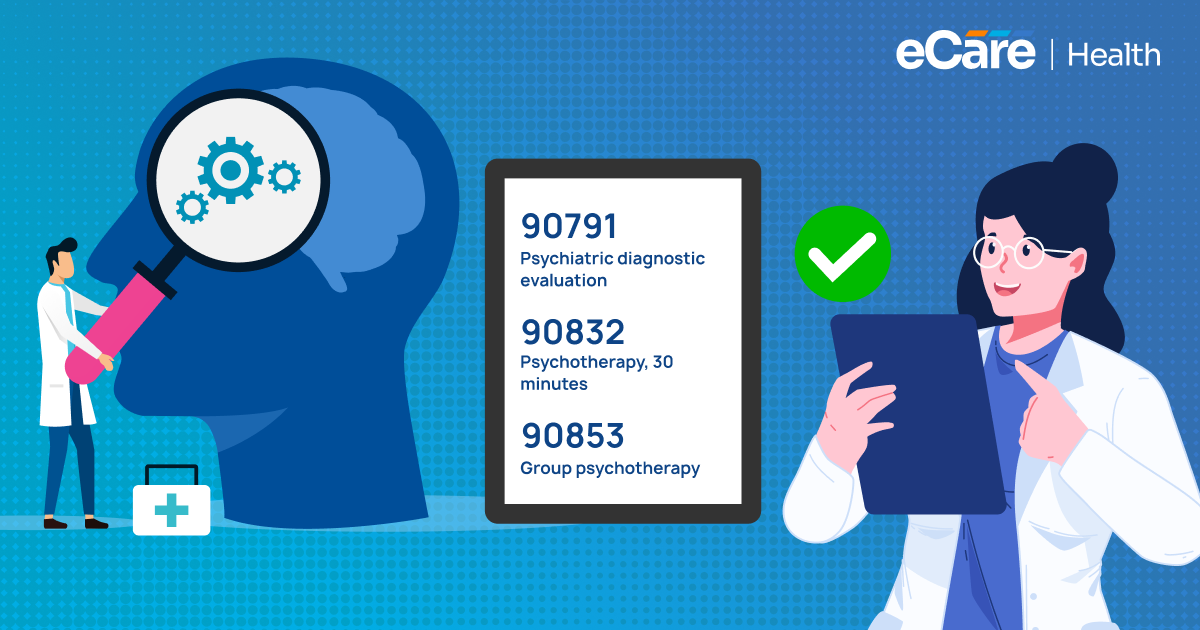
| 90791 | Psychiatric Diagnostic Evaluation | Initial psychiatric evaluation without medical services. |
| 90792 | Psychiatric Diagnostic Evaluation with Medical Services | Initial evaluation that includes medical services, such as medication assessment. |
| 90832 | Psychotherapy (16–37 minutes) | Individual psychotherapy sessions lasting 16–37 minutes. |
| 90834 | Psychotherapy (38–52 minutes) | Individual psychotherapy sessions lasting 38–52 minutes. |
| 90837 | Psychotherapy (53+ minutes) | Individual psychotherapy sessions lasting 53 minutes or longer. |
| 90846 / 90847 | Family Therapy | Family therapy without (90846) or with (90847) the patient present. |
| 90853 | Group Therapy | Psychotherapy provided in a group setting. |
| 90839 | Crisis Psychotherapy | First 60 minutes of crisis intervention. |
| +90840 | Additional Crisis Psychotherapy | Each additional 30 minutes with 90839. |
| 90785 | Interactive Complexity Code | Add-on code for services involving communication-related complexities. |
As using the correct CPT code is only part of the process, your documentation, session time, and medical necessity must also support the code submitted. For psychotherapy time-based billing, this is even more important, where even small documentation gaps can result in denied claims.
With eCareHealth, providers can easily document encounters, capture session time, and support accurate CPT code selection within the same workflow. This can result in manual effort reduction and behavioral health billing improvements, while helping practices to submit cleaner claims with greater confidence.
How Does Psychotherapy Time-Based Billing Work?
In behavioral health, psychotherapy CPT codes rely on the face-to-face time spent providing therapy. Reporting the correct code is important, as even a small difference in documented time can impact reimbursement and increase the risk of claim denials.
Let’s see the time thresholds for commonly used psychotherapy codes, which are defined by the American Medical Association (AMA):
| CPT Code | Face-to-Face Psychotherapy Time |
|---|---|
| 90832 | 16–37 minutes |
| 90834 | 38–52 minutes |
| 90837 | 53 minutes or more |
Only the time spent delivering psychotherapy to the patient counts toward CPT code selection. Administrative work, documentation, care coordination, or other non-face-to-face activities should not be included.
Common Documentation Mistakes
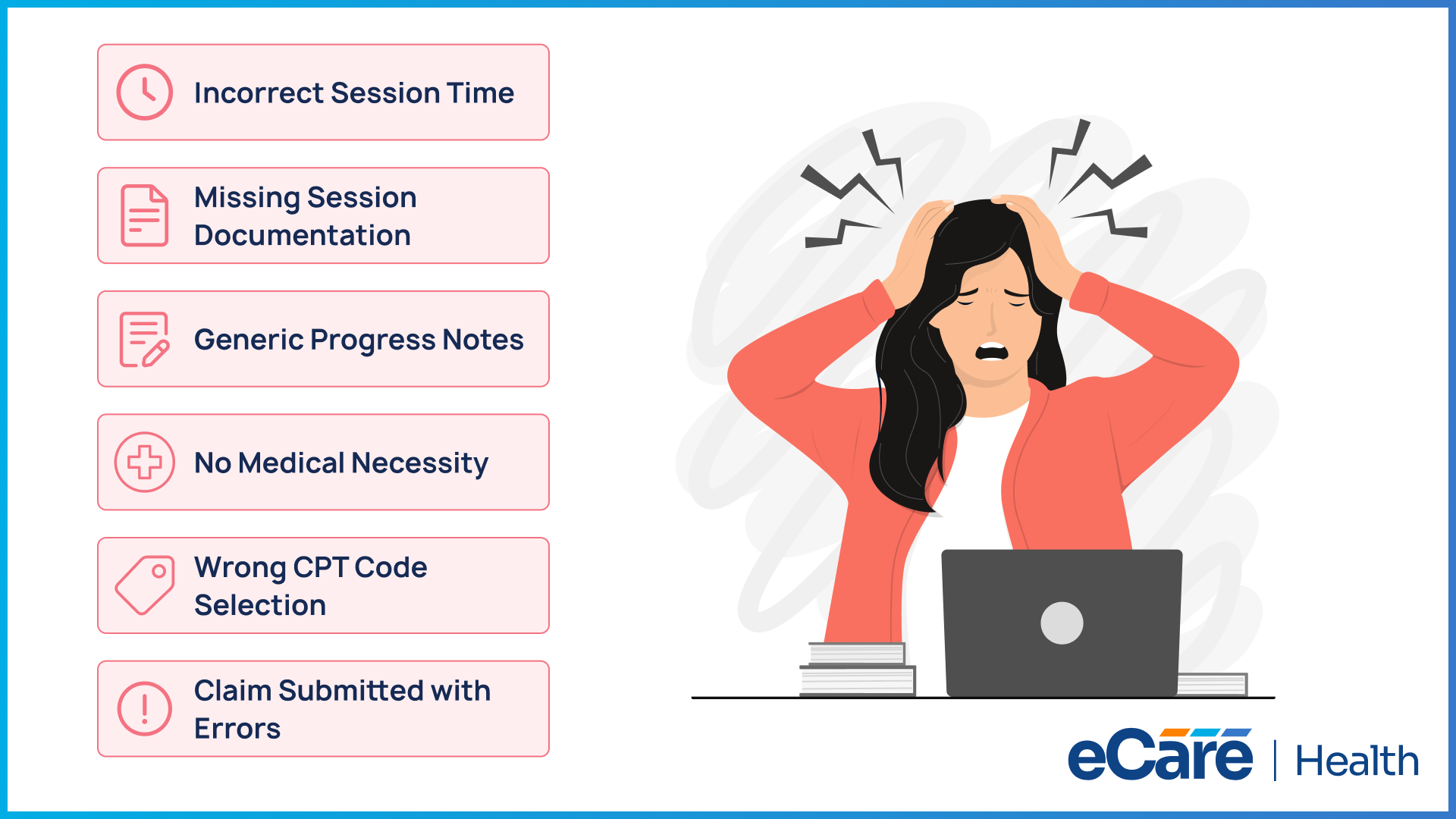
Billing 90837 for a 52-minute session is one of the most common causes of time-based psychotherapy claim denials. As 90837 needs at least 53 minutes of face-to-face psychotherapy, submitting it for a shorter session can lead to denied or downcoded claims.
Failing to document the total session time, using generic progress notes that do not support the service provided, or overlooking medical necessity are some of the other common mistakes.
If the documentation fails to explain why the service was needed and what interventions were performed, payers can raise the question of whether the selected CPT code is appropriate.
You should document the face-to-face session time, therapeutic interventions, the patient’s response, and the medical necessity of the service to support how to document time-based mental health codes accurately. Clear documentation can help to support cleaner claims while reducing avoidable claims.
By integrating time tracking with clinical documentation and billing workflows, eCareHealth simplifies this process. As you complete notes, this platform can support the selection of accurate CPT codes, enhance documentation quality, and streamline behavioral health billing.
When Should the Interactive Complexity Code 90785 Be Reported?
For the interactive complexity code (90785), not every behavioral health encounter can qualify. This add-on code can be used only when the communication factors make a service significantly more complex than usual. As it cannot be billed on its own, it should be reported with an eligible primary CPT code and supported by clear clinical documentation.
According to the billing guidelines for interactive complexity code 90785, providers should document one or more of the following circumstances:
- Communication barriers that interfere with treatment.
- Active involvement of caregivers or other third parties during the session.
- Events involving mandated reporting, such as abuse or neglect.
- The need for an interpreter or other communication support.
When all these factors are present and clearly documented, only then can 90785 be reported. Some of the common reporting mistakes of it are using it routinely, billing it as a standalone code, or pairing it with an ineligible primary service, which can lead to claim denials.
eCareHealth allows providers to document communication complexities within the clinical note while the platform supports appropriate CPT code selection. This further helps strengthen documentation, improve coding accuracy, and reduce billing errors before claims are submitted.
What Are the Most Common CPT Coding Errors That Cause Claim Denials?
Reasons behind many behavioral health claim denials are not the care provided, but actually the avoidable coding and documentation mistakes. Identifying these issues before submitting a claim can help practices improve reimbursement, reduce rework, and create a more efficient billing process.
Here is the quick summary of common coding errors and how to avoid them:
| Common Coding Error | How to Avoid It |
|---|---|
| Selecting the wrong CPT code | Verify that the reported code accurately reflects the service provided and supported documentation. |
| Time documentation inconsistencies | Record accurate face-to-face session time and ensure it matches the billed psychotherapy code. |
| Coding and documentation mismatches | Make sure clinical notes, medical necessity, and the selected CPT code align. |
| Incorrect use of add-on codes (such as 90785) | Report add-on codes only with eligible primary services and document the required supporting criteria. |
| Missing or incomplete documentation | Include session duration, interventions performed, patient response, and medical necessity. |
| Ignoring payer-specific billing requirements | Review payer policies regularly, as documentation and coding requirements may vary. |
While correcting CPT coding errors can improve claim accuracy, reducing denials requires a broader approach to behavioral health billing. For a deeper look at denial prevention strategies, reimbursement challenges, and ways to get claims paid faster, explore our guide on Behavioral Health Billing in 2026: How to Reduce Denials and Get Paid Faster.
Reduction in claim denials always starts with accurate coding, complete documentation, and routine claim reviews before submission. Even small improvements in coding accuracy can result in cleaner claims, faster reimbursement, and fewer billing corrections.
eCareHealth helps practices identify potential coding and documentation errors before claims are submitted. The platform further supports the selection of accurate CPT codes, key documentation elements, and behavioral health billing efficiency improvement by connecting clinical documentation with billing workflows.
How Can Psychiatry Billing Software Improve CPT Coding Accuracy?
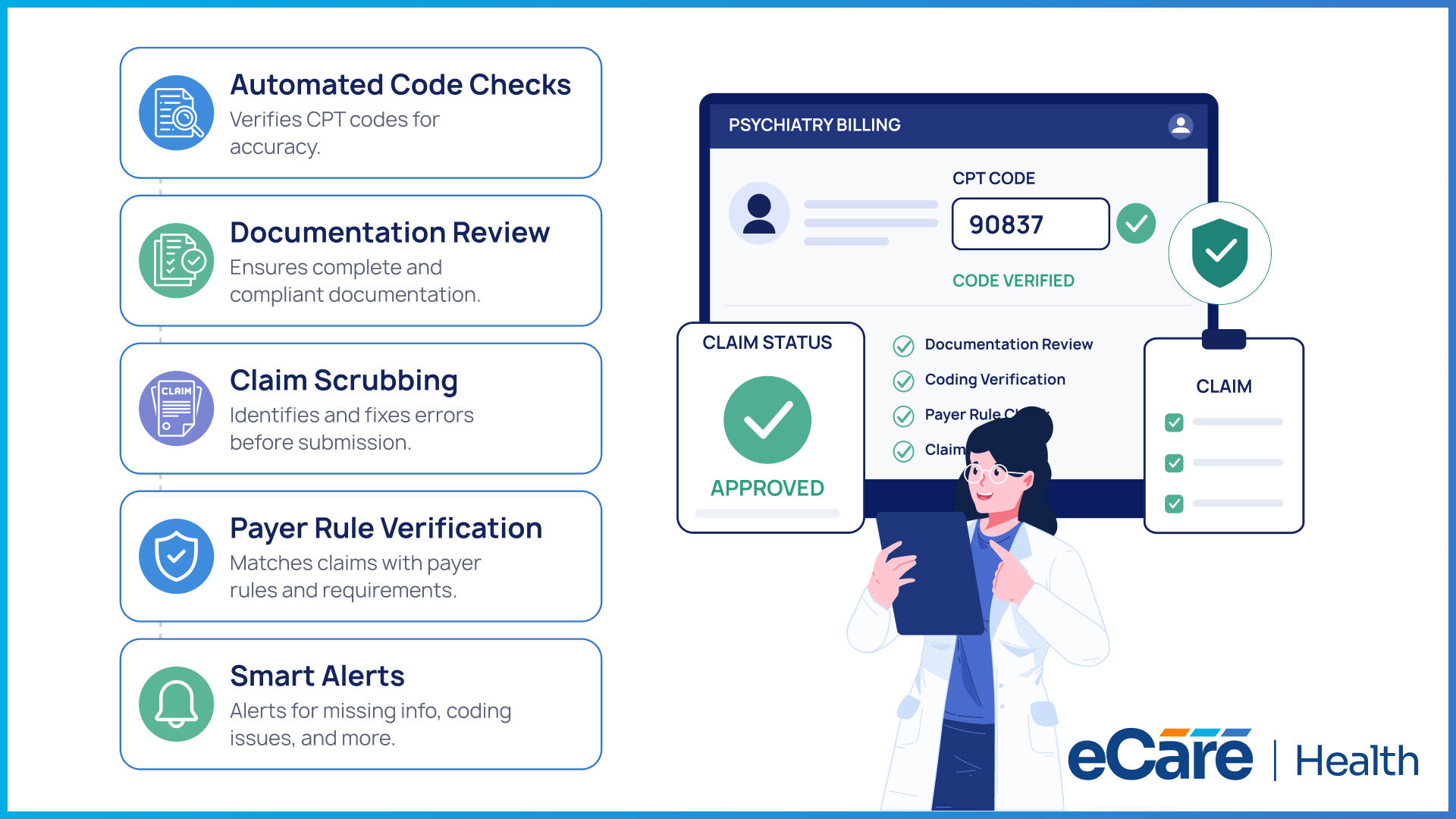
Manual billing processes can result in coding errors, missing documentation, and even denied claims. With modern psychiatry billing software, these risks can be reduced, as it can automate coding verification, documentation reviews, claim scrubbing, and payer rule verification before claims are even submitted.
Furthermore, it can alert providers about coding inconsistencies, incomplete documentation, or missing billing requirements. This further allows issues to be corrected before they can affect reimbursement. Finally, it can result in cleaner claims, fewer denials, and a more efficient billing process.
eCareHealth helps behavioral health organizations manage documentation, coding, and billing from a single platform. It further helps to reduce denials, improve reimbursement, and streamline behavioral health billing workflows by supporting accurate CPT coding and validating claims before submission.
Conclusion
Accurate mental health CPT codes 2026, complete documentation, and proper time reporting are the foundation of successful behavioral health billing. When CPT codes accurately reflect the services provided and are supported by compliant documentation, practices can reduce claim denials, improve reimbursement, and spend less time on billing corrections.
With integrated mental health EHR software, eCareHealth simplifies every step of the billing process, from documentation and CPT code selection to claim validation and submission.
By helping behavioral health organizations improve coding accuracy and streamline billing workflows, mental health EHR software from eCareHealth enables providers to focus more on delivering quality patient care and less on administrative challenges.
Frequently Asked Questions
1. What are the most commonly used mental health CPT codes in 2026?
Some of the most commonly used mental health CPT codes include 90791 (psychiatric diagnostic evaluation), 90792 (psychiatric diagnostic evaluation with medical services), 90832, 90834, and 90837 (individual psychotherapy based on session time), 90846/90847 (family therapy), 90853 (group therapy), 90839 and +90840 (crisis psychotherapy), and 90785 (interactive complexity add-on code).
2. What is the difference between CPT codes 90791 and 90792?
Both codes are used for an initial psychiatric diagnostic evaluation. 90791 is reported when the evaluation does not include medical services, while 90792 is used when the evaluation includes medical components, such as medication assessment or prescribing, and is typically performed by a qualified medical provider.
3. How do psychotherapy time-based billing rules work?
Psychotherapy codes are selected based on the face-to-face time spent providing therapy. Generally, 90832 is used for 16–37 minutes, 90834 for 38–52 minutes, and 90837 for sessions lasting 53 minutes or more. Only face-to-face psychotherapy time counts toward code selection.
4. What documentation is required for time-based psychotherapy billing?
Documentation should include the face-to-face session duration, therapeutic interventions performed, the patient's response to treatment, and the medical necessity for the service. Complete and accurate documentation helps support the billed CPT code and reduces the risk of claim denials.
5. When should Interactive Complexity Code 90785 be billed?
Code 90785 should be reported as an add-on code when communication factors significantly increase the complexity of a behavioral health service. Examples include communication barriers, caregiver involvement, mandated reporting situations, or the need for an interpreter. It must be billed with an eligible primary CPT code and supported by appropriate documentation.
6. What are medication management billing codes?
Medication management services are commonly reported using 90792 during an initial psychiatric evaluation with medical services or appropriate Evaluation and Management (E/M) codes for follow-up medication management visits, depending on the provider type and services performed.
7. What are the most common CPT coding mistakes that lead to claim denials?
Common mistakes include selecting the wrong CPT code, documenting inaccurate session times, submitting incomplete clinical documentation, incorrectly reporting add-on codes, and failing to meet payer-specific billing requirements. These errors can result in delayed or denied claims.
8. How can providers document time-based psychotherapy sessions accurately?
Providers should clearly document the face-to-face psychotherapy time, interventions performed, patient progress, response to treatment, and the clinical rationale for the service. Documentation should always align with the CPT code reported and support medical necessity.
9. How can psychiatry billing software improve CPT coding accuracy?
Psychiatry billing software helps improve coding accuracy by automating documentation reviews, validating CPT code selection, checking payer-specific billing requirements, identifying coding inconsistencies, and flagging missing documentation before claims are submitted. This helps reduce claim denials and streamline the billing process.