Behavioral Health EHR Systems: A Complete Overview and Buyer’s Guide for Mental Health Practices in 2026

Did you know that for many health practices, EHR systems are creating more work than they’re actually solving? And your practice could be one of them.
Sounds shocking, doesn’t it? However, it’s actually happening more often than you might think. Many mental health providers still depend heavily on generic healthcare software, which was never specifically designed for therapy sessions, psychiatric evaluations, treatment plans, or behavioral health documentation.
Rather than making your work easier, these systems can usually create disconnected workflows, repetitive data entry, and unnecessary administrative burden. And this is exactly why many healthcare organizations are switching to behavioral health EHR systems that are built specifically for mental health care.
As compared to traditional EHRs, they can streamline documentation, scheduling, billing, telehealth, and care coordination in one place. This also allows you to spend less time on managing paperwork and more time on caring for patients.
No matter if you are exploring your first EHR for behavioral health or planning to replace an outdated system, choosing the right solution can transform the way your practice operates. In this blog, you will find everything you need to know from the essential features and key benefits to practical tips for selecting the right platform for your practice in 2026.
Understanding Behavioral Health EHR Systems
Until here, it might be clear to you that generic EHRs are not always the perfect match for mental health practices. So, what actually makes behavioral health EHR systems different?
Simply put, they’re specifically designed for the way behavioral health providers work. These systems bring documentation, scheduling, billing, telehealth, treatment planning, and patient engagement all together in just one place, rather than forcing clinicians to struggle with multiple tools.
Behavioral health EHR also supports workflows that are unique to mental health care. For example, every feature from therapy notes and psychiatric evaluations to group sessions and ongoing care plans is built around the daily needs of behavioral health providers.
Today, many therapists, psychologists, psychiatrists, counseling centers, and community mental health organizations are using behavioral health EHR software. The key reason behind this is that it simplifies operations without compromising patient care.
Modern behavioral health EHR platforms have the ability to streamline everyday workflows, minimize administrative burden, enhance care coordination, and allow clinicians to focus more on what matters the most. So, it is fair enough to say that they do much more than just store patient records.
How Behavioral Health EHR Software Supports Modern Mental Health Practices
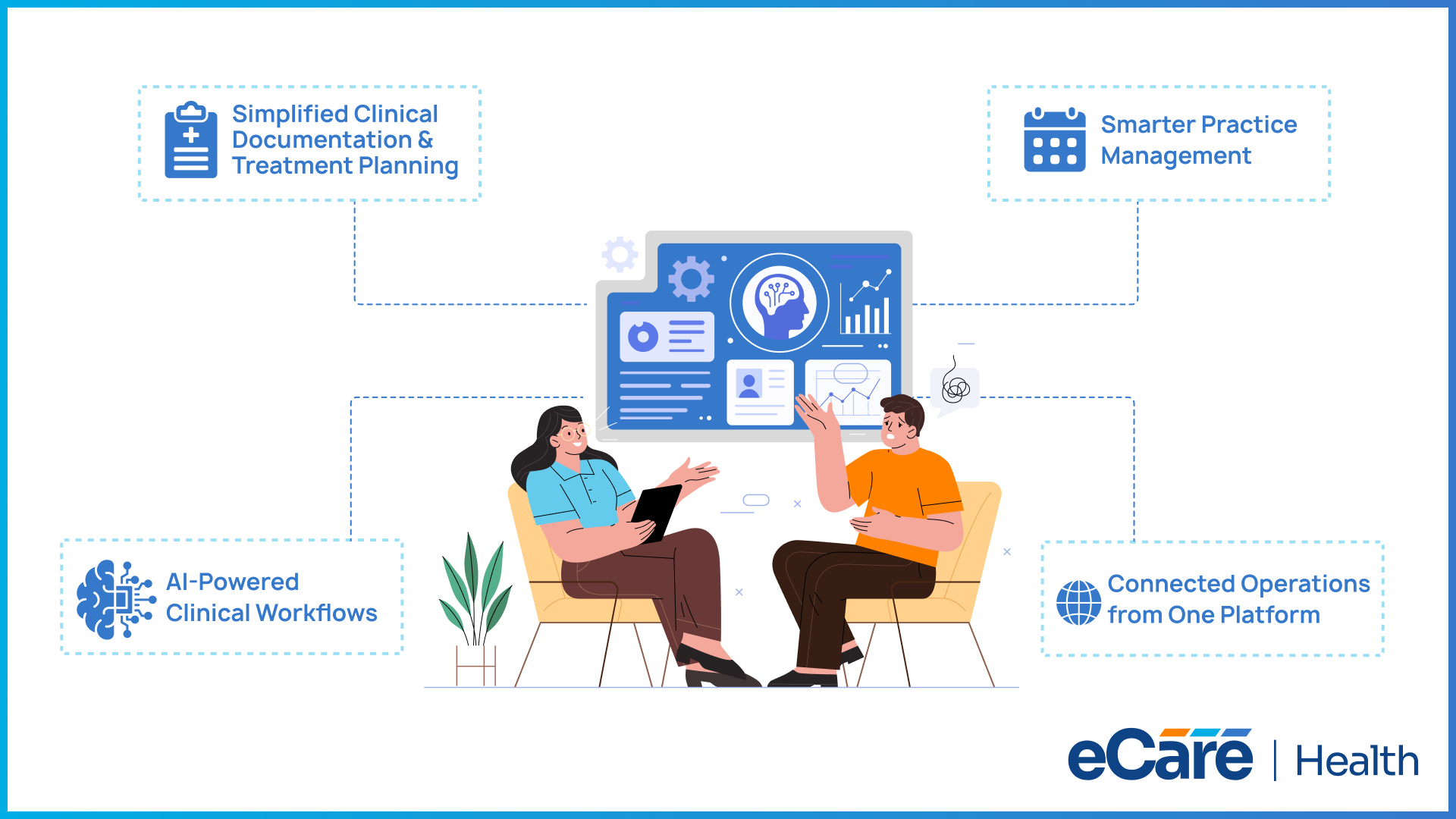
Understanding what behavioral health EHR systems are is only a single part of the story. What’s more, it is how they can simplify the day-to-day challenges of your mental health practice. Let’s explore how the right behavioral health EHR software supports the clinical and operational workflows that keep modern mental health practices running efficiently:
- Simplified Clinical Documentation & Treatment Planning: Specialty-specific templates help providers create therapy notes, psychiatric evaluations, treatment plans, and progress notes more efficiently while maintaining accurate patient records.
- Smarter Practice Management: With built-in mental health practice management software, practices can manage scheduling, appointment reminders, digital intake forms, and patient communication from a single platform. This makes your everyday operations more organized as well as efficient.
- AI-Powered Clinical Workflows: AI-assisted documentation and measurement-based care can minimize repetitive administrative work and support clinical decision-making, while allowing you to spend extra time with your patients, rather than paperwork.
- Connected Operations from One Platform: Modern behavioral health EHR platforms can bring telehealth, interoperability, billing, reporting, and compliance tools together in one place. Rather than switching between multiple systems, practices can manage their entire workflow more effectively and deliver a better patient experience.
Platforms like eCareHealth follow this connected approach by bringing behavioral health documentation, scheduling, billing, telehealth, patient engagement, and interoperability together in one integrated solution, helping practices streamline both clinical and administrative workflows.
To learn more about the benefits of mental health EHR software, read 7 Key Benefits of Mental Health EHR Software for Behavioral Health Practices in 2026.
Essential Features to Evaluate in Behavioral Health EHR Platforms
Not all behavioral health EHR platforms have the ability to offer the same capabilities. While every vendor promises to simplify practice management, the right solution must support your clinical, administrative, and long-term business needs.
- Clinical & Practice Management Features: You should always look for a platform that can simplify your everyday workflows like clinical documentation, treatment planning, appointment scheduling, patient intake, billing, and secure patient communication. Built-in mental health practice management software can assist you in minimizing manual work and keeping your practice organized.
- AI, Telehealth, & Connected Workflows: Modern platforms should do more than just store patient records. Features including AI-assisted documentation, integrated telehealth, reporting dashboards, and interoperability with other healthcare systems help to improve efficiency and support informed clinical decisions, while creating more connected care experiences.
- Security, Compliance, & Room to Grow: Protecting patient information should never be an afterthought. Always choose an EHR for behavioral health that offers strong security, HIPAA-compliant safeguards, role-based access, audit trails, and reliable data protection. Also make sure that the platform can scale with your practice as your patient volume, providers, and service offerings continue to grow.
For a detailed look at the features that matter most, read Top 10 Mental Health EHR Features Every Behavioral Health Practice Needs in 2026
.
Comparing Behavioral Health EHR Systems with General EHR Solutions
At first, you may think that most EHRs are similar. However, when it comes to behavioral healthcare, the differences become much more noticeable. General EHRs are designed to support a range of medical specialties; on the other hand, behavioral health EHR software is built around the unique clinical and operational needs of mental health providers.
| Feature | General EHR | Behavioral Health EHR Systems |
|---|---|---|
| Clinical Documentation | Standard medical templates | Therapy notes, psychiatric evaluations, treatment plans, and behavioral health-specific documentation |
| Clinical Workflows | General medical workflows | Workflows tailored for counseling, psychiatry, and ongoing behavioral care |
| Billing & Practice Management | Basic scheduling and billing | Integrated mental health practice management software, scheduling, billing, and patient communication |
| Compliance & Security | General healthcare compliance | Supports HIPAA requirements and behavioral health privacy needs |
| Patient Engagement | Basic patient portal features | Telehealth, digital intake forms, secure messaging, and ongoing patient engagement tools |
Finally, one thing you should always keep in mind is that the right platform is not necessarily the one with the most features; it’s actually the one designed for the way your practice delivers care.
To understand the key differences in more detail, read Behavioral Health EHR vs General EHR: Why Specialty-Specific Software Matters.
How to Evaluate & Choose the Right Behavioral Health EHR System
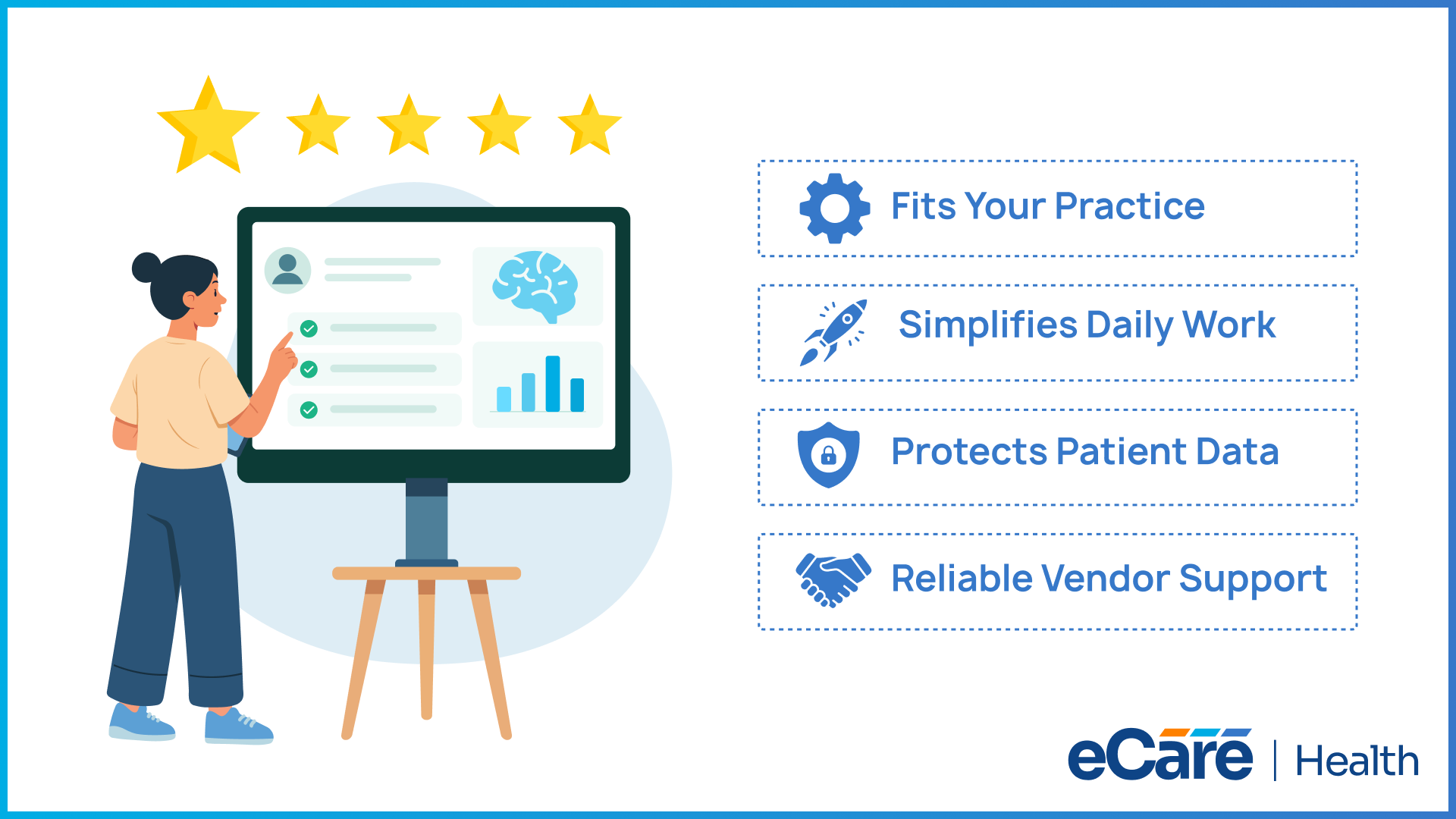
As choosing an EHR is a long-term investment, you should always look beyond the sales demo. You must check the essential pointers before making a decision.
- Fits your Practice, not the Other Way Around: Rather than forcing your team to adapt to complicated software, the system must support your clinical workflows, operational needs, billing processes, and future growth.
- Makes Everyday Work Easier: You should always look for an intuitive interface, cloud-based access, AI-assisted documentation, integrated telehealth, and seamless integrations with the systems you already use.
- Keeps Patient Data Protected: Make sure that platforms support HIPAA, 42 CFR Part 2, role-based access, encryption, audit trails, and other security measures to protect sensitive behavioral health information.
- Comes with a Reliable Partner: A great platform is only one piece of the puzzle. Equally important are responsive customer support, implementation assistance, staff training, and regular product updates for long-term success.
For example, eCareHealth combines behavioral health-specific functionality with implementation guidance, ongoing support, and continuous product enhancements to help practices achieve long-term success.
Understanding Behavioral Health EHR Pricing
The behavioral health EHR system’s cost goes beyond the monthly subscription. Your practice’s size, workflow requirements, implementation needs, and the features you choose are some of the key factors on which your total investment usually depends. Let’s see what typically influences the overall cost:
| Pricing Factor | What It Means for Your Practice |
|---|---|
| Licensing Model | Vendors may charge per provider, per user, or offer organization-wide pricing. |
| Implementation | Data migration, system setup, and staff training can affect upfront costs. |
| Features & Integrations | AI tools, telehealth, billing, analytics, and third-party integrations may increase pricing. |
| Practice Size | Larger organizations with multiple locations or providers often require more customization and support. |
| Ongoing Support | Maintenance, software updates, and customer support should be considered as part of the long-term investment. |
Along with affordability, your organization should also consider not only scalability but also long-term value. Selecting a solution based only on the lowest price can result in additional costs later if the platform is unable to support your future needs. On the other hand, behavioral health EHR software solutions help to balance functionality, flexibility, and total cost of ownership.
Future Trends in Behavioral Health EHR Systems
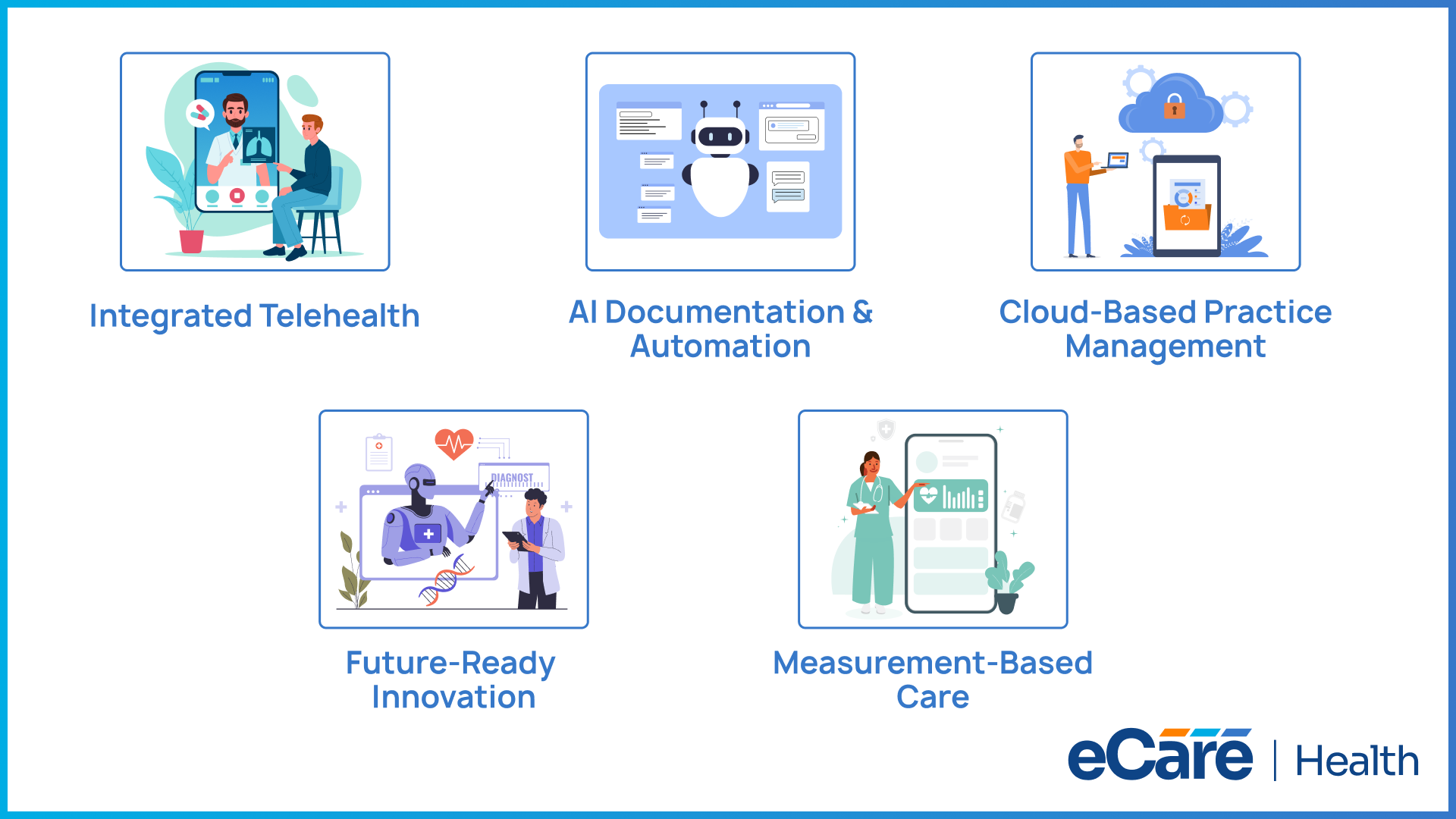
As behavioral healthcare is evolving rapidly, the technologies are too. Patient expectations, regulatory requirements, and clinical workflows are continuing to change; behavioral health EHR systems are now becoming more intelligent, connected, and efficient. Here are some of the key trends shaping the behavioral healthcare future:
- AI-Powered Documentation & Intelligent Automation: AI helps clinicians to spend less time on repetitive administrative tasks and more time with patients. From generating clinical notes to automating routine workflows, intelligent automation can enhance productivity and reduce documentation burden.
- Measurement-Based Care & Connected Behavioral Healthcare: By helping providers track patient outcomes through standardized assessments and real-time insights, modern EHRs are moving beyond just record-keeping. Combined with connected care workflows, this enables more personalized treatment planning and stronger care coordination.
- Behavioral Health EHR Platforms with Integrated Telehealth: Virtual care is no longer an add-on feature. With integrated telehealth, you can schedule appointments, conduct secure virtual visits, document encounters, and communicate with patients through a single platform — creating a more seamless care experience.
- Cloud-Based Psychiatric Practice Management Software: With cloud technology, practices can easily scale without investing heavily in complex IT infrastructure. Cloud-based solutions provide secure access to patient information, automatic software updates, and greater flexibility for providers working across multiple locations.
- Emerging Innovations Shaping Behavioral Healthcare Technology: The future will continue to be driven by innovations such as predictive analytics, enhanced interoperability, remote patient engagement, and smarter clinical decision support. Practices that stay ahead of these trends will be better positioned to improve efficiency, adapt to changing care models, and deliver better patient outcomes.
Conclusion
Choosing the right behavioral health EHR systems is an investment in your practice’s future. The ideal solution should simplify clinical and administrative workflows, support compliance, and scale as your practice grows.
By focusing on your practice’s unique needs and evaluating the right features, you can confidently choose a platform that improves efficiency, enhances patient care, and supports long-term success.
Ready to find the right behavioral health EHR software for your practice? Contact us to learn how eCareHealth can help.
Frequently Asked Questions
1. What are behavioral health EHR systems?
Behavioral health EHR systems are specialized electronic health record solutions designed for mental health providers. They help manage clinical documentation, treatment plans, scheduling, billing, telehealth, patient engagement, and compliance from a single platform.
2. How are behavioral health EHR systems different from general EHR software?
Unlike general EHR software, behavioral health EHR systems are built specifically for mental health workflows. They include features such as therapy notes, psychiatric evaluations, behavioral health treatment plans, integrated telehealth, and specialized documentation templates.
3. Who should use behavioral health EHR software?
Behavioral health EHR software is ideal for psychiatrists, psychologists, therapists, counselors, behavioral health clinics, community mental health centers, substance use treatment facilities, and multi-provider mental health practices.
4. What features should every behavioral health EHR system include?
A behavioral health EHR system should include clinical documentation, treatment planning, appointment scheduling, billing, telehealth, patient engagement tools, reporting, interoperability, AI-assisted documentation, and HIPAA-compliant security features.
5. How does mental health practice management software improve behavioral healthcare?
Mental health practice management software streamlines scheduling, patient communication, billing, documentation, and administrative tasks. This allows providers to spend less time managing operations and more time delivering quality patient care.
6. Do behavioral health EHR platforms support integrated telehealth?
Yes. Most modern behavioral health EHR platforms offer integrated telehealth, enabling providers to schedule virtual visits, conduct secure video consultations, document encounters, and communicate with patients within the same system.
7. Are behavioral health EHR systems HIPAA and 42 CFR Part 2 compliant?
Many behavioral health EHR systems are designed to support HIPAA compliance and, when applicable, 42 CFR Part 2 requirements. However, practices should always verify a vendor’s compliance capabilities before making a purchase.
8. How do AI features improve behavioral health EHR systems?
AI helps automate repetitive tasks such as clinical documentation, note generation, and workflow management. This reduces administrative burden, improves productivity, and gives clinicians more time to focus on patient care.
9. How much do behavioral health EHR systems cost?
Pricing varies depending on the vendor, practice size, deployment model, implementation services, and included features. Many vendors offer subscription-based pricing, while larger organizations may require customized plans.
10. How do I choose the right behavioral health EHR system?
Start by evaluating your clinical workflows, operational needs, compliance requirements, and growth plans. Then compare usability, AI capabilities, integrations, security, customer support, and scalability before making a decision.
11. What integrations should a behavioral health EHR platform support?
A behavioral health EHR platform should support integrations with telehealth solutions, billing systems, laboratories, pharmacies, patient portals, and other healthcare applications to improve workflow efficiency and care coordination.
12. Are cloud-based behavioral health EHR systems secure?
Yes. Reputable cloud-based behavioral health EHR systems use encryption, secure data storage, role-based access controls, regular backups, and other security measures to protect sensitive patient information.
13. What are the best behavioral health EHR systems for mental health practices?
The best behavioral health EHR system depends on your practice’s size, specialty, workflow, and long-term goals. Look for a solution that offers behavioral health-specific features, integrated telehealth, AI-powered automation, strong security, interoperability, and reliable customer support.