Behavioral Health EHR vs General EHR: Why Specialty-Specific Software Matters
One EHR can help a medical practice run seamlessly; on the other hand, the same system can slow a behavioral health practice down.
Ever wondered why? Well, that’s because many mental health providers don’t just document visits; they also handle ongoing therapy, detailed psychiatric evaluations, treatment plans, and highly confidential records.
With almost 23.4% of U.S. adults experiencing mental illness in 2024, the demand for behavioral health services continues to rise. Even so, many practices still depend on software built for primary care rather than for mental healthcare.
The obvious results are more clicks, more workarounds, and more time spent managing technology, instead of caring for patients. This is why behavioral health EHR software becomes a necessity instead of a nice-to-have.
Unlike a general medical system, a specialty-specific EHR is designed around the daily realities of behavioral health providers, from documentation to psychiatric practice management software workflows.
So, what truly separates an EHR designed for behavioral health from one built for general medical practices? Let’s compare behavioral health EHR vs general EHR, explore where general systems fall short, and help you choose software that supports your practice today and as it grows.
Understanding Behavioral Health EHR & General EHR
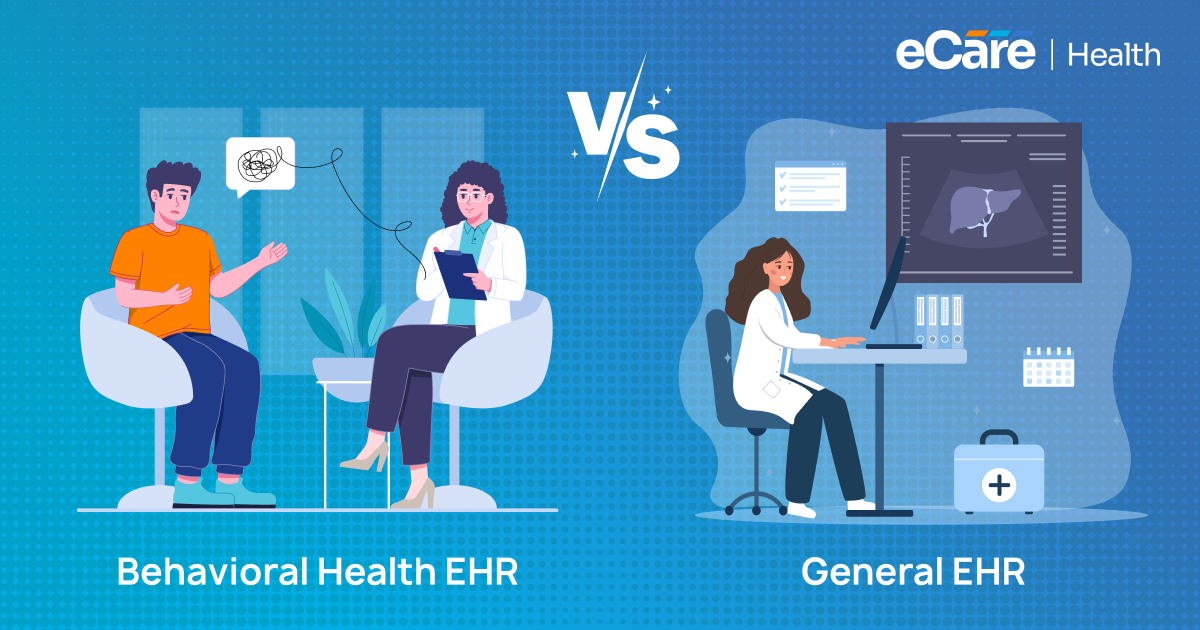
Behavioral health EHR and general EHR are both designed to manage patient information, but they serve different types of healthcare providers and support different clinical workflows.
A general EHR is specifically designed for hospitals, primary care practices, and multispecialty clinics. It helps you to document visits, manage medications, order lab tests, and handle everyday medical workflows.
On the other hand, behavioral health EHR software is specifically designed for mental health and substance use providers. It usually supports therapy notes, psychiatric assessments, treatment plans, and psychiatric practice management software workflows that are not typically available in general systems.
The key difference between these two is not just the features; it’s the purpose. General EHRs focus on physical healthcare; on the other hand, behavioral health EHR systems are built to support ongoing behavioral care. Because of this, choosing the right system can make a huge difference in provider efficiency and patient outcomes.
Purpose-built platforms like eCareHealth are designed around these behavioral health workflows, combining specialty-specific documentation, practice management, billing, telehealth, and patient engagement tools within a single integrated EHR solution.
Behavioral Health EHR vs General EHR: Side-by-Side Comparison
Selecting the right EHR is not just about comparing features. It’s all about finding a system that aligns perfectly with the way your practice delivers care. The table below highlights the major differences between behavioral health EHR software and a general EHR across the areas that truly matter the most.
| Comparison Area | Behavioral Health EHR | General EHR |
|---|---|---|
| Primary Purpose | Designed for mental health, psychiatry, counseling, and addiction treatment. | Designed for primary care, hospitals, and general medical practices. |
| Clinical Documentation | Supports SOAP, DAP, BIRP notes, psychotherapy documentation, and behavioral treatment plans. | Supports general medical documentation focused on physical healthcare. |
| Diagnosis & Coding | Supports ICD-10 diagnosis documentation with behavioral health CPT workflows, including psychotherapy evaluations and time-based therapy services. | Supports ICD-10 diagnosis documentation with general medical evaluation and management (E/M) workflows. |
| Outcome Measurement | Includes behavioral health assessments such as PHQ-9, GAD-7, and other outcome tracking tools. | Limited support for behavioral health outcome measurement. |
| Psychotherapy Notes | Supports secure segregation of psychotherapy notes and other sensitive behavioral health records. | Limited support for separating psychotherapy notes from the general medical record. |
| Clinical Workflows | Built for psychiatric practice management software workflows, including therapy and long-term care management. | Built for general medical workflows with limited behavioral health customization. |
| Scheduling | Supports recurring therapy appointments, family sessions, and group therapy scheduling. | Designed for standard medical appointment scheduling. |
| Billing & Revenue Cycle | Optimized for behavioral health billing, prior authorizations, and reimbursement workflows. | Optimized for general medical billing and reimbursement processes. |
| Compliance | Supports HIPAA, 42 CFR Part 2, and behavioral health privacy requirements. | Supports standard HIPAA compliance requirements. |
| Telehealth | Optimized for virtual therapy and behavioral healthcare delivery. | Provides general telehealth capabilities across medical specialties. |
| AI & Automation | AI-assisted documentation, behavioral workflow automation, and clinical decision support. | General AI features for documentation and administrative tasks. |
| Best Fit | Therapists, psychiatrists, psychologists, counselors, behavioral health clinics, and addiction treatment providers. | Primary care practices, hospitals, urgent care centers, and multispecialty healthcare organizations. |
Why Generic EHRs Do Not Work for Mental Health Clinics
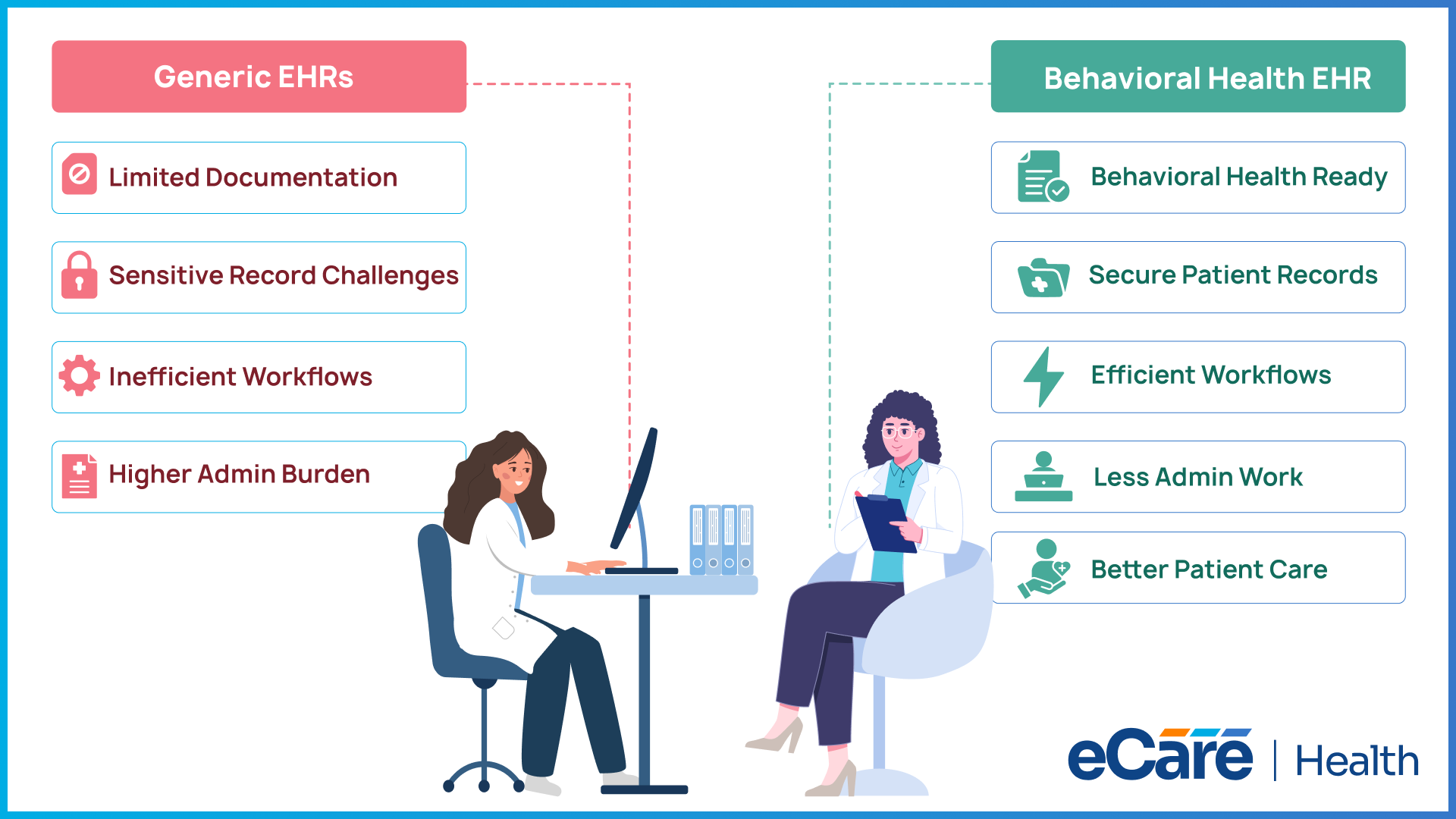
On paper, a general EHR may seem capable of supporting any healthcare practice. But behavioral health providers have unique clinical, operational, and compliance requirements that go beyond standard medical workflows.
Ultimately, many practices end up spending more time on adapting their software rather than delivering patient care. Let’s see some of the key limitations that prevent general EHRs from meeting the unique needs of behavioral health providers:
- Limited behavioral health documentation: General EHRs are not specifically designed for therapy notes, psychiatric evaluations, behavioral treatment plans, or other specialty-specific documentation. This makes clinical workflows more time-consuming.
- Challenges managing sensitive records: Many systems provide limited support for securely handling psychotherapy notes and other confidential behavioral information, which ultimately creates additional compliance concerns.
- Inefficient workflows: Recurring therapy sessions, multidisciplinary care, and long-term treatment planning frequently need manual workarounds, as these workflows are not built into general medical systems.
- More administrative burden: To fill functionality gaps, practices often customize general EHRs or use multiple third-party tools — increasing complexity, training time, and operational costs.
- Better outcomes with a specialized solution: A specialty-specific EHR is designed for behavioral healthcare from the ground up, helping streamline documentation, improve psychiatric practice management software workflows, strengthen compliance, and support better clinical and operational outcomes.
For example, eCareHealth helps behavioral health practices simplify day-to-day operations by bringing documentation, scheduling, billing, telehealth, and interoperability together on one platform, reducing the need for multiple disconnected systems.
Choosing a Specialized Electronic Health Record for Psychiatric Practices
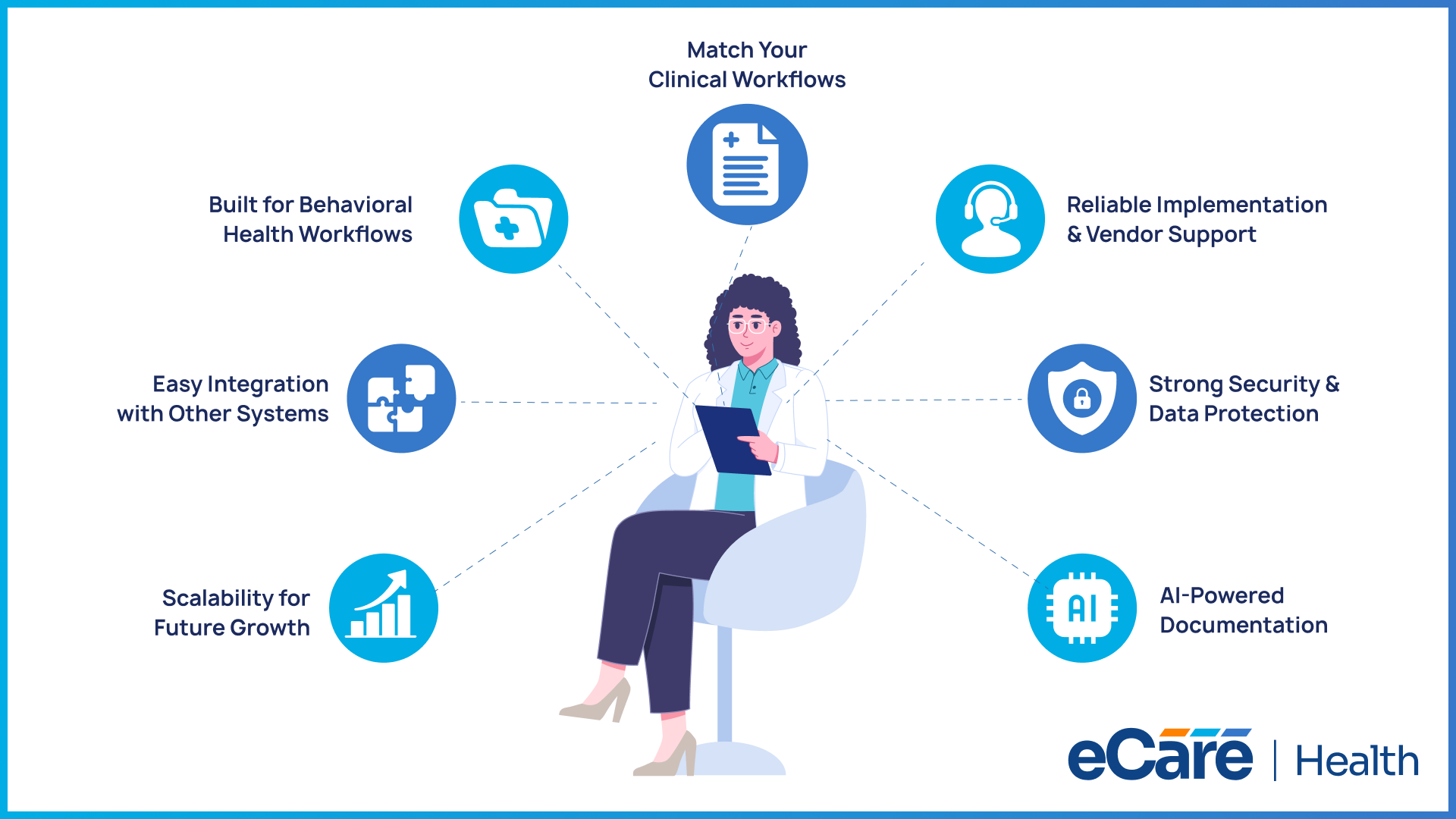
Understanding how your practice delivers care is the first step in choosing the right EHR. Before comparing vendors, it is necessary to identify workflows you depend on every day — for example, therapy documentation, psychiatric evaluations, treatment planning, group sessions, or telehealth.
Here, the one thing that you should always keep in mind is that the closer the software aligns with your clinical processes, the less time your team will spend on adapting to the technology.
Furthermore, equally important is prioritizing a specialty-specific EHR over a system that requires extensive customization. Even though a general EHR can be modified to support behavioral health, it can easily increase complexity, maintenance, and administrative effort. A purpose-built solution is designed to support behavioral health workflows from day one.
Apart from clinical functionality, you should also evaluate how well the platform can integrate with other healthcare systems, support AI-powered documentation, protect sensitive patient data, and scale as your practice grows.
Along with all these, don’t overlook implementation, staff training, and long-term vendor support. The right technology partner must help your team succeed long after the system goes live. This approach makes choosing a specialized electronic health record for psychiatric practices easier while ensuring your investment supports better clinical, operational, and compliance outcomes.
Want to take a closer look at what to consider when selecting a behavioral health EHR? Explore our Behavioral Health EHR Systems: A Complete Overview and Buyer’s Guide for Mental Health Practices in 2026.
Conclusion
Choosing the right EHR can have a lasting impact on your practice’s efficiency, compliance, and quality of care. While general EHRs support a wide range of medical specialties, a specialty-specific EHR is designed to meet the unique needs of behavioral health providers with the right workflows, documentation, and privacy controls.
Before making a decision, evaluate your practice’s current needs, future growth, and long-term goals to ensure you choose a solution that truly supports your team.
Looking for a mental health EHR built for mental health practices? Contact us to learn how the right solution can help streamline your workflows and improve patient care.
Frequently Asked Questions
1. What is the difference between a behavioral health EHR and a general EHR?
A behavioral health EHR is designed specifically for mental health, psychiatry, counseling, and addiction treatment. It supports therapy documentation, behavioral assessments, treatment plans, and specialized workflows. A general EHR, on the other hand, is built for primary care and other medical specialties, focusing on physical health documentation and standard clinical workflows.
2. Why do generic EHRs not work for mental health clinics?
Generic EHRs often lack the documentation templates, privacy controls, treatment planning tools, and behavioral health workflows needed by mental health providers. As a result, practices may rely on manual workarounds that reduce efficiency and increase administrative burden.
3. What is a specialty-specific EHR?
A specialty-specific EHR is software designed to meet the unique clinical and operational needs of a particular healthcare specialty. For behavioral health, it includes features such as psychotherapy documentation, behavioral assessments, treatment planning, and compliance tools tailored to mental health practices.
4. Can a general EHR be customized for behavioral health practices?
Yes, a general EHR can be customized to support some behavioral health workflows. However, customization often requires additional time, cost, and ongoing maintenance. Many practices find that a purpose-built behavioral health EHR provides a more efficient and scalable solution.
5. How do behavioral health EHR systems support psychotherapy documentation?
Behavioral health EHR systems offer templates for therapy notes, treatment plans, progress tracking, and psychotherapy documentation. They also help organize patient records while supporting privacy requirements for sensitive behavioral health information.
6. Why is DSM-5 support important in behavioral health EHR software?
DSM-5 support helps providers accurately document and classify mental health conditions using standardized diagnostic criteria. This improves clinical documentation, treatment planning, communication, and coding accuracy.
7. How do behavioral health EHR systems improve psychiatric practice management software workflows?
Behavioral health EHR systems streamline scheduling, documentation, treatment planning, billing, telehealth, and care coordination. By reducing manual tasks, they allow providers to spend more time focusing on patient care.
8. Do behavioral health EHR systems support AI-assisted documentation and telehealth?
Yes. Many modern behavioral health EHR systems include AI-assisted documentation, automated clinical workflows, and integrated telehealth capabilities to improve efficiency, reduce documentation time, and support virtual behavioral healthcare.
9. How do I choose a specialized electronic health record for psychiatric practices?
Start by evaluating your practice’s workflow requirements, documentation needs, and compliance obligations. Then compare solutions based on specialty-specific features, interoperability, AI capabilities, security, scalability, implementation support, and long-term vendor service to find the best fit for your practice.