SOAP Notes for Mental Health: Format, Examples, and Best Practices for Therapists
Physicians spend almost 26.6% of their daily working time on documentation tasks, which makes paperwork one of the key demands in healthcare.
And for mental health professionals, the challenge is even bigger. As compared to other specialties, therapy sessions usually generate detailed narratives, which should further accurately capture your patient’s thoughts, behaviors, clinical assessments, and treatment progress along with meeting documentation and compliance requirements.
Clinical notes can quickly become inconsistent without a structured approach, making it harder to track progress over time, support informed treatment decisions, and maintain continuity of care when multiple providers are involved.
This is where SOAP notes in mental health come into the spotlight. By following a standardized framework, it becomes easy for therapists to document each session in a clear, organized, and clinically meaningful way, regardless of the complexity of the case.
Furthermore, by combining with a mental health EHR, this approach becomes even more effective. Structured templates and centralized patient records also help to reduce documentation burden and help therapists to focus more on patient care than paperwork.
Let this blog be your comprehensive guide to learn more about the mental health SOAP note format, explore a practical SOAP note template for mental health, review SOAP note examples for mental health therapists, and discover the best practices for writing mental health SOAP notes to improve both documentation quality and clinical workflows.
What Goes in Each Section of a Mental Health SOAP Note?
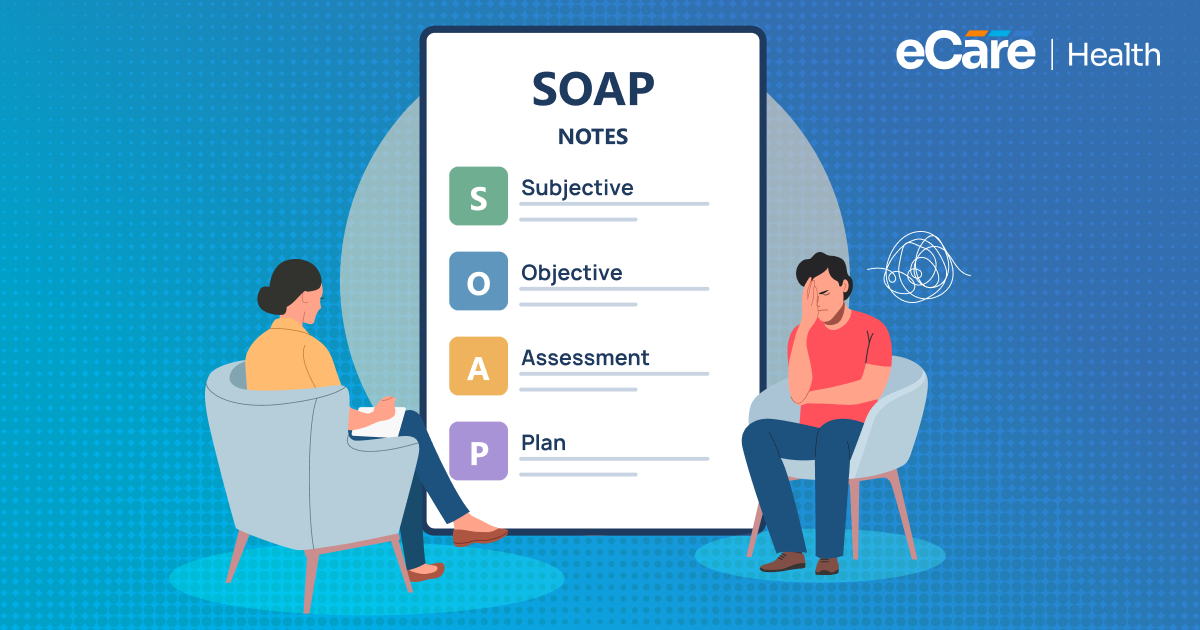
A well-written mental health SOAP note format follows four simple sections, which can organize clinical information in a logical order. By serving a specific purpose, each section helps therapists to document sessions consistently and make notes that can easily be reviewed, shared, and referenced during future appointments. Together, they can create a complete clinical picture that supports treatment planning, continuity of care, and compliance.
| SOAP Component | Purpose | What to Include | Mental Health Example | Common Mistake to Avoid |
|---|---|---|---|---|
| Subjective (S) | Capture what the patient shares about their condition and experiences. | Symptoms, emotions, concerns, treatment goals, and direct patient statements. | “Patient reports increased anxiety before work and difficulty sleeping over the past week.” | Mixing clinician observations or interpretations with the patient's own statements. |
| Objective (O) | Document observable, measurable clinical findings. | Mental Status Examination (MSE), appearance, behavior, speech, affect, orientation, clinician observations, and assessment scores such as PHQ-9 or GAD-7. | Appropriate appearance, anxious affect, coherent speech, fully oriented, PHQ-9: 14, GAD-7: 12. | Recording assumptions instead of objective findings or leaving out measurable assessment data. |
| Assessment (A) | Interpret the clinical findings and evaluate the patient's progress. | Diagnosis, symptom severity, treatment response, risk assessment, medical necessity, and progress toward treatment goals. | Anxiety symptoms improve with CBT; patients demonstrate moderate progress toward treatment goals. | Simply repeating subjective information without providing clinical interpretation. |
| Plan (P) | Outline the next steps in the patient's care. | Therapy interventions, medication changes, referrals, homework, safety planning (if needed), and follow-up appointments. | Continue weekly CBT sessions, assign breathing exercises, review coping strategies, and follow up in one week. | Omitting clear follow-up actions or failing to document measurable treatment goals. |
If you document every session by using the same structure, therapy SOAP notes can become more consistent, easier to understand, and more valuable for not only ongoing patient care, but also collaboration among providers.
Writing Effective SOAP Notes for Mental Health
A consistent format is only half of the story. Effective therapy SOAP notes must clearly reflect your patient’s condition, support clinical decision-making, and provide a full picture of the care delivered. The core goal is to create documentation that is accurate, concise, and easy for other providers to understand.
For broader guidance on creating clear, complete, and defensible clinical documentation, explore: Mental Health Documentation Guide: How to Write Clinical Notes That Protect Your Practice.
SOAP Note Template Mental Health
A standard SOAP note template for mental health can keep documentation organized and allow flexibility based on the behavioral health service types that are being provided.
| Section | What to Include |
|---|---|
| Subjective | Patient's symptoms, concerns, emotions, and treatment goals. |
| Objective | Mental Status Examination (MSE), clinician observations, and assessment scores (e.g., PHQ-9, GAD-7). |
| Assessment | Clinical interpretation, diagnosis, treatment response, and progress toward goals. |
| Plan | Interventions, medication changes, referrals, homework, and follow-up care. |
Even though the structure remains the same, therapists, psychologists, counselors, and psychiatrists can customize the detail level to match their clinical workflow and patient needs.
Clinical SOAP Note Examples
The same framework can be used across different behavioral health encounters, including:
- Individual therapy sessions
- Anxiety counseling sessions
- Medication management visits
- Teletherapy sessions
Best Practices
- Document the medical necessity for every session.
- Keep assessments aligned with treatment goals.
- Use objective, concise, and clinically relevant language.
- Complete notes within 24 hours whenever possible.
- Distinguish clinical SOAP notes from private psychotherapy process notes.
How eCareHealth Simplifies SOAP Documentation
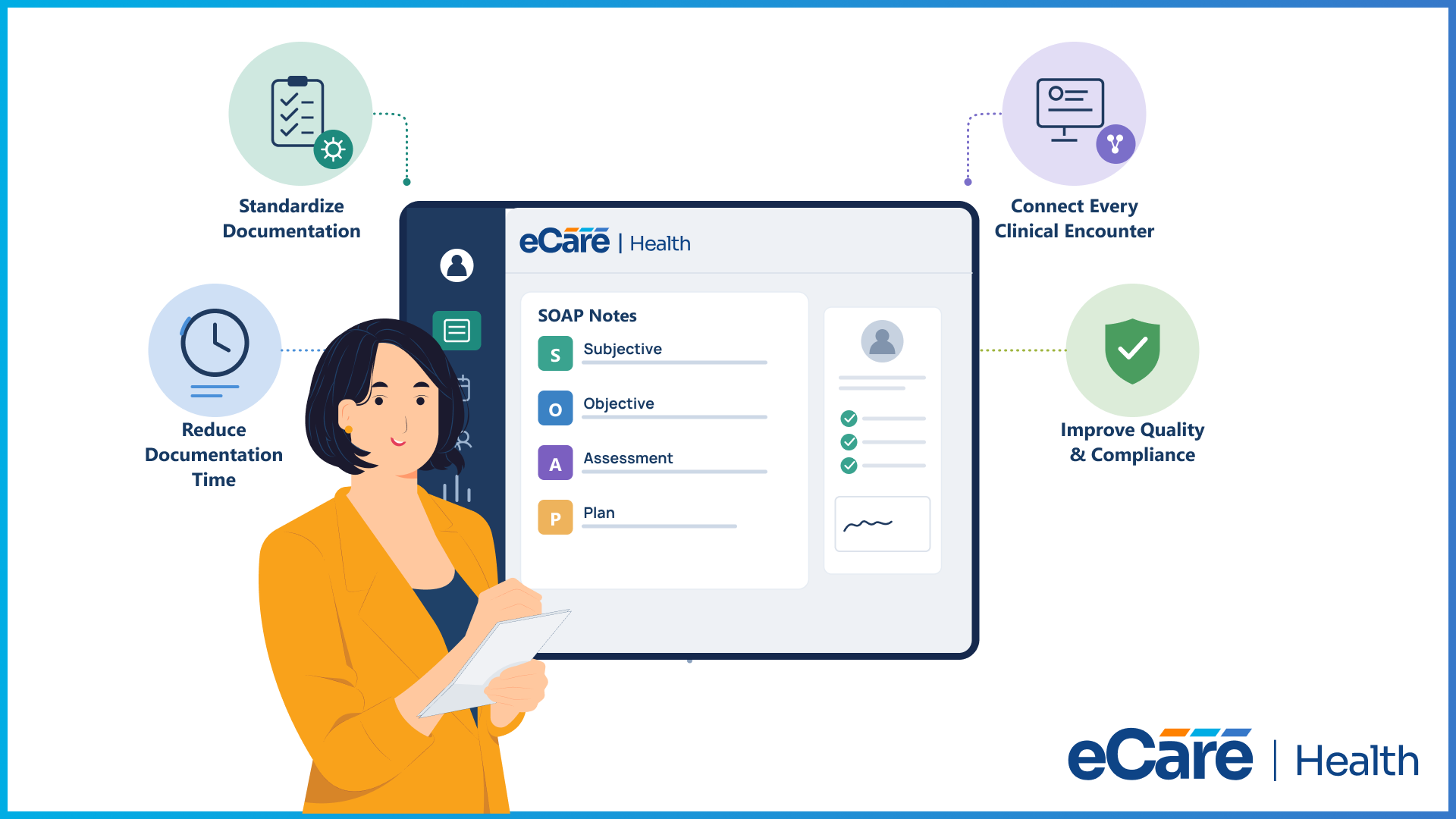
Creating consistent SOAP notes in mental health does not have to be time-consuming. With mental health EHR software, eCareHealth can streamline documentation so that therapists can spend less time on paperwork and more time with patients.
Standardize Documentation Across Your Practice
eCareHealth also helps to maintain consistency with specialty-specific SOAP note templates and configurable workflows designed for therapists, psychologists, counselors, and psychiatrists.
This further ensures that every provider follows the same documentation standards and adapts notes to their clinical workflow.
Reduce Documentation Time
Structured documentation workflows, built-in clinical prompts, and electronic signatures can simplify the note-taking process from start to finish. It becomes easy to complete documentation faster without sacrificing accuracy or clinical detail.
Connect Every Clinical Encounter
SOAP notes are automatically connected to treatment plans, progress notes, diagnoses, medications, and appointments. Instead of switching between multiple records, providers can view a patient's complete clinical history from a single location.
Improve Documentation Quality and Compliance
eCareHealth supports complete and compliant documentation with audit trails, role-based access controls, documentation tracking, and reporting tools. These features help practices maintain accurate records, improve workflow visibility, and stay prepared for compliance reviews.
Conclusion
Structured SOAP notes for mental health provide more than a consistent way to document therapy sessions; they help improve documentation quality, support continuity of care, and give providers a clearer view of each patient's treatment journey. A standardized SOAP framework also makes clinical documentation more accurate, organized, and easier to review over time.
With mental health EHR software, eCareHealth simplifies every step of the documentation process through specialty-specific templates, connected clinical workflows, secure documentation management, and integrated patient records.
By reducing administrative effort while improving documentation consistency, eCareHealth's mental health EHR helps behavioral health practices spend less time on paperwork and more time delivering quality patient care.
Frequently Asked Questions (FAQs)
1. What are SOAP notes in mental health?
SOAP notes are a standardized documentation method used by therapists, psychologists, counselors, and psychiatrists to record clinical encounters. The acronym stands for Subjective, Objective, Assessment, and Plan. This structured format helps organize patient information, document treatment progress, support clinical decision-making, and maintain consistent records across every stage of care.
2. What should a mental health SOAP note include?
A mental health SOAP note should include the patient's reported symptoms, emotions, concerns, and treatment goals in the Subjective section. The Objective section should document observable findings, such as the Mental Status Examination (MSE), clinician observations, and standardized assessment scores like PHQ-9 or GAD-7. The Assessment should provide the clinician's interpretation of the patient's condition and progress, while the Plan should outline interventions, follow-up appointments, referrals, medications, or homework assignments.
3. How do therapists write effective SOAP notes?
Therapists write effective SOAP notes by keeping documentation accurate, objective, and clinically relevant. Each section should serve a specific purpose without repeating information from other sections. Notes should clearly explain the patient's progress, support medical necessity, align with treatment goals, and include actionable next steps. Completing documentation soon after the session also helps improve accuracy.
4. What is the difference between SOAP notes and psychotherapy notes?
SOAP notes are part of a patient's official medical record and are used to document diagnoses, treatment plans, clinical observations, and progress. They may be shared with other authorized healthcare providers when necessary for patient care. Psychotherapy notes, on the other hand, are the therapist's personal process notes that capture private observations, impressions, or reflections. They are maintained separately from the medical record and receive additional privacy protections under HIPAA.
5. What are common mistakes when writing mental health SOAP notes?
Some of the most common mistakes include mixing subjective patient statements with objective clinical observations, using vague or non-specific language, failing to document medical necessity, and omitting measurable findings such as assessment scores. Another frequent error is not including a clear treatment plan or follow-up actions, making it difficult to evaluate patient progress over time.
6. Should PHQ-9 and GAD-7 scores be included in SOAP notes?
Yes. When these assessments are part of the clinical evaluation, PHQ-9 and GAD-7 scores should be documented in the Objective section of the SOAP note. Including standardized assessment results provides measurable evidence of symptom severity, supports treatment decisions, and helps clinicians monitor changes in the patient's condition throughout the course of care.
7. How soon should therapists complete SOAP notes after a session?
Therapists should complete SOAP notes as soon as possible after each session, ideally within 24 hours. Timely documentation ensures important clinical details are accurately captured while they are still fresh. It also supports documentation quality, improves compliance, and provides stronger legal and clinical defensibility if records are reviewed later.
8. How can a Mental Health EHR simplify SOAP documentation?
A Mental Health EHR simplifies SOAP documentation by providing standardized templates, structured documentation workflows, clinical prompts, and integrated patient records. These features reduce repetitive data entry, improve consistency across providers, and make it easier to access treatment plans, diagnoses, medications, and previous notes from a single patient record, allowing therapists to spend more time with patients and less time on paperwork.
9. How does eCareHealth support SOAP documentation for mental health practices?
eCareHealth helps behavioral health practices streamline SOAP documentation with specialty-specific templates, configurable workflows, secure documentation management, and integrated clinical records. It also connects SOAP notes with treatment plans, diagnoses, medications, appointments, and progress notes, creating a complete patient history in one place. This enables providers to document more efficiently, maintain consistency across the practice, and support compliance with documentation requirements.