DAP Notes vs SOAP Notes vs BIRP Notes: Which Format Is Right for Your Therapy Practice?

If you ask five therapists to document the same therapy session, you might end up with five different progress notes, all of which are clinically valid.
The major reason behind this is that there is not a single documentation format that works best for every therapist or every practice. Documenting clinical sessions frequently relies on their workflow, specialty, compliance requirements, and personal preferences.
It is an obvious fact that the note format you choose does far more than just organize information. It can affect how easily you document sessions, collaborate with other clinicians, and track your patient progress, while maintaining continuity of care.
As your practice grows, using a consistent documentation framework along with a mental health EHR can enhance efficiency and keep records clearer across the entire team.
If you are comparing DAP vs SOAP notes, exploring BIRP notes, or trying to understand the differences between DAP, SOAP, BIRP, GIRP, and PIRP notes, this guide will help you understand what each format offers and which one is the best fit for your practice.
Comparing Therapy Note Formats: SOAP, DAP, BIRP, GIRP & PIRP
Even though every therapy note format serves the same purpose, which is documenting patient progress, they differ in structure, documentation priorities, and clinical workflows. Some formats focus on detailed clinical assessments while others focus on interventions, treatment goals, or efficient progress documentation.
By understanding these differences, it becomes easier to choose the right format for your practice:
| Format | Structure | Best For | Primary Focus | Key Strength |
|---|---|---|---|---|
| SOAP | Subjective, Objective, Assessment, Plan | Psychiatry, integrated care, audit-ready documentation | Clinical assessment and treatment planning | Comprehensive and widely recognized |
| DAP | Data, Assessment, Plan | Outpatient therapy, counseling, private practice | Efficient progress documentation | Faster documentation with clinical context |
| BIRP | Behavior, Intervention, Response, Plan | Community behavioral health, DBT, IOPs, substance use treatment | Intervention-focused documentation | Clearly tracks interventions and patient responses |
| GIRP | Goal, Intervention, Response, Plan | Goal-oriented counseling | Goal progression | Keeps measurable goals at the center |
| PIRP | Problem, Intervention, Response, Plan | Case management | Problem-focused care | Organizes notes around patient problems |
Well, the fact is that the right format relies on your documentation requirements. SOAP is usually preferred for detailed assessments and audit-ready records, while DAP is used for efficient outpatient therapy, BIRP notes for intervention-focused care, GIRP notes for therapy to track treatment goals, and PIRP notes for mental health case management and problem-oriented documentation.
How to Choose the Right Documentation Format for Your Therapy Practice
As we discussed earlier, the best documentation format relies on how your practice delivers care. Factors including your specialty, treatment approach, documentation volume, and team structure all influence which framework will work best. Instead of looking for a one-size-fits-all solution, you should choose a format that complements your clinical workflow and supports consistent documentation.
Choose based on your Practice Setting:
| Practice Setting | Recommended Format | Why |
|---|---|---|
| Private Therapy Practice | DAP / SOAP | Balances efficiency with comprehensive documentation |
| Psychiatry Practice | SOAP | Supports detailed assessments and medication management |
| Community Behavioral Health | BIRP | Tracks interventions and patient response |
| Goal-Oriented Counseling | GIRP | Keeps measurable treatment goals at the center |
| Case Management | PIRP | Organizes documentation around identified problems |
Choose Based on Your Clinical Workflow:
- Assessment-driven documentation → SOAP
- Intervention-focused treatment → BIRP
- Goal-oriented therapy → GIRP
- Problem-focused case management → PIRP
- High-volume outpatient documentation → DAP
Questions to Ask Before Standardizing a Note Format:
Before adopting a documentation framework across your practice, consider these questions:
- Does it fit your clinical workflow?
- Can it be standardized across all providers?
- Does it support treatment planning and progress tracking?
- Will it scale as your practice grows?
- Can your Mental Health EHR support configurable templates for multiple documentation formats?
Is There a “Best” Therapy Note Format?
There isn't a single documentation format that works for every practice. DAP is often preferred for efficient outpatient therapy documentation, while SOAP is ideal for detailed assessments and audit-ready records. BIRP notes, GIRP notes therapy, and PIRP notes mental health are best suited for specific treatment models and clinical workflows. Ultimately, the right choice depends on your practice's needs and documentation style.
How eCareHealth Supports Multiple Therapy Note Formats
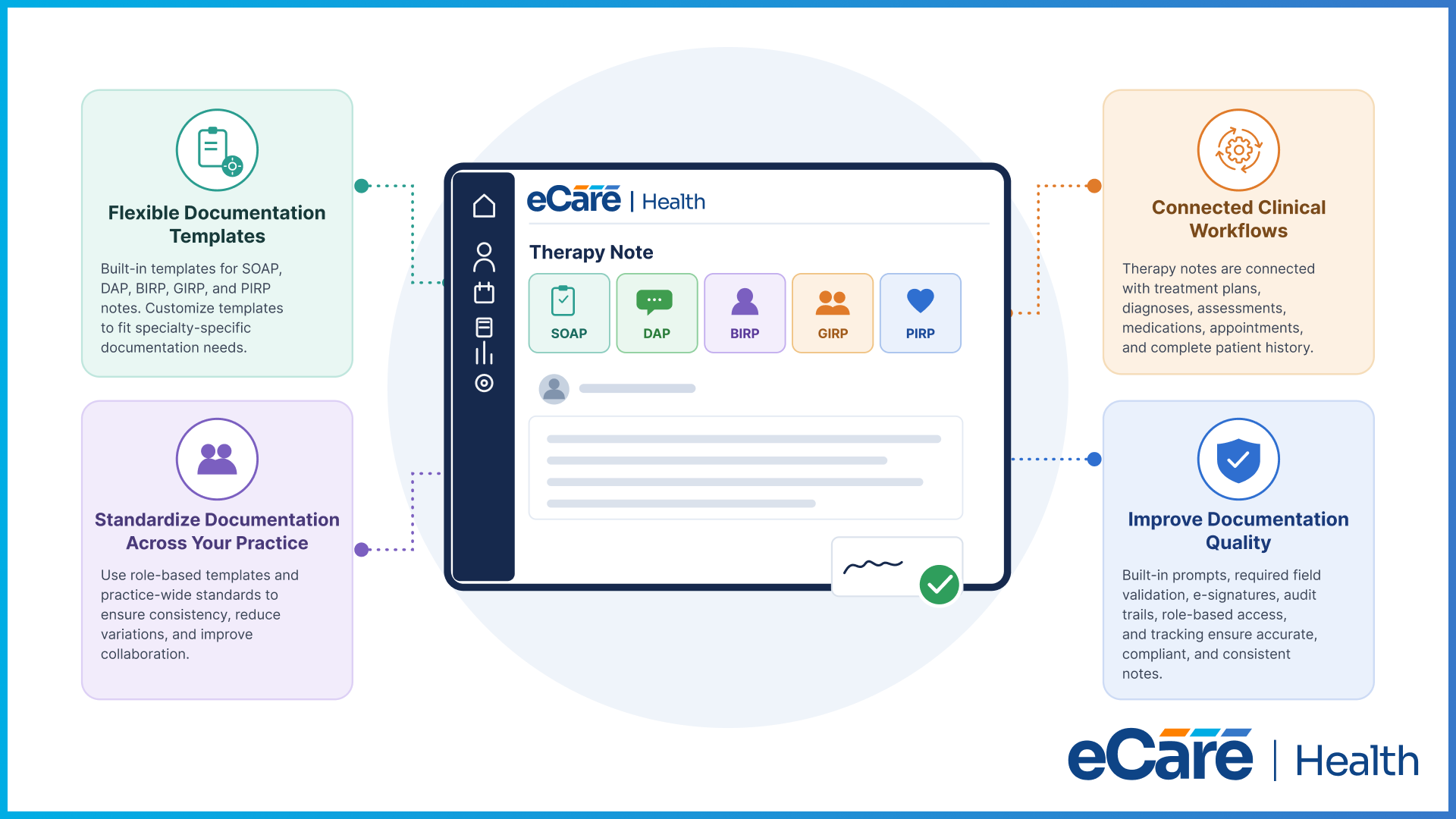
Selecting the right documentation format is only half of the story. Your EHR must make it easier for you to use that format consistently across your practice. With eCareHealth’s mental health EHR, it becomes easier for behavioral health providers to streamline documentation with flexible templates and connected clinical workflows.
Flexible Documentation Templates:
As eCareHealth offers built-in templates for SOAP, DAP, BIRP, GIRP, and PIRP notes, it allows you to document sessions by using the format that best fits your workflow. Furthermore, templates can also be customized to support specialty-specific documentation requirements.
Standardize Documentation Across Your Practice:
Maintain consistent documentation across clinicians with role-based templates and practice-wide standards. By using behavioral health EHR software, your practice can minimize documentation variations and improve collaboration and record consistency.
Connected Clinical Workflows:
Therapy notes are automatically connected with treatment plans, diagnoses, assessments, medications, appointments, and complete patient history. This keeps all behavioral health documentation organized in one centralized system.
Improve Documentation Quality:
Built-in documentation prompts, required field validation, electronic signatures, audit trails, role-based access controls, and documentation tracking help providers complete accurate, compliant, and consistent clinical notes with confidence.
For additional guidance on creating defensible behavioral health records, see our: Mental Health Documentation Guide: How to Write Clinical Notes That Protect Your Practice.
Conclusion
Choosing between DAP vs SOAP notes or other formats isn't about finding a single “best” option; it's about selecting the one that fits your clinical workflow, documentation needs, and practice setting.
While SOAP supports detailed assessments, DAP streamlines outpatient documentation, and BIRP, GIRP, and PIRP each serve specific treatment approaches and organizational workflows.
The right technology can make that choice even more effective. With configurable templates, connected clinical workflows, and secure documentation management, behavioral health EHR software like eCareHealth's mental health EHR helps practices standardize documentation, improve consistency across providers, and spend more time focusing on patient care.
Frequently Asked Questions (FAQs)
1. What is the difference between DAP and SOAP notes?
DAP and SOAP both document therapy sessions, but they differ in structure and level of detail. DAP notes use three sections—Data, Assessment, and Plan—making them a simpler and more efficient option for outpatient therapy and counseling. SOAP notes include Subjective, Objective, Assessment, and Plan, providing a clearer separation between patient-reported information and clinical observations. This additional structure makes SOAP notes a popular choice for psychiatry, integrated care, medication management, and practices that require detailed, audit-ready documentation.
2. When should therapists use BIRP notes?
Therapists should use BIRP notes when documenting therapeutic interventions and evaluating how clients respond to treatment is a priority. This format is commonly used in community behavioral health, dialectical behavior therapy (DBT), intensive outpatient programs (IOPs), and substance use treatment. BIRP notes help clinicians clearly record patient behavior, interventions delivered during the session, treatment response, and the next steps in care.
3. What are GIRP notes used for in therapy?
GIRP notes are used in goal-oriented therapy to keep treatment goals at the center of documentation. Instead of focusing primarily on assessments or problems, they document the client's goals, the interventions used, the client's response, and the plan moving forward. This format is particularly useful for therapists who regularly measure treatment progress and want to demonstrate goal achievement over time.
4. What are PIRP notes in mental health documentation?
PIRP notes organize documentation around the client's presenting problem rather than the entire therapy session. They include the identified problem, the intervention provided, the client's response, and the ongoing treatment plan. This format is widely used in case management, community support services, and coordinated care programs where addressing specific patient concerns and documenting follow-up actions are essential.
5. Which therapy note format is best for private practice?
The best therapy note format depends on the type of services your practice provides and your documentation preferences. Many private practices prefer DAP notes because they are efficient, easy to complete, and still provide meaningful clinical documentation. However, therapists who conduct detailed assessments, collaborate with other providers, or manage complex cases may find SOAP notes to be a better fit due to their more comprehensive structure.
6. How do I choose between SOAP, DAP, BIRP, GIRP, and PIRP notes?
The right documentation format should match your clinical workflow, treatment model, and practice setting. SOAP notes work well for assessment-driven care, while DAP notes are ideal for efficient outpatient documentation. BIRP notes are best for intervention-focused treatment, GIRP notes support goal-oriented counseling, and PIRP notes are well suited for case management and problem-focused care. Consider your documentation requirements, team collaboration needs, and compliance expectations before standardizing a format.
7. Can one behavioral health practice use multiple documentation formats?
Yes. Many behavioral health organizations use multiple documentation formats across different departments, specialties, or provider roles. For example, psychiatrists may use SOAP notes, therapists may prefer DAP notes, and case managers may document using PIRP notes. A standardized documentation policy and configurable EHR templates help ensure consistency while allowing clinicians to use the format that best supports their work.
8. How can a Mental Health EHR support different therapy note formats?
A Mental Health EHR supports multiple documentation formats by offering configurable templates for SOAP, DAP, BIRP, GIRP, and PIRP notes. It can also connect therapy notes with treatment plans, diagnoses, medications, assessments, appointments, and patient history. This allows clinicians to document more efficiently while keeping records organized, accessible, and compliant across the entire practice.
9. What features should Behavioral Health EHR Software include for flexible clinical documentation?
Behavioral Health EHR Software should include customizable documentation templates, role-based workflows, treatment plan integration, documentation prompts, required field validation, electronic signatures, audit trails, and role-based access controls. Reporting and documentation tracking features are also valuable for monitoring note completion, maintaining compliance, and ensuring consistent documentation across providers. Together, these capabilities help improve documentation quality while reducing administrative burden.