Telepsychiatry Software: How to Choose a Platform for Virtual Psychiatric Care

The video visit went seamlessly. The patient connected on time, the psychiatrist completed the session, and the conversation went just as planned. Then the call ended, and the real work actually started.
The psychiatrist still had to document the visit, update the patient’s chart, send a prescription, schedule the next appointment, and make sure the encounter was ready for billing.
If the practice uses separate tools for video visits, documentation, scheduling, prescribing, and billing, completing these tasks can mean switching between multiple screens and systems. Over time, those extra steps can add up.
This is why psychiatric practices need more than a video-conferencing tool to deliver effective virtual care. Telepsychiatry software can connect the virtual visit with the clinical and administrative workflows that follow it, helping providers manage documentation, prescribing, scheduling, and telepsychiatry billing from a more connected environment.
However, choosing the right telepsychiatry platform is not as simple as picking the one with the clearest video quality. Practices also need to consider security, EHR integration, prescribing capabilities, workflow efficiency, and how easily the platform can fit into their existing operations. After all, a virtual psychiatry solution should simplify care delivery, not create another system for staff to manage.
In this blog, we’ll explore how to choose a telepsychiatry platform for virtual care, the features that matter most, and what psychiatric practices should look for in online psychiatry software. We’ll also cover how integrated technology can connect virtual visits with the broader clinical workflow, including the mental health EHR with telehealth that supports it.
What Should You Look for in Telepsychiatry Software?
A good telepsychiatry platform should do more than provide a secure video connection. It should support the clinical and administrative work that happens before, during, and after a virtual psychiatric visit. When comparing options, practices should evaluate how well each platform connects these essential workflows.
| Capability | What to Evaluate | Why It Matters for Psychiatry |
|---|---|---|
| Virtual Care | Secure video, patient access, waiting room, and session controls | Supports reliable virtual psychiatric encounters |
| Psychiatric Documentation | Notes, assessments, diagnoses, treatment plans, and patient history | Keeps virtual care connected to the clinical record |
| E-Prescribing & EPCS | Electronic prescribing and controlled-substance workflows | Supports psychiatric medication management |
| PDMP Support | Appropriate PDMP access and workflow integration | Helps incorporate prescription-monitoring requirements into care workflows |
| Scheduling & Intake | Online scheduling, digital forms, consent, and reminders | Simplifies virtual patient onboarding |
| Telepsychiatry Billing | Eligibility, patient responsibility, claims, and payment workflows | Connects virtual visits with reimbursement |
| Security & Compliance | Access controls, audit trails, encryption, and BAA support | Helps protect sensitive psychiatric information |
| EHR Integration | Shared patient data and connected clinical workflows | Reduces duplicate documentation and fragmented records |
Psychiatry-Specific Capabilities to Prioritize
Not every feature carries the same weight in psychiatric care. Practices should give extra attention to capabilities that support medication management, ongoing assessments, and continuity of care. A platform should also work well for practices that combine virtual and in-person appointments rather than forcing providers to maintain separate workflows.
- EPCS and psychiatric medication-management workflows
- Psychiatric assessments, clinical documentation, and treatment plans
- Longitudinal patient records for ongoing care
- Support for both virtual and in-person psychiatric encounters
- Patient communication and digital intake within the same workflow
When these capabilities work together, telepsychiatry software becomes part of the practice’s broader clinical workflow instead of functioning as just another video-conferencing tool.
How to Choose a Telepsychiatry Platform for Virtual Care
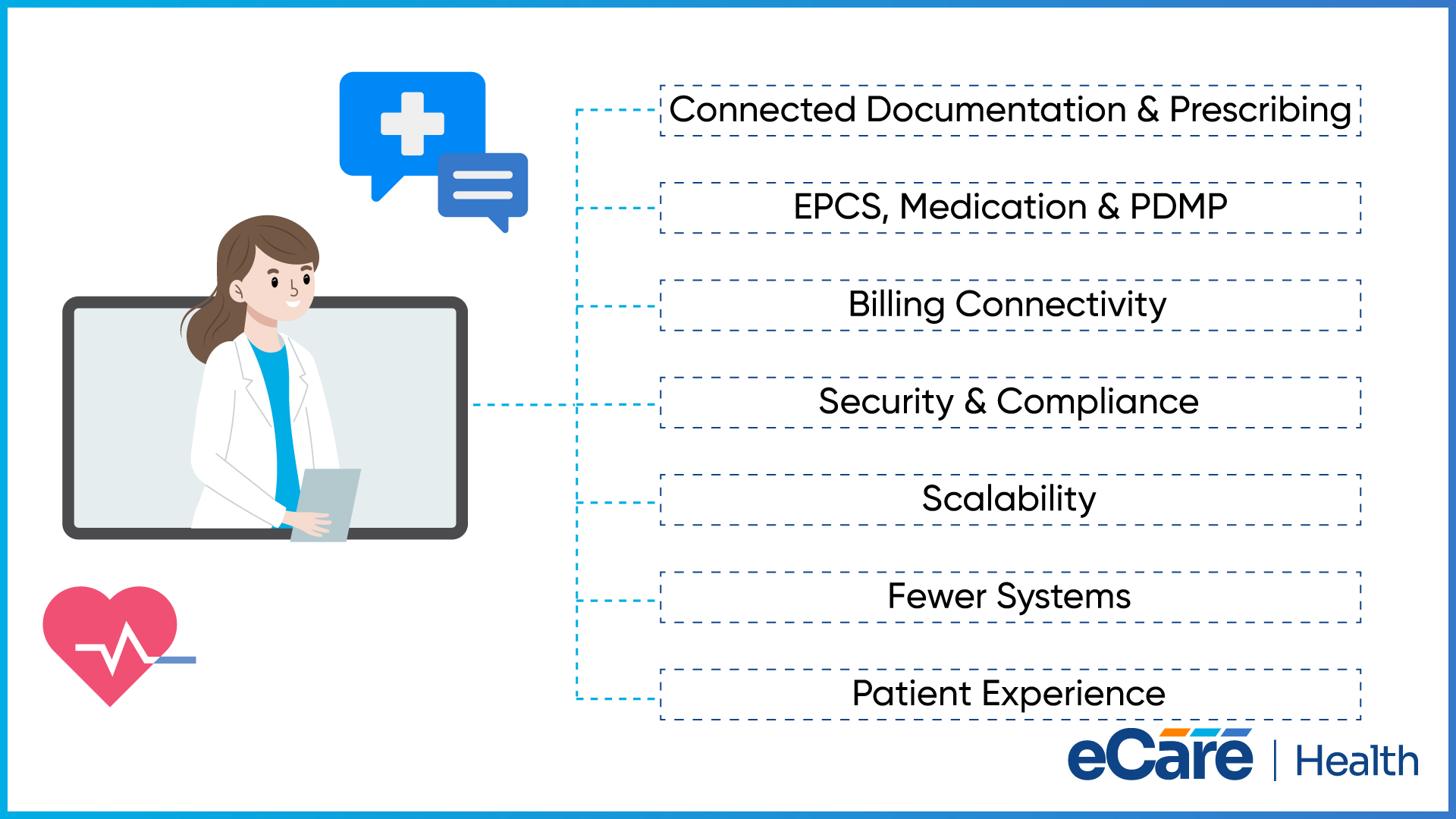
Choosing telepsychiatry software is less about checking off the longest feature list and more about seeing how the platform works in real-world psychiatric care. A solution may look impressive in a product demo, but the real test is whether it makes everyday workflows simpler for providers, staff, and patients.
Start With the Patient Experience:
Follow the patient journey from scheduling to the virtual appointment. Check whether patients can easily book appointments, complete digital forms and consent, receive reminders, and join their sessions without unnecessary steps. A smooth experience from start to finish can make telepsychiatry services easier to deliver and easier for patients to use.
Keep Documentation and Prescribing Connected:
During a virtual visit, providers should not have to jump between applications to document the encounter or manage medications. Check whether clinical notes, assessments, treatment plans, and prescribing remain connected to the same patient record and encounter.
Verify EPCS, Medication Management, and PDMP Support:
For psychiatric practices that prescribe controlled substances, look closely at EPCS capabilities and medication-management workflows. Also verify whether the platform supports appropriate PDMP access or integration. These capabilities should fit naturally into the clinical workflow rather than add another disconnected step.
Look at Billing and Revenue-Cycle Connectivity:
A virtual visit does not end when the patient leaves the screen. Evaluate whether the platform connects the encounter with eligibility, patient responsibility, claims, payments, and other telepsychiatry billing workflows. Better connectivity can help reduce manual work and keep reimbursement processes organized.
Review Security and Compliance:
Before choosing a platform, review its security controls, access permissions, audit trails, encryption, and vendor compliance documentation. Practices should also understand how the vendor handles sensitive psychiatric information and whether appropriate agreements, such as a BAA, are available.
Think Beyond Today's Practice:
The platform should be able to grow with the organization. Consider whether it can support a solo psychiatrist today and still work for a group practice or multi-location psychiatric organization tomorrow. Scalability matters when patient volume, providers, locations, or service lines expand.
Reduce the Number of Systems You Need:
Finally, look at the bigger picture. If providers have to move constantly between separate telehealth, EHR, prescribing, and billing applications, even good tools can create a fragmented workflow. Prioritize a virtual psychiatry platform that brings as many essential processes as possible into one connected environment.
Why Integrated Telepsychiatry Software Is Better Than Standalone Video Tools
A standalone video-conferencing tool can handle the virtual appointment, but the work around that appointment still has to happen somewhere. Providers may need to move between separate systems for the patient record, documentation, prescribing, and billing. That extra switching can lead to duplicate data entry and fragmented workflows.
Integrated telepsychiatry software connects the virtual encounter with the clinical record and the processes that support it. Instead of documenting the same patient information in multiple places, providers can keep notes, assessments, treatment plans, and patient history connected to the longitudinal psychiatric record.
The same connection can extend across the broader workflow. Intake and scheduling can feed into the encounter, clinical documentation can remain linked to the patient record, prescribing can stay within the medication-management workflow, and encounter information can move into billing processes. Providers also have access to the clinical information they need without constantly jumping between applications.
This matters even more as a practice expands its telepsychiatry services. A workflow that works for one provider can become difficult to manage as more clinicians, patients, and locations are added. An integrated platform can help maintain consistency instead of requiring practices to piece together additional tools as they grow.
A mental health EHR with telehealth brings this approach together by connecting virtual care with core clinical workflows. Rather than treating telehealth as a separate service, it makes the virtual encounter part of the same environment used for documentation, patient records, prescribing, and billing.
How eCareHealth Supports Virtual Psychiatric Care
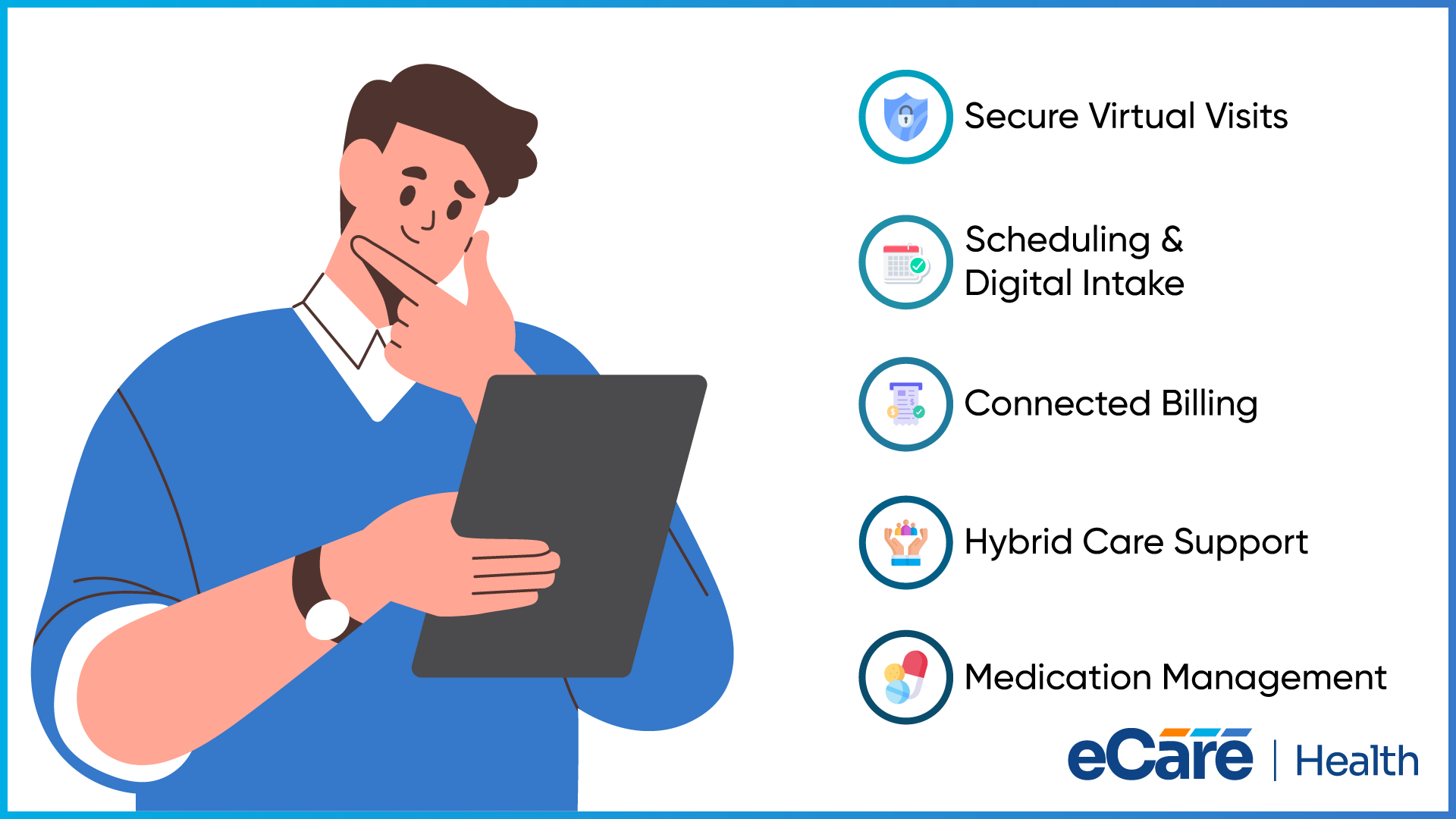
Once the right capabilities are clear, the next step is finding a platform that can bring them together in everyday practice. eCareHealth supports virtual psychiatric care by connecting telehealth with the clinical and administrative workflows that surround each encounter.
With eCareHealth, practices can manage secure virtual psychiatric visits alongside scheduling, digital intake, clinical documentation, and patient records. This keeps the information collected before and during the appointment connected instead of scattered across separate systems.
The platform also supports psychiatric documentation, medication management, e-prescribing, and EPCS workflows, helping providers manage the clinical side of virtual care within the same environment. Billing and payment workflows can also remain connected to virtual encounters, helping practices manage the financial side of care without creating another disconnected process.
For practices that combine telepsychiatry with in-person visits, eCareHealth supports both care settings within the same clinical environment. Providers can maintain continuity of documentation and patient information regardless of how the encounter takes place.
At the center of these connected workflows is the Psychiatry EHR, which brings patient records, clinical workflows, virtual care, and practice operations together. This gives psychiatric practices a more centralized way to manage care as their virtual services evolve.
Conclusion
A successful virtual psychiatric visit involves much more than a stable video connection. The right telepsychiatry software should support the complete encounter, from scheduling and patient intake to clinical documentation, prescribing, billing, and follow-up care. When these workflows are connected, providers can spend less time switching between systems and more time focused on their patients.
As you evaluate a platform, look beyond the feature list. Consider the patient experience, clinical integration, EPCS and medication-management capabilities, appropriate PDMP workflows, billing connectivity, security, and the platform’s ability to scale with your practice. These factors can make the difference between simply offering telepsychiatry and building a workflow that can support it effectively.
eCareHealth brings these capabilities together in one connected clinical environment, helping psychiatric practices manage virtual and in-person care without piecing together multiple disconnected systems. With a centralized psychiatry EHR, practices can create a more streamlined approach to virtual psychiatric care while preparing their workflows for continued growth.
Frequently Asked Questions (FAQs)
1. What is telepsychiatry software?
Telepsychiatry software is a digital platform designed to help psychiatric practices deliver and manage care remotely. It typically combines secure video visits with scheduling, patient intake, clinical documentation, prescribing, billing, and patient records. Unlike a basic video-conferencing tool, it connects the virtual appointment with the clinical workflows that happen before and after the session. Depending on the platform, it may also support EPCS, PDMP workflows, medication management, and integration with an EHR, giving providers a more centralized way to manage virtual psychiatric care.
2. What features should a telepsychiatry platform include?
A telepsychiatry platform should support more than secure video. Key capabilities include online scheduling, digital intake and consent, virtual waiting rooms, psychiatric documentation, e-prescribing, EPCS, appropriate PDMP workflows, billing, and patient communication. Security features such as access controls, encryption, and audit trails are also important when handling sensitive psychiatric information. Practices should also look for EHR integration and support for both virtual and in-person encounters. The goal is to find a platform that connects these capabilities rather than making providers manage each workflow separately.
3. How do I choose a telepsychiatry platform for virtual care?
Start by looking at the complete patient and provider journey. Evaluate how easily patients can schedule appointments, complete intake, and join virtual visits. Then check whether providers can access patient history, document encounters, manage prescriptions, and complete other clinical tasks without switching between multiple applications. Practices should also review EPCS, PDMP, billing, security, EHR integration, and scalability. A good platform should fit the practice’s current workflow while being capable of supporting additional providers, patients, or locations as virtual psychiatric services grow.
4. Does telepsychiatry software need EPCS support?
EPCS support is particularly important for psychiatric practices that prescribe controlled substances through telepsychiatry. Electronic Prescribing of Controlled Substances can help eligible providers manage these prescriptions electronically while keeping prescribing connected to the patient’s clinical workflow. However, not every practice will have the same prescribing requirements. When evaluating software, practices should confirm whether EPCS is supported, how the workflow operates, and whether the platform can work with their medication-management processes and applicable regulatory requirements.
5. How does telepsychiatry billing work with an integrated platform?
An integrated platform can connect the virtual encounter with the billing and revenue-cycle processes that follow it. Depending on the system, this may include eligibility verification, patient responsibility, claim preparation, payment processing, and other billing workflows. Because encounter information can remain connected to clinical documentation and scheduling, staff may spend less time entering the same information into separate systems. Practices should still verify that the platform supports their payer requirements and billing workflows, since reimbursement can vary based on the service, payer, and applicable rules.
6. What is the difference between standalone telehealth software and a virtual psychiatry platform?
Standalone telehealth software is primarily designed to facilitate remote communication, usually through secure video. A virtual psychiatry platform goes further by connecting the virtual encounter with workflows such as scheduling, intake, psychiatric documentation, prescribing, patient records, and billing. This distinction matters because a video call is only one part of a psychiatric encounter. An integrated platform can reduce duplicate data entry and system switching while giving providers access to relevant clinical information during the visit.
7. What should HIPAA-compliant online psychiatry software provide?
HIPAA-compliant online psychiatry software should include safeguards designed to protect protected health information throughout the virtual care workflow. Practices should evaluate features such as encryption, role-based access controls, audit trails, secure data handling, and appropriate vendor compliance documentation. A Business Associate Agreement (BAA) may also be required when the vendor handles protected health information on behalf of a covered entity. Practices should remember that choosing a compliant vendor is only one part of maintaining HIPAA compliance; their own policies, configurations, and workflows also matter.
8. Can telepsychiatry software integrate with a Psychiatry EHR?
Yes. Telepsychiatry software can integrate with a Psychiatry EHR to connect virtual visits with patient records and clinical workflows. Depending on the platform and integration, information such as appointments, documentation, patient history, treatment plans, and prescribing data may be shared between systems. The important consideration is how well the integration works in practice. A useful integration should reduce duplicate documentation, limit unnecessary data entry, and allow providers to access the information they need without constantly moving between disconnected applications.
9. How can a Mental Health EHR with Telehealth support virtual and in-person psychiatric care?
A Mental Health EHR with Telehealth can bring virtual and in-person psychiatric encounters into the same clinical environment. Providers can maintain patient histories, assessments, treatment plans, documentation, and other clinical information regardless of how the appointment is delivered. This is especially useful for practices that use a hybrid care model, where some patients are seen remotely and others visit the office. By keeping both encounter types within connected workflows, the practice can maintain continuity of documentation and care without creating separate systems for telepsychiatry and in-person services.