Mental Health Telehealth Software: How to Choose and Set Up Virtual Care for Your Behavioral Health Practice

From the fourth quarter of 2025 to the first three months of 2026, telehealth utilization in the U.S. increased by 10.1%.
This shows that virtual care has become a preferred choice for patients and providers. By saving travel time, minimizing no-shows, or making care accessible, telehealth is setting a new standard for healthcare.
Among all the specialties, behavioral health has been one of the fastest to adopt this shift. In behavioral healthcare, most therapy, counseling, and psychiatry sessions depend heavily on conversation instead of physical examination, which makes virtual care a perfect match for it. It helps patients attend appointments from a familiar environment, making it easier to engage patients and continue treatment.
This makes virtual care a routine part of the provider's daily life. However, many of them also realized that video calls are only the tip of the iceberg. Providers still struggle a lot with scheduling appointments, documenting sessions, communicating with their patients, and managing consent forms, while staying HIPAA-compliant.
Workflow becomes more fragmented, administrative burden increases, and valuable clinical time gets lost when all of these tasks are handled across various systems. This is where the right mental health telehealth moves the needle.
Integration of mental health EHR with telehealth brings virtual visits, documentation, scheduling, patient communication, and clinical records all together in one connected platform, which ultimately leads to improved patient outcomes, operational efficiency, and long-term practice growth.
However, as there are multiple options available, you might be wondering: How to choose mental health telehealth software?
This blog will provide guidance on how you can select mental health telehealth software, which key features you should look for, and key steps to implement a solution that improves patient outcomes, streamlines operations, and supports long-term practice growth.
So, without further ado, let’s get started!
What Is Mental Health Telehealth Software?
At first glance, every telehealth solution looks the same, but not every telehealth solution is specifically designed to support the unique requirements of mental health.
On the basis of that approach, mental health telehealth software is specifically designed for therapists, psychologists, counselors, psychiatrists, and behavioral health clinics. Along with secure video consultation, it also brings scheduling, communication, documentation, treatment planning, and other daily workflows in one connected platform.
Unlike general behavioral healthcare telehealth platforms or standard telemedicine solutions, which are designed to serve multiple specialties. On the other hand, behavioral health requires tools that can support frequent therapy sessions, clinical progress notes, long-term treatment plans, and continuous patient engagement.
Managing all these tasks through separate systems can become a major hurdle, especially as your practice grows. However, HIPAA-compliant telehealth software helps to keep everything in just one place, which can further reduce administrative work and deliver a seamless patient experience.
No matter if you are a solo therapist, a psychiatry provider, or a part of a larger behavioral healthcare practice, integrated teletherapy software for therapists and psychiatry providers can help you simplify your daily operations, so that you can spend less time on managing technology and more time on caring for patients.
Benefits of Using Mental Health Telehealth Software
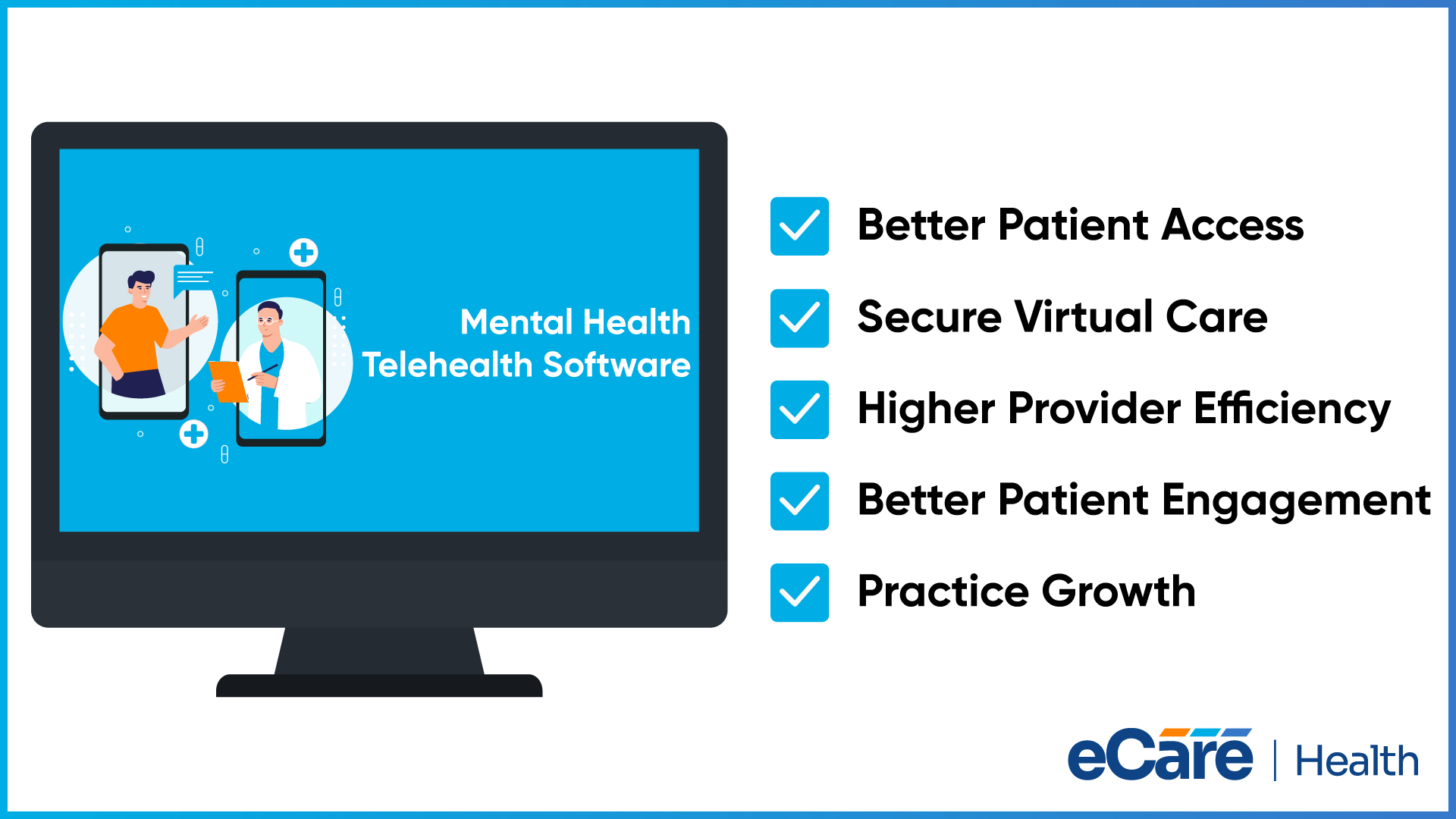
Till now, you might have understood that virtual care has become a key part of behavioral healthcare, instead of just an added service. The real value of mental health telehealth software doesn't just lie in hosting online sessions. The right solution also helps you to enhance patient care and makes day-to-day operations more effective.
Here are some of the key benefits of using mental health telehealth software:
Improve patient access and appointment attendance
With virtual care, it becomes easier to remove obstacles like travel time, transportation issues, and scheduling conflicts. Patients can attend appointments as per their convenience and from their familiar environment, which makes them feel more comfortable and easier for you to keep appointments and continue treatment.
Deliver secure, HIPAA-compliant virtual care
A reliable HIPAA-compliant virtual mental health platform setup helps you protect your patients' sensitive information via secure video consultation, encrypted communication, role-based access controls, and built-in privacy safeguards. This enables you to deliver more efficient virtual care while meeting regulatory requirements.
Increase provider productivity and documentation efficiency
As we discussed earlier, the right mental health telehealth software allows you to schedule appointments, conduct virtual sessions, document progress notes, and manage prescriptions all in one connected place. This ultimately minimizes administrative burden and gives you more time to focus on your patient care.
Enhance patient engagement and continuity of care
A dedicated virtual mental health platform helps to keep your patients connected through automated appointment reminders, secure messaging, digital intake and consent forms, progress tracking, or post-visit follow-ups. Better communication helps to encourage continuous participation, while supporting long-term treatment success.
Support practice growth with scalable virtual healthcare delivery
With a behavioral health telehealth platform, it becomes easier to add providers and manage large patient volumes, while expanding virtual care services without disturbing your daily workflows. It provides flexibility to your practice to grow and continue to deliver quality care.
Must-Have Features in a Behavioral Health Telehealth Platform
Here, the first thing you must understand is that selecting a mental health telehealth platform is not just about finding software with video calling. The best solution must help you to simplify your day-to-day tasks, stay compliant, while making virtual care easier for not only providers but also patients.
Let’s have a quick look at some of the must-have features in a behavioral health telehealth platform:
| Feature | Why It Matters |
|---|---|
| Secure HIPAA-compliant video consultations. | Enables encrypted virtual therapy sessions that protect patient privacy and ensure compliance with HIPAA regulations. |
| Integrated EHR, scheduling, and patient documentation. | Brings patient records, appointment management, and clinical documentation together in one platform to improve workflow efficiency |
| Digital intake forms and online consent management. | Lets patients complete registration, questionnaires, and consent forms before their visit, reducing paperwork and saving staff time. |
| E-prescribing and medication management. | Allows providers to prescribe medications electronically, manage refills, and maintain accurate medication records. |
| Billing and insurance integration. | Simplifies insurance verification, claims processing, and payment collection to support faster reimbursements. |
| Patient portal and secure messaging. | Gives patients a convenient way to schedule appointments, access health information, and communicate securely with their providers. |
| AI-assisted clinical documentation. | Helps automate therapy notes and clinical documentation, reducing administrative burden and giving providers more time for patient care. |
| Reporting, analytics, and measurement-based care tools. | Tracks patient outcomes, practice performance, and standardized assessments to support data-driven clinical decisions and continuous care improvement. |
How to Choose Mental Health Telehealth Software
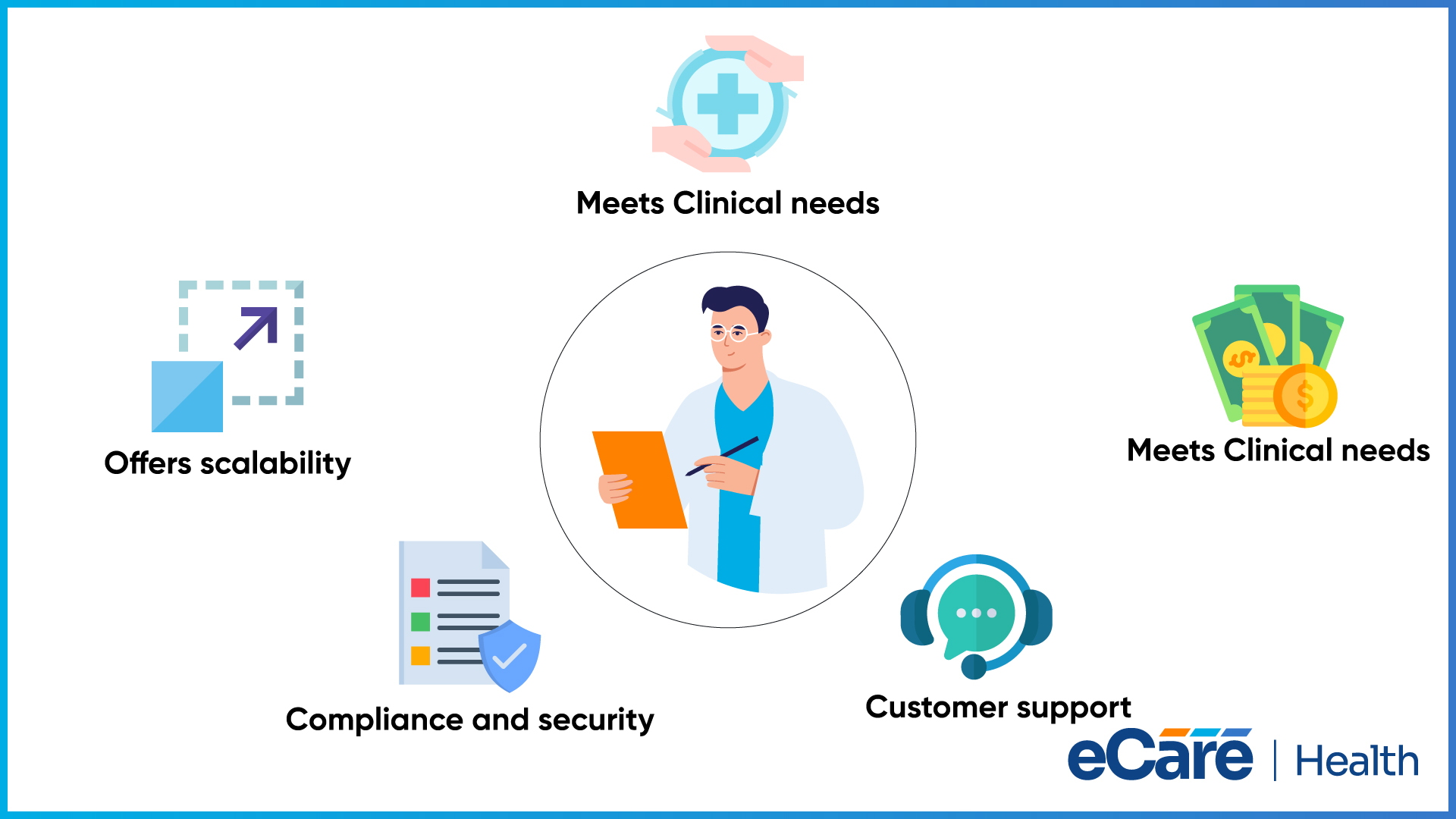
Along with features, to choose the right mental health telehealth software for your practice, you should also look for one that can fit the way your practice operates today while giving you the flexibility to grow in the future. If you take your time today to evaluate options, it can definitely save you from costly software changes.
You should start with understanding the unique requirements of your practice, for which it will be useful if you specifically consider your specialty, patient volumes, number of providers, and daily workflows. For example, a solo therapist may require a simple and easy-to-use solution; on the other hand, a growing behavioral clinic may need multi-provider scheduling, a patient portal with secure messaging, or multi-location support.
The right software not only supports clinical, but also operational needs without even disrupting your day-to-day workflow and adding unnecessary complexity.
Along with this, looking beyond virtual visits is equally important. A reliable HIPAA-compliant telehealth solution must integrate with your EHR, protect your patient data, support secure communication, and scale as your practice expands.
What’s more important is turning your attention to the vendor behind the product. Factors like a seamless onboarding process, responsiveness of customer support, regular updating of software, and transparent pricing have the same impact as the platform itself.
Moreover, before settling on the right option, always ask yourself whether the software can actually simplify your daily work, whether it integrates with your existing systems, and whether it meets your practice requirements. If all answers are yes, you are investing in a solution that can deliver long-term value, instead of solving only today’s challenge.
Mental Health Telehealth Software Buyer's Checklist
Before choosing a solution, make sure it:
- Meets your practice's clinical and operational needs
- Offers the right deployment option, scalability, and integrations
- Ensures HIPAA compliance and strong security
- Provides reliable onboarding, training, and customer support
- Fits your budget with transparent pricing
How to Set Up a HIPAA-Compliant Virtual Mental Health Platform
Choosing the right mental health telehealth software is only the beginning. To get the most from your software, equally important is setting up a HIPAA-compliant virtual mental health platform.
Build a Smooth Virtual Care Experience
You can start with setting up secure video consultations and giving your patients the easiest way to book appointments and access virtual sessions. By adding digital intake forms, online consent forms, and documentation workflows earlier, it becomes easy to create a seamless experience for providers and patients.
Connect the Systems That Matter
The one thing you must keep in mind is that your telehealth platform should not work in isolation. Integrating your EHR, billing software, e-prescribing, and patient communication tools helps to keep information flowing seamlessly across the entire care journey, while reducing duplicate work.
Make Security Part of Every Workflow
A secure HIPAA-compliant telehealth software unlocks the possibilities beyond secure video calls. Business Associate Agreements (BAAs), encryption, audit logs, and regular staff training all work together to protect your patient information and support compliance.
Before You Go Live
Before launching virtual care, make sure you’ve checked the essentials:
- Secure video consultations are configured
- Patient login and access are set up
- Online scheduling and digital intake forms are ready
- Consent forms and clinical documentation are in place
- EHR, billing, and e-prescribing are connected
- Patient messaging is enabled
- HIPAA security settings are enabled
- Staff have completed telehealth training
Supporting Virtual Psychiatric Care with Telepsychiatry
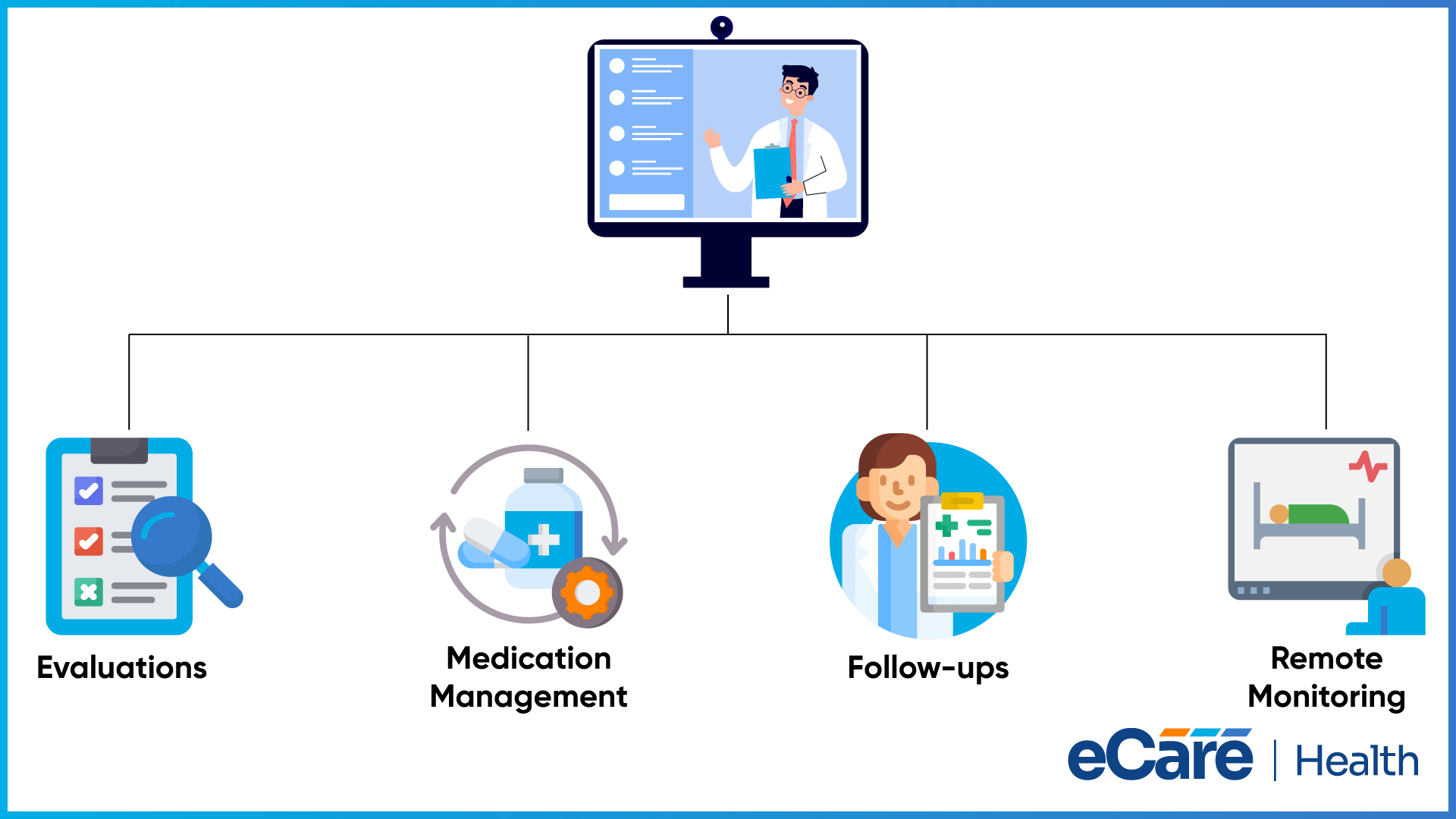
Virtual care has transformed how psychiatric services are delivered. This makes it easier for your patients to access care without frequent in-person visits. With telepsychiatry, psychiatrists and psychiatric nurse practitioners can conduct psychiatric evaluations, provide medication management, monitor patients’ treatment progress, and provide follow-up care from anywhere. This can improve access to care and help patients to stay consistent in their overall care journey.
Even so, psychiatric care involves more than just secure video consultations. Providers need to manage frequent follow-up visits, detailed clinical documentation, treatment progress, and ongoing patient communication. And because of this, many psychiatric practices select a behavioral telehealth platform, which is designed specifically for mental healthcare instead of a general telemedicine solution.
Providers are more likely to spend their time on quality patient care when all these workflows are connected within a single platform. This further helps to deliver secure, efficient, and more patient-centered virtual care.
Telehealth Mental Health Billing and Reimbursement
Delivering virtual care is just scratching the surface; what’s more necessary is getting reimbursed correctly. Even though telehealth follows many of the same billing principles as in-person behavioral health services, there are some of the additional requirements that your practice needs to understand to avoid claim denials and payment delays.
Correct CPT codes, telehealth modifiers, Place of Service (POS) codes, and complete clinical documentation are required frequently for telehealth claims. Even a small coding error or missing modifier can result in claims rejection, which makes accurate billing a key part of every virtual visit.
Along with this, you should also document the delivered service type, patient consent, clinical notes, and the time spent during the encounter whenever needed. Clear and complete documentation can support reimbursement and help your practice to stay compliant with payer and regulatory requirements.
Furthermore, equally important is staying updated on payer policies. Medicare, Medicaid, and commercial insurers might have different coverage rules, modifier requirements, and reimbursement guidelines for virtual visits.
By reviewing these requirements regularly and using integrated billing workflows, your practice can reduce billing errors, speed up reimbursements, and keep revenue flowing seamlessly.
Mental Health Insurance Billing for Virtual Care
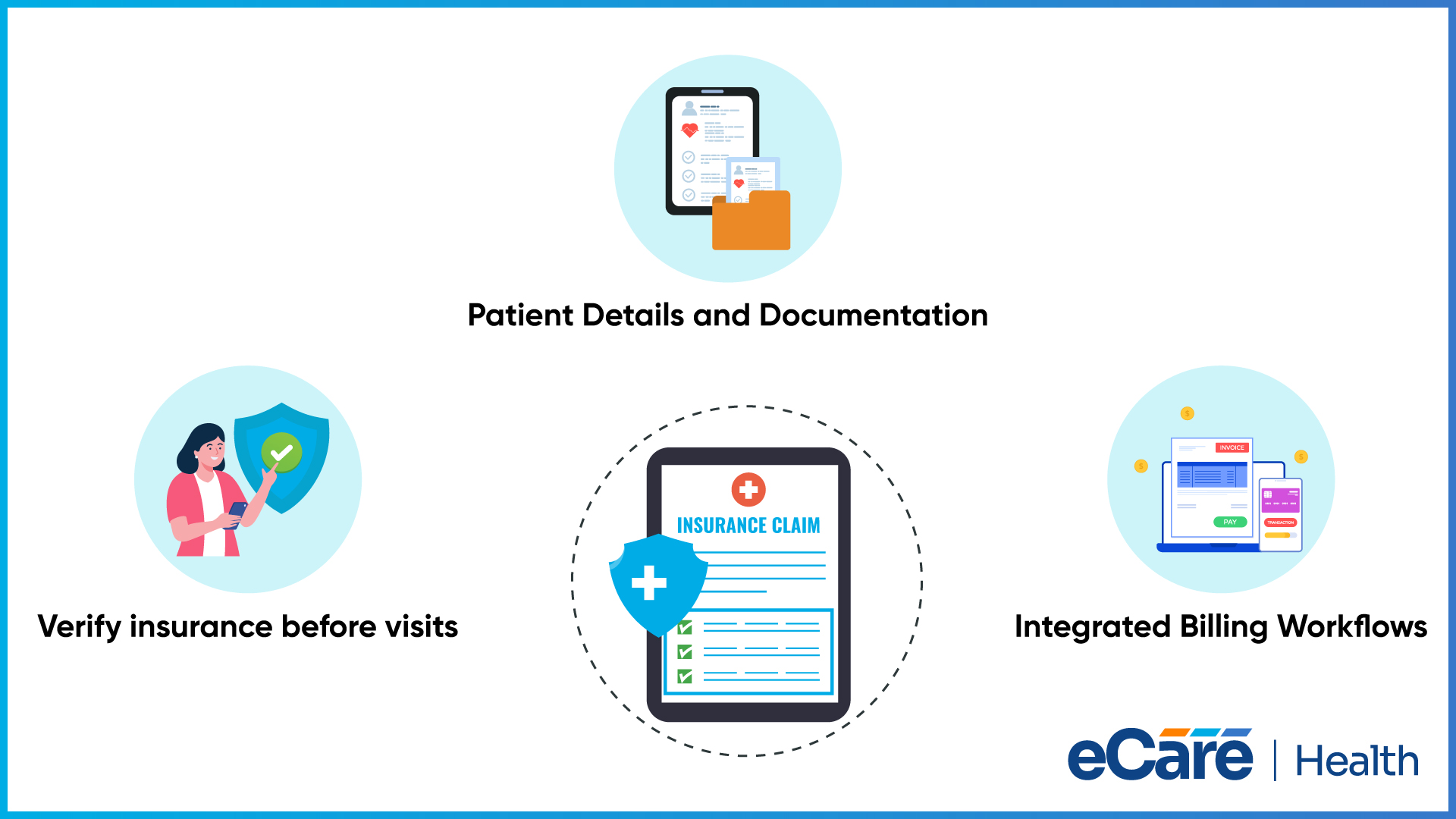
Accurate billing actually starts even before a virtual appointment takes place. If you verify your patient’s insurance coverage and eligibility in advance, it helps your practice to confirm benefits, identify any prior authorization requirements, and avoid unexpected billing issues after the visit.
Incorrect patient information, inactive coverage, or incomplete documentation usually causes insurance-related claim denials. If you take a few extra minutes to verify eligibility and ensure record accuracy, it can significantly minimize claim rejections and reduce delays in reimbursement.
What makes this process even more efficient is an integrated billing workflow. When insurance verification, clinical documentation, and claims management work together within the same system, behavioral health practices can improve reimbursement accuracy, reduce administrative work, and create a smoother experience for both providers and patients.
Managing Virtual Group Therapy with an Integrated EHR
For expanding access to care and supporting your patients through shared experiences, virtual group therapy has become an effective way for behavioral health practices. It enables you to treat multiple participants in a single session, enhancing scheduling flexibility, while making better use of clinical time without compromising care quality.
However, running successful group sessions requires careful planning and coordination. Participant scheduling, individual progress notes management, and patient management, while ensuring every session meets compliance requirements, are some of the factors providers need to manage. All these tasks can become time-consuming without the right tools.
With an integrated virtual mental health platform combined with an EHR, the entire process can be simplified as it brings scheduling, secure group video sessions, clinical documentation, and patient communication into one connected workflow. This further helps providers to coordinate multiple participants effectively and deliver organized, secure, and high-quality virtual group therapy.
Why Choose an Integrated Mental Health EHR with Telehealth Over Standalone Telehealth Software?
Even though standalone telehealth software can support virtual visits, managing separate systems for telehealth, EHR, scheduling, billing, and patient communication usually creates extra work. As a result, you may end up switching between platforms, entering the same information multiple times, and dealing with disconnected workflows that affect efficiency and patient care.
With an integrated mental health EHR with telehealth, it becomes easy to bring everything together in one place. For example, from virtual visits and clinical documentation to scheduling, billing, and patient communication. Connected workflows can also help to reduce administrative tasks, enhance care coordination, and keep patient information accurate.
As behavioral health practices grow, an all-in-one behavioral health telehealth platform also makes it easier to scale services, maintain compliance, and deliver a consistent patient experience without the complexity of managing multiple systems.
To make it clearer, let’s have a look at the key comparison between standalone telehealth software vs. integrated mental health EHR with telehealth:
| Feature | Standalone Telehealth Software | Integrated Mental Health EHR with Telehealth |
|---|---|---|
| Core functionality | Virtual consultations with basic scheduling and communication tools. | Complete virtual care platform with EHR and practice management capabilities. |
| Clinical documentation | Limited or requires a separate documentation system. | Built-in therapy notes, treatment plans, and patient records. |
| Practice management | Basic scheduling with limited administrative features. | Integrated scheduling, billing, insurance, and patient management. |
| Medication management | May require a separate e-prescribing solution. | Built-in e-prescribing and medication management. |
| Patient engagement | Secure messaging and appointment reminders. | Patient portal, secure messaging, forms, reminders, and ongoing communication. |
| Best suited for | Solo providers or practices with basic virtual care needs. | Group practices, psychiatry clinics, and growing or multi-location behavioral health organizations. |
Decision Matrix: Which Solution Fits Your Practice?
| Practice Type | Recommended Solution | Reason |
|---|---|---|
| Solo therapist | Standalone Telehealth Software or Integrated EHR (if planning to grow) | Basic virtual care needs with the option to scale later. |
| Small group practice | Integrated Mental Health EHR with Telehealth | Simplifies scheduling, documentation, and collaboration across providers. |
| Psychiatry clinic | Integrated Mental Health EHR with Telehealth | Supports e-prescribing, medication management, documentation, and billing in one platform. |
| Multi-location behavioral health organization | Integrated Mental Health EHR with Telehealth | Centralizes patient records, reporting, scheduling, and operations across multiple locations. |
Conclusion
Choosing the right mental health telehealth software is more than a technology decision; it's an investment in the future of your practice. The ideal solution should support your clinical workflows, simplify daily operations, protect patient data, and adapt as your practice grows. When implemented thoughtfully, it helps improve patient access, strengthen care delivery, and reduce administrative burden.
As virtual care continues to evolve, practices that invest in an integrated mental health EHR with telehealth will be better equipped to deliver secure, connected, and patient-centered care.
By bringing telehealth, documentation, scheduling, billing, and communication into one platform, providers can focus less on managing systems and more on helping patients achieve better outcomes.
If you're looking to build a more efficient and scalable behavioral health practice, choosing the right EHR for Therapists with integrated telehealth capabilities is a smart step toward delivering high-quality virtual care today while preparing for the needs of tomorrow.
Frequently Asked Questions (FAQs)
1. What is mental health telehealth software?
Mental health telehealth software is a HIPAA-compliant platform that enables therapists, psychologists, psychiatrists, and other behavioral health providers to deliver virtual care through secure video consultations. It also includes tools for appointment scheduling, digital intake forms, patient documentation, secure messaging, billing, and e-prescribing. By combining these capabilities in one platform, it helps practices streamline daily operations, improve patient engagement, and deliver accessible, high-quality mental healthcare from virtually anywhere.
2. How do I choose the best mental health telehealth software?
Choose software based on your practice's clinical, operational, and long-term needs. Look for features such as secure video consultations, integrated EHR, scheduling, billing, patient communication, and documentation. Evaluate HIPAA compliance, scalability, ease of use, customer support, implementation services, and pricing before making a decision. Selecting a solution that aligns with your workflow and future growth will improve efficiency and enhance both provider and patient experiences.
3. What features should a behavioral health telehealth platform include?
A behavioral health telehealth platform should include HIPAA-compliant video consultations, integrated EHR, appointment scheduling, digital intake forms, online consent management, clinical documentation, e-prescribing, billing integration, patient portal, and secure messaging. Advanced platforms may also offer AI-assisted documentation, reporting, analytics, and measurement-based care tools. Together, these features simplify practice management, improve patient engagement, and help providers deliver coordinated, high-quality behavioral healthcare.
4. How do you set up a HIPAA-compliant virtual mental health platform?
Start by selecting HIPAA-compliant telehealth software with strong security features. Configure secure video consultations, patient access, appointment scheduling, digital intake forms, and documentation workflows. Integrate your EHR, billing, e-prescribing, and patient communication tools into one system. Finally, enable encryption, audit logs, and role-based access controls, sign a Business Associate Agreement (BAA), and train your staff to ensure a secure and successful telehealth implementation.
5. Can telehealth software integrate with an EHR?
Yes. Many modern telehealth platforms integrate directly with behavioral health EHR systems, allowing providers to manage virtual visits, patient records, documentation, scheduling, billing, and e-prescribing from one platform. This integration reduces duplicate data entry, improves workflow efficiency, and ensures clinicians have access to complete patient information during every virtual session. It also supports better care coordination and a more seamless patient experience.
6. What are the benefits of integrated teletherapy software for therapists and psychiatry providers?
Integrated teletherapy software combines virtual care with essential practice management tools in a single platform. Providers can schedule appointments, conduct video sessions, document care, manage billing, prescribe medications, and communicate with patients without switching between multiple systems. This improves workflow efficiency, reduces administrative workload, enhances care coordination, and allows therapists and psychiatry providers to spend more time focusing on patient care.
7. How much does mental health telehealth software cost?
The cost of mental health telehealth software depends on factors such as features, number of users, deployment model, and vendor pricing. Basic platforms typically offer monthly subscription plans, while comprehensive solutions with integrated EHR, billing, AI-assisted documentation, and advanced reporting may cost more. Before choosing a solution, compare pricing models, implementation costs, and ongoing support to ensure the platform fits both your budget and practice requirements.
8. What security features should HIPAA-compliant telehealth software include?
HIPAA-compliant telehealth software should include end-to-end encryption, secure video conferencing, multi-factor authentication, role-based access controls, audit logs, secure cloud storage, and regular security updates. It should also provide a Business Associate Agreement (BAA) and protect patient data during storage and transmission. These security measures help behavioral health practices maintain compliance, safeguard sensitive health information, and build trust with their patients.
9. How does telehealth billing differ from in-person behavioral health billing?
Telehealth billing follows many of the same coding guidelines as in-person care but often requires telehealth-specific modifiers, Place of Service (POS) codes, and payer-specific documentation. Coverage and reimbursement policies may vary between insurance providers and government programs. Using accurate coding, verifying patient eligibility, and staying current with payer requirements can help behavioral health practices reduce billing errors and improve reimbursement.
10. How can behavioral health practices reduce telehealth claim denials?
Behavioral health practices can reduce telehealth claim denials by verifying insurance eligibility before appointments, using the correct CPT and POS codes, applying required telehealth modifiers, and maintaining complete clinical documentation. Regular staff training, accurate claim submission, and reviewing payer-specific billing guidelines also improve reimbursement success. An integrated telehealth and billing solution can further reduce administrative errors and streamline the claims process.
11. Can telehealth software support virtual group therapy sessions?
Yes. Many behavioral health telehealth platforms support HIPAA-compliant virtual group therapy by allowing multiple participants to join secure online sessions. These platforms often include scheduling, attendance tracking, clinical documentation, secure messaging, and patient management tools to simplify group session administration. This makes it easier for providers to offer support groups, counseling programs, and collaborative therapy while maintaining privacy and regulatory compliance.
12. What should I look for when comparing telehealth software vendors?
When comparing telehealth software vendors, evaluate HIPAA compliance, security features, EHR integration, ease of use, scalability, implementation support, customer service, pricing, and behavioral health-specific capabilities. Request product demonstrations and compare how each platform supports documentation, scheduling, billing, patient communication, and reporting. Choosing a vendor with experience in behavioral healthcare can help ensure smoother implementation and long-term success.
13. Why should behavioral health practices choose an integrated Mental Health EHR with Telehealth instead of standalone telehealth software?
An integrated Mental Health EHR with Telehealth brings virtual care, patient records, scheduling, documentation, billing, e-prescribing, and patient communication together in one platform. Unlike standalone telehealth software, it eliminates the need to manage multiple systems, reduces duplicate work, and improves care coordination. This integrated approach helps behavioral health practices increase efficiency, enhance the patient experience, and scale their operations more effectively as they grow.