Group Therapy EHR: How to Document and Manage Group Sessions More Efficiently

The group session is over; everyone has left, but for the therapists, the work does not end here. It is only half the work.
Now, the clinician has to turn one shared conversation into several individual patient records. Even though the session topic and interventions are similar across the group, each patient may have responded differently, shared something unique, or made different progress toward their treatment goals. Along with this, clinicians also have to ensure that one patient’s private information never finds its way into another patient’s chart.
This is only one factor among many. Coordinating several patients for the same session, tracking attendance, completing individual notes, and keeping documentation consistent can turn your routine group session into hours of repetitive administrative work. Without a structured workflow, you can miss details, and you are more likely to spend your time on managing charts instead of engaging with patients.
Here, a well-designed group therapy EHR can change the whole picture. The right mental health EHR software can help manage group scheduling, capture shared session details, and personalize documentation for each participant while keeping records separate.
However, the key is to choose an EHR built for handling the realities of group care and not just simply one that happens to support multiple patients. So, what should mental health practices look for?
Let this blog be your comprehensive guide to explore the features and workflows that can make group therapy documentation more efficient without adding another layer of complexity.
How Does Group Therapy Documentation Work in an EHR?
After the end of the group session, the EHR must make the documentation process feel more like filling in the pieces of one clinical picture instead of starting from scratch for every patient. The therapist can start with details like the date and time, group topic, intervention used, and overall activities, which are further shared across the session.
After this, the next attendance can be recorded for each participant before the clinician adds the details that are specific to that patient. This is where one-to-many clinical charting can help to take much of the repetitive work out of group documentation.
Rather than entering the same session information into every chart separately, it becomes easy for clinicians to document the shared details once while carrying them across the appropriate participant records. Individual responses, progress, observations, and treatment-related notes can then be added separately. This further helps to keep each patient’s chart complete without making the clinician do the same work over and over.
For billing, this distinction matters the most. CPT 90853 is usually used for group psychotherapy and is billed per participant per session. This means that the record should clearly show who attended the session and support the services documented for each participant. As a result, accurate attendance and participant-level documentation go hand in hand.
A structured EHR workflow makes it possible to document the group once where the information is shared, personalize it where the patient is unique, and keep every record distinct. This balance makes group therapy documentation easier to manage and supports more consistent clinical and billing workflows.
What Features Should a Group Therapy EHR Include?
The one tricky job that group therapy has is that it needs to make shared sessions easier to manage without treating every patient record as if it were the same. With the right features, clinicians can capture common session details once, personalize each participant’s record, while keeping sensitive information properly separated.
Here are the key capabilities practices should consider:
| Feature | What It Should Handle | Practice Benefit |
|---|---|---|
| Group Scheduling | Link multiple patients to one group session. | Simplifies recurring group appointments and reduces scheduling work |
| Attendance Tracking | Record attendance and status for each participant | Supports accurate clinical and billing records |
| Group Documentation | Capture shared session topics, interventions, and activities. | Reduces repetitive charting |
| Individual Notes | Document patient-specific responses, observations, and progress | Preserves important clinical detail in each record |
| Privacy Controls | Keep participant records separate and control access to sensitive information. | Helps protect patient confidentiality |
| Templates | Provide reusable structures for recurring group sessions | Standardizes documentation while reducing time spent starting from scratch |
The actual value comes from how well these features work together. A clinician can schedule the group, mark who attended, document the shared session information, and then add individual observations without jumping between disconnected workflows. This makes one-to-many clinical charting more practical: shared information can be entered once, while each patient still receives a distinct and complete clinical record.
Participant-level documentation also matters when the session is tied to billing. Since group psychotherapy services are generally documented and billed based on the participants who received the service, accurate attendance and individual records help ensure that the clinical documentation tells a consistent story.
How to Document Group Therapy Sessions Efficiently
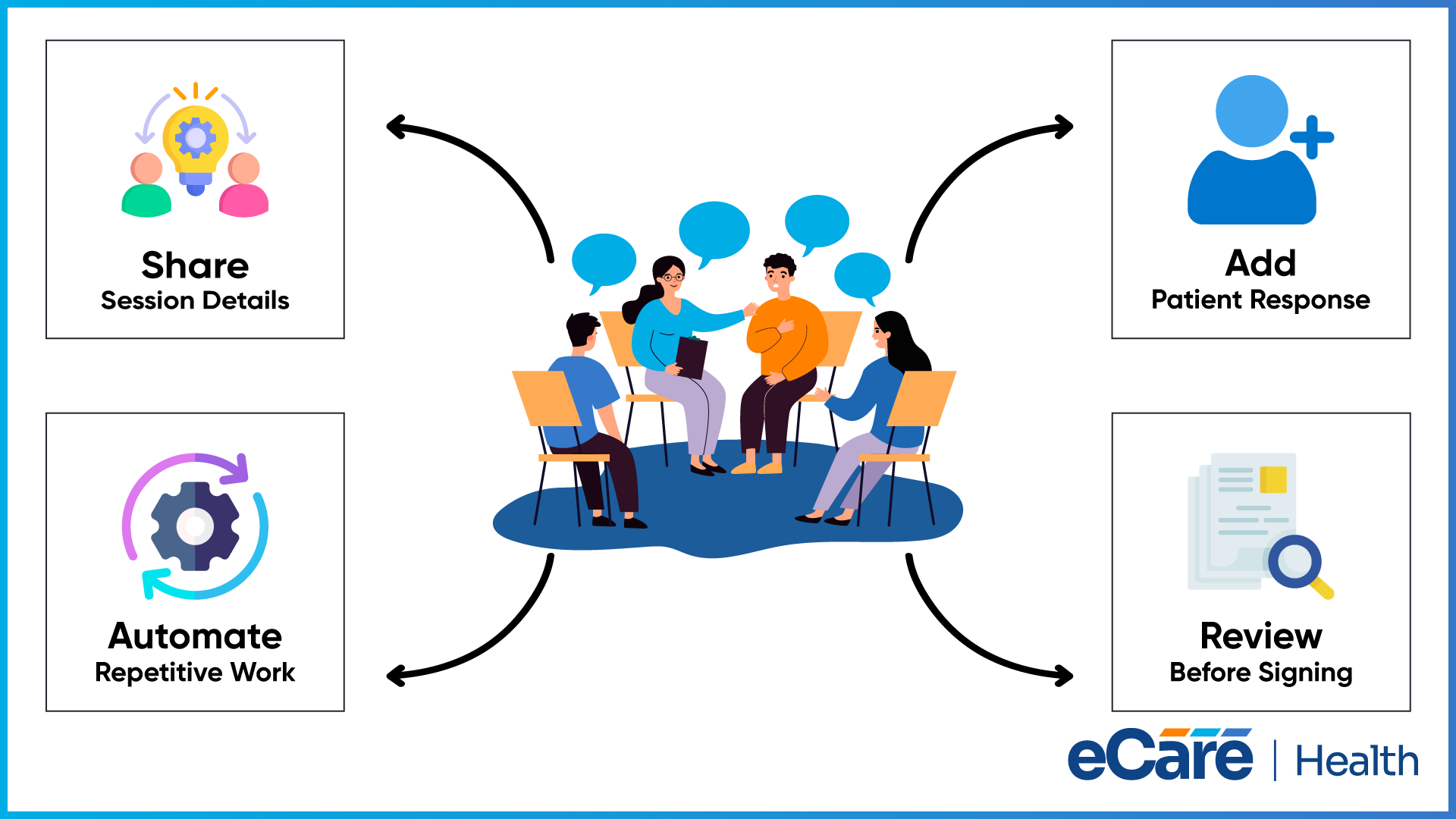
Good group documentation means not just simply writing the same note several times; it actually means knowing what can be documented once and what needs to remain patient-specific. With a simple workflow, it becomes easier for clinicians to save time without losing clinical details.
Start with the shared session details
Always start with the information that applies to the entire group, including the session data, topic, goals, interventions, and activities. With templates, all these details can be entered once rather than recreated for every participant.
Add each participant's response
The shared portion is only half of the story. In line with this, each patient’s response, progress, behavior, and relevant clinical observations must be documented separately. This helps to keep every chart focused on the individual instead of creating a series of identical notes.
Let the EHR handle the repetitive work
By using group therapy notes software with reusable templates, recurring sessions become much easier to document. Furthermore, clinicians can also work from a consistent structure and still add the details that make each patient’s record unique.
Review before signing
Before closing each note, you must take a quick look at the participant-specific information. Also ensure the right response, observations, and progress details are attached to the right patient record. A few seconds of review help to catch errors before they become part of the permanent chart.
How to Protect Individual Patient Privacy in Group Therapy Notes
Even though group therapy brings several patients into the same session, their clinical records should never become a shared file. The EHR needs to draw a clear line between what happened in the group and what belongs only to one participant.
A few simple safeguards can help maintain that line:
- Separate shared and individual information: Keep the group topic, activities, and common interventions separate from each patient's personal responses, progress, and clinical observations. Information from one participant should never accidentally appear in another patient's chart.
- Use role-based access: Staff should only have access to the patient information they need for their role. This limits unnecessary exposure of sensitive clinical information.
- Require individual signatures: Each clinician should sign the records they document, creating clear accountability for who entered or approved the information.
- Maintain audit trails: A good EHR should track important record activity, such as who viewed, added, or changed information. This creates a useful trail when records need to be reviewed.
Extra care may be needed for substance-use treatment groups. The 2024 final rule updating 42 CFR Part 2 brought Part 2 requirements more closely into alignment with HIPAA in several areas while maintaining specific protections for substance-use-disorder records. Practices handling information covered by Part 2 should make sure their EHR workflows and disclosure practices reflect the applicable requirements.
Virtual groups bring another privacy consideration. A convenient consumer video app may not provide the safeguards a healthcare practice needs. Practices should instead consider secure telehealth platforms with appropriate privacy and security controls for virtual behavioral health sessions.
Ultimately, protecting individual patient privacy in group therapy notes comes down to maintaining separation: one shared session, but distinct and protected records for every participant.
How eCareHealth Supports Group Therapy Workflows
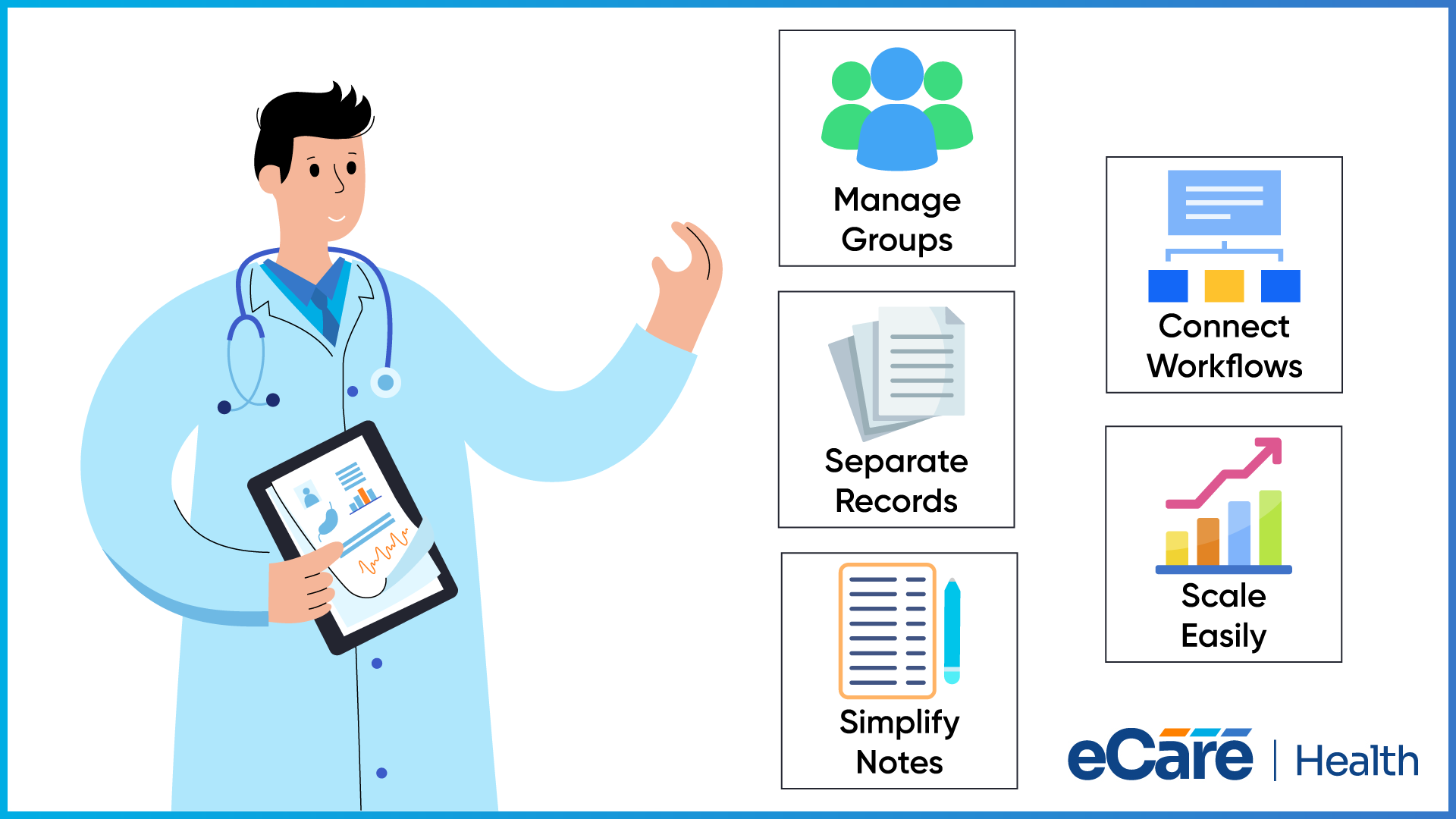
With the right workflow, group therapy documentation becomes much easier to manage, especially as the number of sessions and participants grows. eCareHealth helps to bring the key pieces of that workflow together, so your practice can manage group sessions without losing sight of each patient’s individual record.
Furthermore, eCareHealth allows practices to support multi-patient session scheduling by connecting a group appointment with the individual patient records involved in that session. This further gives clinicians a clearer view of who is part of the group and keeps each patient’s chart separate.
Moving forward, structured documentation also helps clinicians capture shared group-session information without repeating the same details from scratch. Participant-specific responses and clinical observations can still be documented within the appropriate individual records, which keep the workflow efficient and personalized.
As group therapy is only one part of behavioral healthcare, eCareHealth also helps to connect group-session documentation with broader workflows through mental health EHR software. This helps your practice keep scheduling, documentation, and patient information within a more connected workflow rather than depending on scattered tools.
As group programs expand, Behavioral Health EHR Software can provide the structured practices needed to manage documentation at scale while maintaining consistent and individualized patient records. The result is a group therapy workflow that can grow with the practice without turning documentation into an everyday bottleneck.
Conclusion
Group therapy may happen in one room, but documenting it requires attention to every individual patient. Practices need a workflow that makes shared documentation easier while still capturing each participant’s progress, responses, attendance, and clinical details accurately. At the same time, privacy cannot take a back seat.
Structured templates, participant-level attendance tracking, group scheduling, and privacy controls can take much of the repetitive work out of group documentation. When these capabilities work together, clinicians can spend less time managing multiple records and more time focusing on patient care.
eCareHealth brings these workflows together to help practices manage recurring group sessions while keeping individual patient records organized and protected. With behavioral health EHR software, practices can build a more connected approach to group therapy documentation that is efficient today and ready to scale as their group-care programs grow.
Frequently Asked Questions (FAQs)
1. What is a group therapy EHR?
A group therapy EHR is an electronic health record system designed to help mental health practices manage sessions involving multiple patients. It can connect group scheduling, attendance, shared session documentation, and individual patient notes within one workflow. It helps clinicians reduce repetitive administrative work while keeping each participant’s clinical information separate, organized, and accessible when needed.
2. How does a group therapy EHR simplify documentation for multiple patients?
A group therapy EHR allows clinicians to record shared session details, such as the topic, interventions, and activities, once instead of entering them repeatedly. Clinicians can then add each participant’s individual response, progress, and observations to their respective records. This approach saves documentation time while ensuring that every patient has a complete and personalized clinical record.
3. How should therapists document individual responses during group sessions?
Therapists should document each participant’s response, behavior, progress, and relevant clinical observations separately. Shared information about the session can be recorded once, but patient-specific details should remain in the individual chart. This keeps documentation clinically meaningful and helps prevent one participant’s private information from accidentally appearing in another patient’s record.
4. What features should practices look for in group therapy notes software?
Practices should look for group scheduling, participant-level attendance tracking, structured group documentation, individual notes, reusable templates, and privacy controls. The software should make it easy to capture common session information without losing important patient-specific details. Features that connect scheduling and documentation can also help clinicians manage recurring group sessions with fewer manual steps.
5. How can practices protect individual patient privacy in group therapy notes?
Practices should keep shared session information separate from patient-specific clinical details and ensure that each participant’s record remains distinct. Role-based access, individual signatures, and audit trails can help control access and maintain accountability. For virtual sessions, practices should also use secure platforms with appropriate healthcare privacy safeguards rather than relying on consumer video applications that may not meet healthcare requirements.
6. What is one-to-many clinical charting?
One-to-many clinical charting refers to documenting information from one shared clinical session across multiple participant records. Instead of recreating the same group-session details for every patient, clinicians can capture common information once and then add individual responses and observations to each record. This reduces repetitive charting while maintaining separate, accurate, and complete clinical records for every participant.
7. How does multi-patient session scheduling work for group therapy?
Multi-patient session scheduling allows several patients to be linked to the same group therapy appointment while keeping their individual records separate. Practices can manage the shared session from one scheduling workflow and track participant attendance as needed. This makes recurring group appointments easier to organize and creates a smoother connection between scheduling and clinical documentation.
8. How can Mental Health EHR Software support group therapy documentation?
Mental Health EHR Software can connect group scheduling, attendance, documentation, and individual patient records within a single workflow. Clinicians can capture shared session information while adding participant-specific observations and progress to each chart. This connected approach can reduce administrative work, improve documentation consistency, and make recurring group therapy sessions easier for practices to manage.
9. How can Behavioral Health EHR Software improve group session management?
Behavioral Health EHR Software can help practices manage recurring group sessions through connected scheduling, attendance tracking, structured documentation, and individual patient records. It can reduce repetitive administrative tasks while supporting participant-level clinical documentation. As group programs grow, having these workflows in one system can make it easier to maintain organization, privacy, and consistent documentation without adding unnecessary work for clinicians.